Weekend Special 75% Discount offer - Ends in 0d 00h 00m 00s - Coupon code: 75brite

ExamsBrite Dumps

Fortinet NSE 7 - FortiSASE 25 Enterprise Administrator Question and Answers

Fortinet NSE 7 - FortiSASE 25 Enterprise Administrator

Last Update Aug 24, 2026
Total Questions : 88

We are offering FREE NSE7_SSE_AD-25 Fortinet exam questions. All you do is to just go and sign up. Give your details, prepare NSE7_SSE_AD-25 free exam questions and then go for complete pool of Fortinet NSE 7 - FortiSASE 25 Enterprise Administrator test questions that will help you more.


NSE7_SSE_AD-25 pdf

NSE7_SSE_AD-25 PDF

$26.25  $104.99
NSE7_SSE_AD-25 Engine

NSE7_SSE_AD-25 Testing Engine

$31.25  $124.99
NSE7_SSE_AD-25 PDF + Engine

NSE7_SSE_AD-25 PDF + Testing Engine

$41.25  $164.99
Questions 1

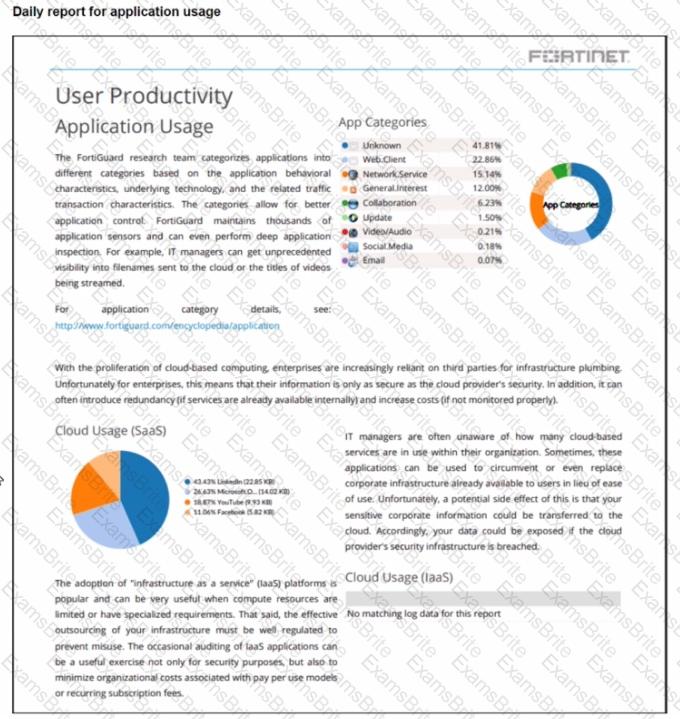
Refer to the exhibit.

The daily report for application usage shows an unusually high number of unknown applications by category.

What are two possible explanations for this? (Choose two.)

Options:

A.  

Certificate inspection is not being used to scan application traffic.

B.  

The inline-CASB application control profile does not have application categories set to Monitor

C.  

Zero trust network access (ZTNA) tags are not being used to tag the correct users.

D.  

Deep inspection is not being used to scan traffic.

Discussion 0
Questions 2

Which secure internet access (SIA) use case minimizes individual workstation or device setup, because you do not need to install FortiClient on endpoints or configure explicit web proxy settings on web browser-based end points?

Options:

A.  

SIA for inline-CASB users

B.  

SIA for agentless remote users

C.  

SIA for SSLVPN remote users

D.  

SIA for site-based remote users

Discussion 0
Questions 3

What are the two key features and benefits of Fortinet SOCaaS when integrated with FortiSASE? (Choose two answers)

Options:

A.  

Fortinet SOCaaS offers monitoring only during standard business hours, uses AI without human analysis, and provides annual reports without dashboards or FortiSASE integration.

B.  

Fortinet SOCaaS monitors only remote users, does not support log forwarding, and provides threat notifications without response guidance or expert meetings.

C.  

Fortinet SOCaaS allows for consistent security monitoring through log forwarding, offers rapid threat notifications and response guidance, and includes intuitive dashboards.

D.  

Fortinet SOCaaS provides 24x7x365 cloud-based monitoring by Fortinet experts using AI, machine learning, and human analysis.

E.  

Fortinet SOCaaS is a standalone service that monitors only FortiGate environments, provides automated patching without human analysis, and does not integrate with FortiSAS

E.  

Discussion 0
Questions 4

Which statement about FortiSASE and SAML is true? (Choose one answer)

Options:

A.  

FortiSASE acts as the SP, relies on an external IdP, and can use SAML group matching.

B.  

FortiSASE supports SAML login but cannot use SAML group matching.

C.  

FortiSASE acts as the IdP and can perform SAML group matching internally.

D.  

FortiSASE includes IdP functionality and uses it for SAML group matching.

Discussion 0
Questions 5

In the Secure Private Access (SPA) use case, which two FortiSASE features facilitate access to corporate applications? (Choose two answers)

Options:

A.  

SD-WAN

B.  

zero trust network access (ZTNA)

C.  

thin edge

D.  

cloud access security broker (CASB)

Discussion 0
Questions 6

One user has reported connectivity issues; no other users have reported problems. Which tool can the administrator use to identify the problem? (Choose one answer)

Options:

A.  

Mobile device management (MDM) service to troubleshoot the connectivity issue.

B.  

Digital experience monitoring (DEM) to evaluate the performance metrics of the remote computer.

C.  

Forensics service to obtain detailed information about the user ' s remote computer performance.

D.  

SOC-as-a-Service (SOCaaS) to get information about the user ' s remote computer.

Discussion 0
Questions 7

A customer wants to upgrade their legacy on-premises proxy to a could-based proxy for a hybrid network. Which FortiSASE features would help the customer to achieve this outcome?

Options:

A.  

SD-WAN and NGFW

B.  

SD-WAN and inline-CASB

C.  

zero trust network access (ZTNA) and next generation firewall (NGFW)

D.  

secure web gateway (SWG) and inline-CASB

Discussion 0
Questions 8

Which FortiSASE feature ensures least-privileged user access to all applications?

Options:

A.  

secure web gateway (SWG)

B.  

SD-WAN

C.  

zero trust network access (ZTNA)

D.  

thin branch SASE extension

Discussion 0
Questions 9

An administrator must restrict endpoints from certain countries from connecting to FortiSASE. Which configuration can achieve this? (Choose one answer)

Options:

A.  

A network lockdown policy on the endpoint profiles

B.  

Source IP anchoring to restrict access from the specified countries

C.  

A geography address object as the source for a deny policy

D.  

Geofencing to restrict access from the required countries

Discussion 0
Questions 10

How does FortiSASE Secure Private Access (SPA) facilitate connectivity to private resources in a hub-and-spoke network? (Choose one answer)

Options:

A.  

SPA establishes direct links to spokes without IPsec or BGP and uses an easy configuration key to secure web traffic for remote users.

B.  

SPA applies source network address translation (SNAT) for remote user traffic and uses IKEv1 for IPsec tunnels to connect to standalone hubs without BGP support.

C.  

SPA connects to private resources using HTTP and HTTPS protocols and relies on FortiClient for agentless access to SD-WAN deployments.

D.  

SPA connects a FortiSASE POP to a FortiGate hub or SD-WAN deployment using IPsec and BGP for dynamic route exchange with an easy configuration key for simplified setup on FortiOS.1

Discussion 0
Questions 11

Which three traffic flows are supported by FortiSASE Secure Private Access (SPA)? (Choose three answers)

Options:

A.  

From private resources to FortiSASE agent-based users.

B.  

From private resources to the internet.

C.  

From agent-based users to private resources behind the Fortinet SD-WAN.

D.  

From private resources to other private resources (SPA to SPA).

E.  

From thin branches/branch on-ramp to private resources behind the Fortinet SD-WAN.

Discussion 0
Questions 12

What is required to enable the MSSP feature on FortiSASE? (Choose one answer)

Options:

A.  

Multi-tenancy must be enabled on the FortiSASE portal.

B.  

MSSP user accounts and permissions must be configured on the FortiSASE portal.

C.  

The MSSP add-on license must be applied to FortiSASE.

D.  

Role-based access control (RBAC) must be assigned to identity and access management (IAM) users using the FortiCloud IAM portal.

Discussion 0
Questions 13

Refer to the exhibits.

WiMO-Pro and Win7-Pro are endpoints from the same remote location. WiMO-Pro can access the internet though FortiSASE, while Wm7-Pro can no longer access the internet

Given the exhibits, which reason explains the outage on Wm7-Pro?

Options:

A.  

The Win7-Pro device posture has changed.

B.  

Win7-Pro cannot reach the FortiSASE SSL VPN gateway

C.  

The Win7-Pro FortiClient version does not match the FortiSASE endpoint requirement.

D.  

Win-7 Pro has exceeded the total vulnerability detected threshold.

Discussion 0
Questions 14

What happens to the logs on FortiSASE that are older than the configured log retention period? (Choose one answer)

Options:

A.  

The logs are deleted from FortiSASE.1

B.  

The logs are compressed and archived.

C.  

The logs are backed up on FortiCloud.

D.  

The logs are indexed and can be stored in a SQL database.

Discussion 0
Questions 15

What are two advantages of using zero-trust tags? (Choose two.)

Options:

A.  

Zero-trust tags can be used to allow or deny access to network resources

B.  

Zero-trust tags can determine the security posture of an endpoint.

C.  

Zero-trust tags can be used to create multiple endpoint profiles which can be applied to different endpoints

D.  

Zero-trust tags can be used to allow secure web gateway (SWG) access

Discussion 0
Questions 16

Which two advantages does FortiSASE bring to businesses with multiple branch offices? (Choose two.)

Options:

A.  

It offers centralized management for simplified administration.

B.  

It enables seamless integration with third-party firewalls.

C.  

it offers customizable dashboard views for each branch location

D.  

It eliminates the need to have an on-premises firewall for each branch.

Discussion 0
Questions 17

A FortiSASE administrator is configuring a Secure Private Access (SPA) solution to share endpoint information with a corporate FortiGate.

Which three configuration actions will achieve this solution? (Choose three.)

Options:

A.  

Add the FortiGate IP address in the secure private access configuration on FortiSASE.

B.  

Use the FortiClient EMS cloud connector on the corporate FortiGate to connect to FortiSASE

C.  

Register FortiGate and FortiSASE under the same FortiCloud account.

D.  

Authorize the corporate FortiGate on FortiSASE as a ZTNA access proxy.

E.  

Apply the FortiSASE zero trust network access (ZTNA) license on the corporate FortiGate.

Discussion 0
Questions 18

How does FortiSASE hide user information when viewing and analyzing logs?

Options:

A.  

By hashing data using Blowfish

B.  

By hashing data using salt

C.  

By encrypting data using Secure Hash Algorithm 256-bit (SHA-256)

D.  

By encrypting data using advanced encryption standard (AES)

Discussion 0
Questions 19

Which two benefits come from integrating SoCaaS with FortiSASE? (Choose two answers)

Options:

A.  

Eliminates the need of endpoint projection software

B.  

Continuous threat monitoring of all connected endpoints

C.  

Centralized visibility of all threat events

D.  

Provides bandwidth usage analytics

Discussion 0
Questions 20

Which service is included in a secure access service edge (SASE) solution, but not in a security service edge (SSE) solution? (Choose one answer)

Options:

A.  

SWG

B.  

SD-WAN1

C.  

CASB

D.  

ZTNA

Discussion 0
Questions 21

A customer needs to implement device posture checks for their remote endpoints while accessing the protected server. They also want the TCP traffic between the remote endpoints and the protected servers to be processed by FortiGate.
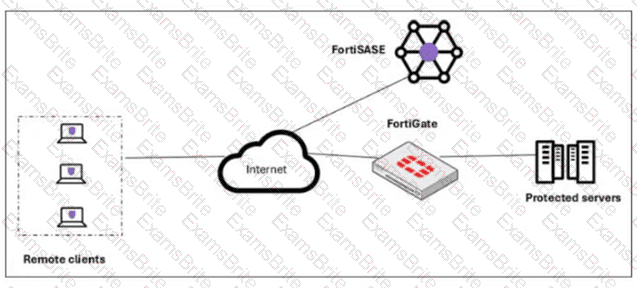
In this scenario, which two setups will achieve these requirements? (Choose two answers)

Options:

A.  

Configure ZTNA tags on FortiGate.

B.  

Configure FortiGate as a zero trust network access (ZTNA) access proxy.

C.  

Configure ZTNA servers and ZTNA policies on FortiGate.

D.  

Configure private access policies on FortiSASE with ZTNA.

Discussion 0
Questions 22

Your organization is currently using FortiSASE for its cybersecurity. They have recently hired a contractor who will work from the HQ office and who needs temporary internet access in order to set up a web-based point of sale (POS) system. How can you provide secure internet access to the contractor using FortiSASE? (Choose one answer)

Options:

A.  

Use a proxy auto-configuration (PAC) file and provide secure web gateway (SWG) service as an explicit web proxy.

B.  

Use a tunnel policy with a contractors user group as the source on FortiSASE to provide internet access.

C.  

Use zero trust network access (ZTNA) and tag the client as an unmanaged endpoint.

D.  

Use the self-registration portal on FortiSASE to grant internet access.

Discussion 0
Questions 23

A company must provide access to a web server through FortiSASE secure private access for contractors. What is the recommended method to provide access? (Choose one answer)

Options:

A.  

Configure a TCP access proxy forwarding rule and push it to the contractor FortiClient endpoint.

B.  

Publish the web server URL on a bookmark portal and share it with contractors.

C.  

Update the PAC file with the web server URL and share it with contractors.

D.  

Update the DNS records on the endpoint to access private applications.

Discussion 0
Questions 24

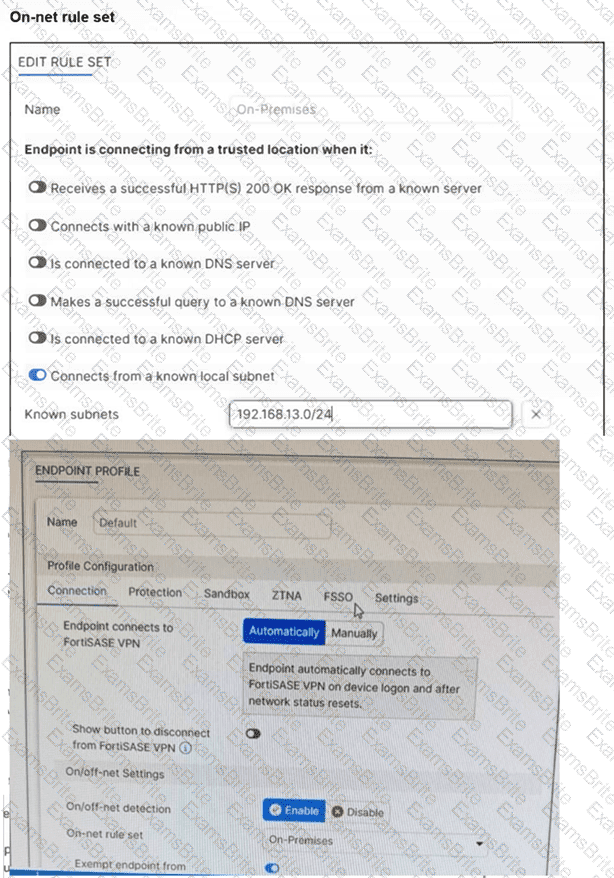
Refer to the exhibits.

An endpoint is assigned an IP address of 192.168.13.101/24. Which action will be run on the endpoint? (Choose one answer)

Options:

A.  

The endpoint will be able to bypass the on-net rule because it is connecting from a known subnet.

B.  

The endpoint will be detected as off-net.

C.  

The endpoint will be exempted from auto-connect to the FortiSASE tunnel.

D.  

The endpoint will automatically connect to the FortiSASE tunnel.

Discussion 0
Questions 25

A customer configured the On/off-net detection rule to disable FortiSASE VPN auto-connect when users are inside the corporate network. The rule is set to Connects with a known public IP using the company’s public IP address. However, when the users are on the corporate network, the FortiSASE VPN still auto-connects. The customer has confirmed that traffic is going to the internet with the correct IP address.
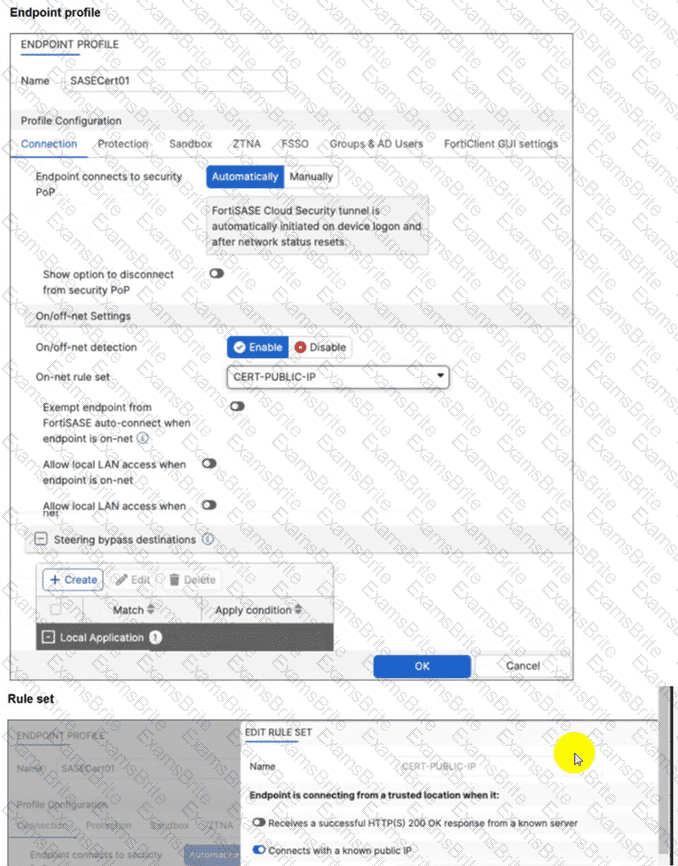
Which configuration is causing the issue? (Choose one answer)

Options:

A.  

The On-net rule set configuration is incorrect.

B.  

Allow local LAN access when endpoint is on-net is disabled when it should be enabled.

C.  

Exempt endpoint from FortiSASE auto-connect is disabled when it should be enabled.

D.  

Is connected to a known DNS server should be enabled and configured.

Discussion 0
Questions 26

For monitoring potentially unwanted applications on endpoints, which information is available on the FortiSASE software installations page? (Choose two answers)

Options:

A.  

The endpoint the software is installed on1

B.  

The license status of the software2

C.  

The vendor of the software3

D.  

The usage frequency of the software

Discussion 0