Emergency Medical Technicians (EMT002) Exam
Last Update Sep 22, 2026
Total Questions : 280
We are offering FREE EMT NREMT exam questions. All you do is to just go and sign up. Give your details, prepare EMT free exam questions and then go for complete pool of Emergency Medical Technicians (EMT002) Exam test questions that will help you more.



A 21-year-old patient is nauseous and actively vomiting. The patient has a sweet odor on the breath. The skin is warm, flushed, and dry. The patient is breathing at 40/min. What should the EMT most strongly suspect is the cause of the patient ' s condition?
A 60-year-old patient has severe pain in the right hip after falling down four stairs. They have deformity and shortening of the right leg. The vital signs are BP 164/88, P 90, R 18, and SpO₂ 96% on room air. What actions should the EMT take for this patient? Select the two answer options that are correct.
An EMT is responding to a motor vehicle collision on a busy highway at nighttime. Which of the following tactics should the EMT employ to keep themselves safe from moving traffic? Select the three answer options that are correct.
An 83-year-old patient is unresponsive and lying on the floor. The patient has a large bruise and laceration on the forehead. The patient’s vital signs are BP 90/60 mmHg, P 126/min, and R 0. Which of the following conditions should the EMT most suspect?
A 3-year-old patient ingested laundry detergent. The patient is drowsy and has crackles in all lung fields. What should most concern the EMT at this time? Select the three answer options that are correct.
Which of the following is a potential complication of positive pressure ventilation?
A 24-year-old patient is in respiratory distress after being stung by a bee. What initial management action should the EMT take for this patient?
A 7-year-old patient has severe difficulty breathing. Which of the following characteristics indicate that the patient is in respiratory failure? Select the two answer options that are correct.
A 25-year-old patient had ingested an unknown quantity of a household cleaner one hour earlier. The patient has swelling around the mouth and stridor. Which of the following actions should the EMT prioritize? Select the two answer options that are correct.
A 24-year-old patient is unresponsive after a metal rod impaled through the mandible and out of the mouth. There are copious amounts of hemorrhaging in the mouth. What action should the EMT take first?
A patient has heart failure with pulmonary edema. They have shortness of breath, and crackles are present in both lungs. The patient is nauseated and has vomited once. The vital signs are BP 90/40, P 110, R 10, and SpO₂ 89% on room air. Which of the following signs or symptoms prevent the EMT from using CPAP? Select the three correct options.
A patient is having a stroke. Which of the following details are most important to report to the receiving hospital? Select the two answer options that are correct.
A 3-year-old female choked while eating a hot dog and then became unresponsive. You should first
Which of the following sections are designated by command at an MCI? Select the three correct options.
A 17-year-old patient was stung by a bee and is now confused and short of breath. The vital signs are BP 78/60, P 140, R 26 and shallow, and SpO₂ 86% on room air. After administering epinephrine, what should the EMT do next?
A 30-year-old patient is injured in a motor vehicle collision. The patient cannot move their diaphragm, and they are apneic. In which of the following locations should the EMT suspect the spinal injury occurred?
A 19-year-old patient has received multiple stab wounds. The patient is unresponsive. The vital signs are BP 82/60, P 116, R 28, and SpO2 86%. Which substance would the EMT expect to increase in the patient ' s body?
A 27-year-old patient is under arrest and in handcuffs after an altercation with police. The patient has a swollen left wrist that is tender to the touch. There is no deformity to the wrist, and distal pulses are present. The EMT is considering the following transport options:
• Option 1: Transport the patient in the ambulance, handcuffed, with the key-holding officer following the ambulance in a police car.
• Option 2: Transport the patient in the ambulance, but exchange the handcuffs for locking leather restraints to which the EMT has a key.
Which of these options should the EMT choose, if either?
A 67-year-old patient is sitting in the tripod position. What general impression should the EMT most strongly suspect from this patient ' s position?
A 23-year-old patient reports loss of appetite, vomiting, fatigue, and joint pain. The patient has yellow sclera and right upper quadrant pain. Which of the following conditions is most likely the cause of the signs and symptoms?
A 17-year-old patient was stung by a bee and is now confused and short of breath. The vital signs are BP 78/60 mmHg, P 140/min, R 26 and shallow, and SpO₂ 86% on room air. After administering epinephrine, what should the EMT do next?
Witnesses state a patient is unresponsive and not breathing after a vehicle collision. What action should the EMT perform first?
Ice crystals are found in several medications during a daily check. What should the EMT do next?
A choking patient becomes unresponsive. What should the EMT perform next? Select the two correct options.
A 21-year-old patient has difficulty swallowing. The patient is leaning forward and drooling. The skin is hot to the touch. The vital signs are BP 128/82 mmHg, P 116/min, R 22/min, and SpO₂ 94% on room air. What should the EMT do for this patient? Select the two correct options.
A 1-year-old patient has meningitis. Which of the following signs and symptoms should the EMT expect to find? Select the three answer options that are correct.
Which of the following injuries occurs when the epidermis is damaged by a scraping force?
A 9-month-old patient is unresponsive in a crib. The patient is not breathing. Which of the following actions should the EMT perform first?
A 48-year-old patient was shot in their left shoulder. The EMT observes bright red blood pulsating from the wound. Which of the following actions should the EMT perform first?
Which of the following signs or symptoms are indications of hypoglycemia? Select the three answer options that are correct.
A 68-year-old patient is anxious with shortness of breath and crackles in their basal lungs. The patient ' s skin is pale and clammy. The vital signs are BP 180/100, P 100, and R 22 and shallow. Which of the following positions would be the most appropriate for transport?
What is the most effective way an EMT can protect themselves from spreading infectious diseases?
An 18-year-old patient has difficulty breathing after being rescued from a lake. The vital signs are BP 142/74 mmHg, P 108/min, R 28/min and shallow, and SpO₂ 92% on room air. Despite administering oxygen, there is no improvement in the patient condition. What action should the EMT take next?
At which of the following anatomic locations can wound packing be performed to stop bleeding? Select the three answer options that are correct.
Which of the following techniques are appropriate for examining a patient with an acute abdomen? Select the two correct options.
What patient conditions have an indication for the use of a CPAP device? Select the three answer options that are correct.
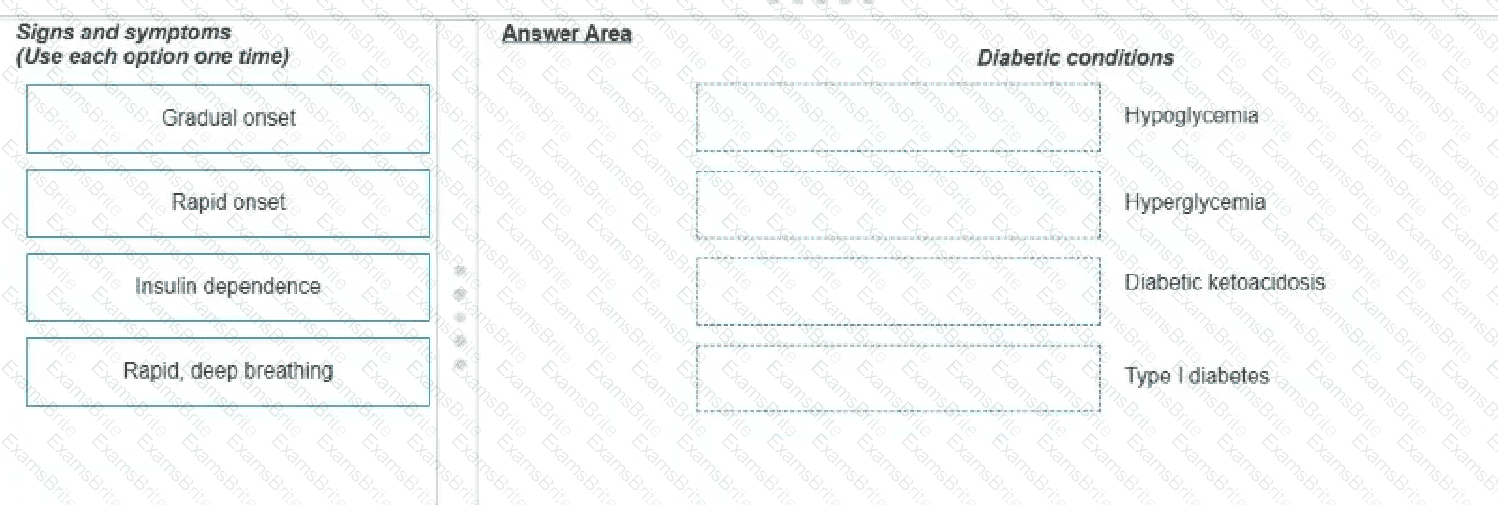
Which of the following signs or symptoms would be most closely associated with each of these diabetic conditions? Move each sign or symptom into the Answer Area one time to indicate the most closely associated diabetic condition.
A 30-year-old patient has a gunshot wound to the chest and is unconscious. The skin is pale and cool, and capillary refill is 2 seconds. Lung sounds are absent on the right side. The vital signs are BP 100/50, P 140, R 18 and shallow, and SpO₂ 88% on room air.
Which of the following signs or symptoms are the strongest indicators of hypovolemic shock? Select the three answer options that are correct.
The most common finding in a patient who is experiencing a sickle cell crisis is
A 44-year-old patient is unresponsive, and an EMT checks for a pulse prior to applying an AED. Which of the following shockable rhythms, ventricular fibrillation or ventricular tachycardia, if either, may still produce a pulse in this patient?
A 6-year-old female rode her bicycle into a parked car. She is in moderate respiratory distress and you palpate subcutaneous emphysema. Of the following, what is the most important management for her?
A 60-year-old has severe shortness of breath. Audible wheezing is present. The patient has a history of COPD, asthma, and diabetes with prescribed medications. The vital signs are BP 138/80, P 110, R 30, and SpO₂ 89% on room air. What actions should the EMT take? Select the two answer options that are correct.
A 32-year-old female has a history of dysmenorrhea, abdominopelvic pain, and pain when having a bowel movement. She has not been sexually active in 8 months. Her symptoms are most likely caused by
When would application of an oxygen humidifier be most beneficial? Select the three answer options that are correct.
A 42-year-old patient with a history of COPD has exertional dyspnea. The patient has a productive cough with green-tinged sputum. Which additional findings should the EMT expect to see with this patient? Select the two answer options that are correct.
While responding to an emergency, a car is tailgating the ambulance. Which of the following actions should the EMT take?
A 7-year-old patient is confused and disoriented. What should the EMT assess to rapidly determine the patient ' s condition? Select the three answer options that are correct.
A 22-year-old patient fell and had pain in their right arm. The EMT began transporting the patient without splinting the arm. During transport, the patient’s pain increased, and a deformity formed. The patient required surgical intervention for a displaced fracture. Based on this example, which of the following elements of negligence could be applied?
A 22-year-old patient fell and had pain in their right arm. The EMT began transporting the patient without splinting the arm. During transport, the patient ' s pain increased, and a deformity formed. The patient required surgical intervention for a displaced fracture. Based on this example, which of the following elements of negligence could be applied?
A 67-year-old patient reports crushing chest pressure. The vital signs are BP 156/98, P 64, R 14, and SpO₂ 94%. What treatments should the EMT provide first? Select the two answer options that are correct.
A 65-year-old patient with a history of angina reports chest pain and shortness of breath after playing golf. The patient stated the pain began one hour ago and has not stopped with rest. The vital signs are BP 86/64, P 112, R 22, and SpO₂ 89% on room air. Which of the following actions should the EMT do next?
A 60-year-old patient has crushing, midsternal chest pain that began about 5 minutes ago with exercise. The patient has no prescription medications. The vital signs are BP 142/102 mmHg, P 90/min, R 16/min, and SpO₂ 95% on room air. What treatments should the EMT provide? Select the two answer options that are correct.
Following insertion of an oropharyngeal airway in an unresponsive 1-year-old male, he develops cyanosis and bradycardia. You should
Which of the following findings are consistent with congestive heart failure? Select the two answer options that are correct.
What finding indicates that a mild airway obstruction has become a severe obstruction?
You have achieved ROSC (Return of Spontaneous Circulation) in a 77-year-old female. She remains unresponsive and her vital signs are BP 94/58, P 82, and R 18. In what position should she be placed?
You have achieved ROSC in a 77-year-old female. She remains unresponsive and her vital signs are BP 94/58, P 82, and R 18. In what position should she be placed?
An 84-year-old patient becomes dyspneic, feels faint, and develops blurred vision when going from sitting to standing. When at rest, the patient’s symptoms resolve. The vital signs are BP 188/90, P 78, R 20, and SpO₂ 93% on room air. Which of the following causes is the patient’s most likely presentation?
A 24-year-old male was injured in an explosion at a large factory. He is breathing shallowly at a rate of 40 and his capillary refill is 3 seconds. What color should you assign him for triage?

TESTED 22 Sep 2026