Summer Sale 65% Discount Offer - Ends in 0d 00h 00m 00s - Coupon code: exams65

ExamsBrite Dumps

TOGAF Enterprise Architecture Part 1 Exam (English) Question and Answers

TOGAF Enterprise Architecture Part 1 Exam (English)

Last Update Jul 25, 2026
Total Questions : 172

We are offering FREE OGEA-101 The Open Group exam questions. All you do is to just go and sign up. Give your details, prepare OGEA-101 free exam questions and then go for complete pool of TOGAF Enterprise Architecture Part 1 Exam (English) test questions that will help you more.


OGEA-101 pdf

OGEA-101 PDF

$36.75  $104.99
OGEA-101 Engine

OGEA-101 Testing Engine

$43.75  $124.99
OGEA-101 PDF + Engine

OGEA-101 PDF + Testing Engine

$57.75  $164.99
Questions 1

Complete the sentence. The “Statement” part of the recommended TOGAF template for Architecture Principles
Options:

A.  

should highlight the requirements for carrying out the principle

B.  

should highlight the business benefits

C.  

should be easy to remember

D.  

should clearly communicate the fundamental rule

Discussion 0
Questions 2

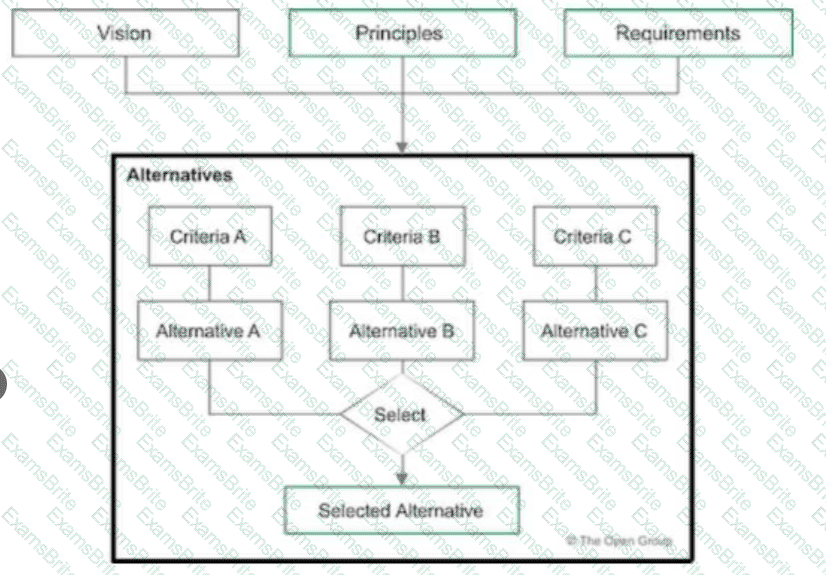
Consider the graphic from the TOGAF Standard.

The graphic shows Vision, Principles, and Requirements feeding into a box labeled Alternatives. Inside that box, multiple alternatives are assessed against Criteria A, Criteria B, and Criteria C. A selection step then leads to a Selected Alternative.

What does this illustrate?

Options:

A.  

The Architecture Trade-off method

B.  

Architecture Partitioning

C.  

The Business Scenario method

D.  

Iteration

Discussion 0
Questions 3

Which of the following describes a purpose of Architecture Principles?

Options:

A.  

To describe likely impacts resulting from successful deployment of the target architecture.

B.  

To establish a common understanding of how to control the business in pursuit of strategic objectives

C.  

To provide a better understanding about the enterprise ' s culture and values

D.  

To form a contract between sponsoring organization and the enterprise architects

Discussion 0
Questions 4

Which of the following best describes a Business Scenario?

Options:

A.  

A business problem together with the desired outcome.

B.  

A use-case for developing a business model.

C.  

A method to quantify readiness for change.

D.  

A technique to identify differences between a baseline and a target architecture.

Discussion 0
Questions 5

Which of the following best describes the need for the ADM process to be governed?

Options:

A.  

To enable development of reference architectures

B.  

To verify that the method is being applied correctly

C.  

To enable a fast response to market changes

D.  

To permit the architecture domains to be integrated

Discussion 0
Questions 6

Consider the following descriptions of deliverables consumed and produced across the TOGAF ADM cycle.

    General rules and guidelines, intended to be enduring and seldom amended, that inform and support the way in which an organization sets about fulfilling its mission.

    The joint agreements between development partners and sponsors on the deliverables, quality, and fitness-for-purpose of an architecture.

    A document that is sent from the sponsoring organization to the architecture organization to trigger the start of an architecture development cycle.

    A set of quantitative statements that outline what an implementation project must do in order to comply with the architecture.

Complete the sentence.

Deliverable 3 is an output of ________, and deliverable 4 can form ________.

Options:

A.  

Phase A, an assessment of the changes to the architecture

B.  

The Preliminary Phase, an approach to change for the Implementation and Migration Plan

C.  

The Preliminary Phase, a major component of an implementation project

D.  

Phase A, the plan for how the architecture is governed

Discussion 0
Questions 7

Complete the sentence. Architecture effort at the Logical abstraction level is about:

Options:

A.  

Decomposing the requirements to understand the problem, and what is needed to address the problem, without unduly focusing on how the architecture will be realized

B.  

Managing the allocation and implementation of physical components to meet the identified logical components

C.  

Identifying the kinds of business, data, application, and technology components needed to achieve the services identified in the conceptual level

D.  

Understanding the environment in which an enterprise operates and the context in which architecture work is planned and executed

Discussion 0
Questions 8

Which of the following is a purpose of Phase A of the TOGAF ADM?

Options:

A.  

Identifying key stakeholders

B.  

Defining the Enterprise strategy

C.  

Describing the target architecture

D.  

Developing an Enterprise Architecture Capability

Discussion 0
Questions 9

Which of the following is a responsibility of an Architecture Board?

Options:

A.  

Determining the scope of an architecture compliance review

B.  

Allocating resources for architecture projects

C.  

Conducting assessments of the maturity level of architecture discipline within the organization

D.  

Achieving consistency between sub-architectures

Discussion 0
Questions 10

Consider the following graphic illustrating a method supporting the TOGAF ADM.

Question:

What does the method help identify?

Options:

A.  

Business Scenarios

B.  

Alternative Target Architectures

C.  

Solution Building Blocks

D.  

Architecture Solutions

Discussion 0
Questions 11

Which ADM Phase includes creation of an Enterprise Architecture Capability?

Options:

A.  

Phase A

B.  

Phase H

C.  

Phase G

D.  

Preliminary Phase

Discussion 0
Questions 12

Complete the sentence The Architecture Landscape is divided into levels known as__________________________.

Options:

A.  

Gaps Plateaus, and Target Architectures

B.  

Baseline. Transition and To Be Architectures

C.  

Segment Strategic and Capability Architectures

D.  

Transitional Complete and incremental Architectures

Discussion 0
Questions 13

Which of the following is included as part of the practice of Architecture Governance?

Options:

A.  

Interacting with the CxO level on Enterprise Architecture.

B.  

Implementation of controls over the creation of architectural components.

C.  

Creating and maintaining the Statement of Architecture Work throughout the ADM cycle.

D.  

Managing stakeholders, their concerns, and their requirements.

Discussion 0
Questions 14

Consider the following statements:

1. Each contracted party is required to act responsibly to the organization and its stakeholders.

2. All decisions taken, processes used, and their implementation will not be allowed to create unfair advantage to any one particular party.

3. Digital Transformation and operations will be more effective and efficient.

4. Strategic decision-making by C-Level executives and business leaders will be more effective.

Which statements highlight the value and necessity for Architecture Governance to be adopted within organizations?

Options:

A.  

1 & 2

B.  

2 & 3

C.  

3 & 4

D.  

1 & 4

Discussion 0
Questions 15

Which of the following supports the need to govern Enterprise Architecture?

Options:

A.  

The Architecture Project mandates the governance of the target architecture

B.  

The TOGAF standard cannot be used without executive governance

C.  

Best practice governance enables the organization to control value realization

D.  

The Stakeholders preferences may go beyond the architecture project scope and needs control

Discussion 0
Questions 16

Which of the following can be used to structure the collection of work products and models that describe the architecture?

Options:

A.  

The Enterprise Continuum

B.  

The Architecture Repository

C.  

The Enterprise Metamodel

D.  

The Content Framework

Discussion 0
Questions 17

Consider the diagram showing a classification model for Architecture Landscapes.
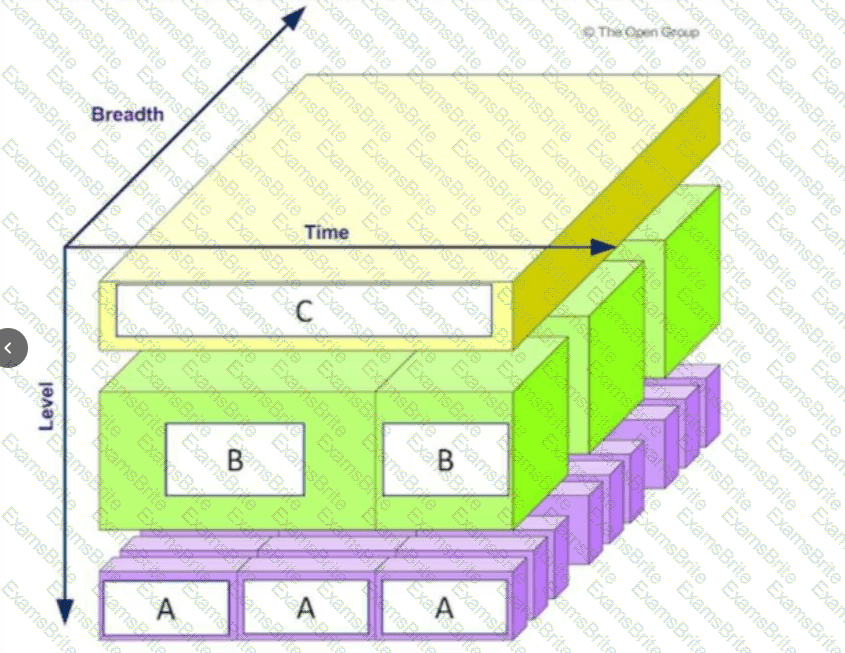
What are the items labelled A, B and C?

Options:

A.  

A-Corporate Capability, B-Portfolio Capability, C-Project Capability

B.  

A-Strategy Architecture, B-Tactic Architecture, C-Operational Architecture

C.  

A-Architecture Vision, B-Business Architecture, C-Architecture Development

D.  

A-Capability Architecture, B-Segment Architecture, C-Enterprise Strategic Architecture

Discussion 0
Questions 18

Which of the following does the TOGAF standard describe as a package of functionality defined to meet business needs across an organization?

Options:

A.  

An application

B.  

A deliverable

C.  

A solution architecture

D.  

A building block

Discussion 0
Questions 19

Complete the following sentence:

Presenting different_________and_________to stakeholders helps architects to extract hidden agendas principles and requirements that could impact the final Target Architecture

Options:

A.  

Alternatives Trade-offs

B.  

Solutions Applications

C.  

Architecture Views Architecture Viewpoints

D.  

Business Scenarios Business Models

Discussion 0
Questions 20

Consider the following classification model for Architecture Landscapes.

Consider the framework for the Architecture Landscape and the following names of levels:

    Enterprise Strategic Architecture

    Segment Architecture

Match the levels marked A, B, or C to the names marked 1 and 2.

Options:

A.  

A-2, B-1

B.  

B-1, C-2

C.  

A-1, C-2

D.  

B-2, C-1

Discussion 0
Questions 21

What are the four dimensions used to scope an architecture?

Options:

A.  

Business Data Application Technology

B.  

Strategy Segment Capability Budget

C.  

Breadth Depth Time Period Architecture Domains

D.  

Strategy Portfolio Project Solution Delivery

Discussion 0
Questions 22

Complete the sentence. When considering agile development, Architecture to Support Portfolio will identify what products the Enterprise needs, the boundary of the products, and what constraints a product owner has; this defines the Enterprise ' s

Options:

A.  

risk tolerance

B.  

business continuity

C.  

backlog

D.  

operating model

Discussion 0
Questions 23

Which of the following best describes the purpose of the Architecture Roadmap?

Options:

A.  

It provides for effective communication of the end architecture project to the stakeholders

B.  

It is sent from the sponsor and triggers the start of an architecture development cycle

C.  

It forms the basis of a contractual agreement between the sponsor and the architecture organization

D.  

It lists work packages on a timeline showing progress towards the Target Architecture

Discussion 0
Questions 24

Consider the following ADM phases objectives.
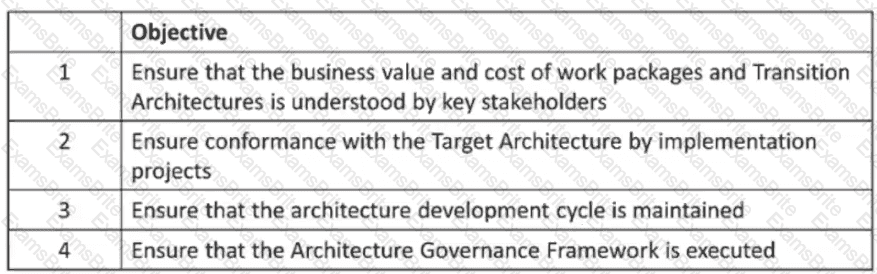
Which phase does each objective match?

Options:

A.  

1F-2G-3G-4H

B.  

1H-2F-3F-4G

C.  

1F-2G-3H-4H

D.  

1G-2H-3H-4F

Discussion 0
Questions 25

Consider the following descriptions of deliverables consumed and produced across the TOGAF ADM cycle.

2) A set of quantitative statements that outline what an implementation project must do in order to comply with the architecture.

4) The scope and approach that will be used to complete an architecture development cycle.

Complete the sentence. Deliverable 2 is the ___, deliverable 4 is a deliverable from ___.

Options:

A.  

Architecture Requirements Specification, Phase A

B.  

Architecture Definition Document, Phase H

C.  

Architecture Principles, Phase G

D.  

Request for Architecture Work, Preliminary Phase

Discussion 0
Questions 26

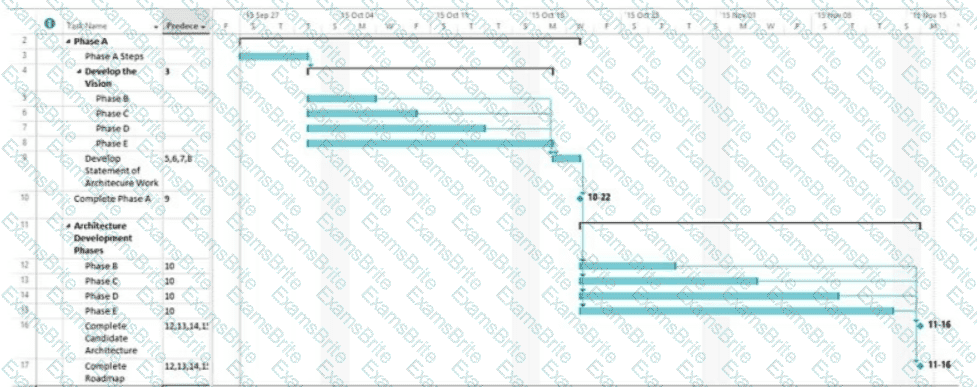
Consider the following chart:

Question:

Which concept for Enterprise Architecture Practitioners does it illustrate?

Options:

A.  

ADM phases must be run simultaneously until the candidate architecture is tested for acceptance.

B.  

Enterprise Architects must use Gantt charts to communicate the planning with stakeholders.

C.  

ADM phases must be run sequentially to produce a candidate architecture.

D.  

An Enterprise Architecture must be developed in phases with fixed durations as shown.

Discussion 0
Questions 27

Complete the following sentence. In the ADM, documents which are under development and have not undergone any formal review and approval process are called______ Documents which have been reviewed and approved are called ______

Options:

A.  

" draft " - " finalized "

B.  

" draft " - " approved "

C.  

" concept " - " deliverable "

D.  

" Version 0.1 " - " Version 1.0 "

Discussion 0
Questions 28

Which of the following is included as part of Architecture Governance1?

Options:

A.  

Ensuring compliance with internal and external standards and regulatory obligations

B.  

Creating and maintaining the Statement of Architecture Work though out the ADM cycle

C.  

Managing Stakeholders and their requirements

D.  

Interacting with the CxO level on Enterprise Architecture

Discussion 0
Questions 29

Complete the sentence. The key purpose of Gap Analysis is to _____

Options:

A.  

establish quality parameters for the architecture

B.  

identify potential missing or overlapping functions

C.  

validate nonfunctional requirements

D.  

identify commercial building blocks to be purchased

E.  

determine the required service levels for the architecture

Discussion 0
Questions 30

Which section of the TOGAF template for Architecture Principles should highlight the requirements for carrying out the principle?

Options:

A.  

Rationale

B.  

Name

C.  

Statement

D.  

Implications

Discussion 0
Questions 31

Complete the following sentence. In the ADM, documents which are under development and have not undergone any formal review and approval process are _________

Options:

A.  

in between phases

B.  

known as " Version 0.1 "

C.  

invalid

D.  

called " draft "

Discussion 0
Questions 32

Complete the sentence. The purpose of the Gap Analysis technique is to

Options:

A.  

determine service levels for the architecture

B.  

validate the architecture

C.  

identify nonfunctional requirements for the architecture

D.  

establish quality metrics for the architecture

Discussion 0
Questions 33

Consider the following ADM phases objectives.
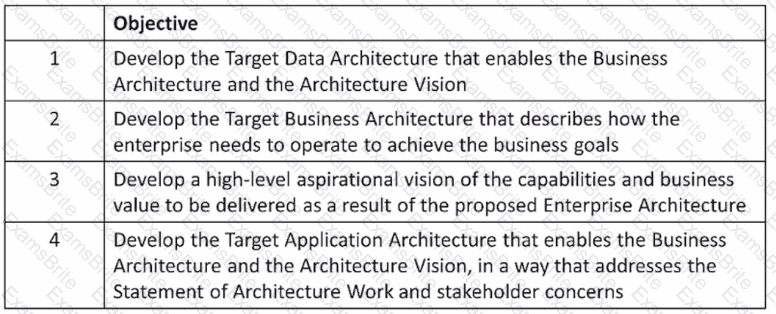
Objective:

1.Develop the Target Data Architecture that enables the Business Architecture and the Architecture Vision

2.Develop the Target Business Architecture that describes how the enterprise needs to operate to achieve the business goals

3.Develop a high-level aspirational vision of the capabilities and business value to be delivered as a result of the proposed Enterprise Architecture

4.Identify candidate Architecture Roadmap components based upon gaps between the Baseline and Target Technology Architectures

Which phase does each objective match?

Options:

A.  

1B-2D-3A-4C

B.  

1C-2D-3B-4A

C.  

1C-2B-3A-4D

D.  

1A-2B-3C-4D

Discussion 0
Questions 34

Full Question:

Consider the following description of the purpose of an ADM Phase:

To develop a domain architecture approved by the stakeholders for the problem being addressed, together with a set of gaps, and work to clear the gaps understood by the stakeholders.

Which ADM Phase does this describe?

Options:

A.  

Preliminary Phase

B.  

Phase A

C.  

Phase E

D.  

Phase B

Discussion 0
Questions 35

Complete the sentence Business Transformation Readiness Assessment is_________________.

Options:

A.  

a joint effort between corporate staff lines of business and IT planners

B.  

to ensure the active support of powerful stakeholders

C.  

a way to put building blocks into context thereby supporting re-usable solutions

D.  

widely used to validate an architecture that is being developed

Discussion 0
Questions 36

What component of the Architecture Repository represents architecture requirements agreed with the Architecture Board?

Options:

A.  

Reference Library

B.  

Architecture Capability

C.  

Architecture Requirements Repository

D.  

Governance Log

Discussion 0
Questions 37

Complete the following sentence. In the ADM documents which are under development and have not undergone any formal review and approval process are_______________.

Options:

A.  

Called ‘’draft’’

B.  

Invalid

C.  

In between phases

D.  

Known as ‘’Version 0.1’’

Discussion 0
Questions 38

Which of the following is a responsibility of an Architecture Board?

Options:

A.  

Conducting assessments of the maturity level of architecture discipline within the organization

B.  

Allocating resources for architecture projects

C.  

Creating the Statement of Architecture Work

D.  

Establishing targets for re-use of components

Discussion 0
Questions 39

Which of the following statements about architecture partitioning are correct?

    It is equivalent to architecture levels.

    It enables different groups of architects to own and develop specific parts of an architecture.

    It is implemented following a generally applicable partitioning model.

    It is used to simplify the management of an Enterprise Architecture.

Options:

A.  

1 & 4

B.  

1 & 3

C.  

2 & 3

D.  

2 & 4

Discussion 0
Questions 40

Which of the following describes the practice by which the enterprise architecture is managed and controlled at an enterprise-wide level?

Options:

A.  

Corporate governance

B.  

Architecture governance

C.  

IT governance

D.  

Technology governance

Discussion 0
Questions 41

Which of the following best describes the TOGAF Architecture Development Method?

Options:

A.  

A classification mechanism for architectures and solutions.

B.  

A process for managing architecture requirements.

C.  

A technique to assess readiness for change.

D.  

A repeatable process for developing architectures.

Discussion 0
Questions 42

Consider the following ADM phases objectives.

Which phase does each objective match?

Options:

A.  

1C-2B-3A-4C

B.  

1A-2B-3C-4D

C.  

1B-2D-3A-4C

D.  

1C-2D-3B-4A

Discussion 0
Questions 43

Which statement about Requirements Management is most correct?

Options:

A.  

The purpose of Requirements Management is to process change requests

B.  

Stakeholder requirements are captured once in Phase A and managed throughout the ADM cycle

C.  

Requirements Management is a step of all ADM Phases

D.  

Requirements Management and stakeholder engagement are placed at the center of architecture development

Discussion 0
Questions 44

Which section of the TOGAF template for Architecture Principles should highlight the business benefits of adhering to the principle?

Options:

A.  

Rationale

B.  

Name

C.  

Implications

D.  

Statement

Discussion 0
Questions 45

Complete the sentence. A business scenario describes:

Options:

A.  

A business problem and the technology environment in which the problem occurs

B.  

Shortfalls between the Baseline and Target Architectures

C.  

General rules and guidelines for the architecture being developed

D.  

Business domain gaps, such as cross-training requirements

Discussion 0
Questions 46

Complete the sentence. The purpose of Enterprise Architecture is to

Options:

A.  

take major improvement decisions.

B.  

guide effective change.

C.  

govern the stakeholders.

D.  

control the bigger changes.

Discussion 0
Questions 47

In which section of the TOGAF template for Architecture Principles would a reader find the answer to the question of “How does this affect me?”

Options:

A.  

Statement

B.  

Rationale

C.  

Name

D.  

Implications

Discussion 0
Questions 48

Complete the sentence A business scenario describes______________

Options:

A.  

shortfalls between the Baseline and Target Architectures

B.  

business domain gaps such as cross-training requirements

C.  

business and technology environment in which those problems occur

D.  

general rules and guidelines tor the architecture being developed

Discussion 0
Questions 49

What is the role of an Architecture Board?

Options:

A.  

It conducts the assessments of the maturity level of architecture discipline within the organization.

B.  

It oversees implementation of the Architecture Governance strategy for the enterprise.

C.  

It creates the Statement of Architecture Work for an Enterprise Architecture project.

D.  

It determines the scope of an architecture compliance review.

Discussion 0
Questions 50

Which section of the TOGAF template for Architecture Principles should describe the relationship to other principles?

Options:

A.  

Name

B.  

Rationale

C.  

Statement

D.  

Implications

Discussion 0
Questions 51

What is an objective of the ADM Preliminary Phase?

Options:

A.  

To develop a vision of the business value to be delivered by the proposed enterprise architecture

B.  

To select and implement tools to support the Architecture Capability

C.  

To obtain approval for the Statement of Architecture Work

D.  

To create the initial version of the Architecture Roadmap

Discussion 0