Pre-Winter Limited Time 70% Discount Offer - Ends in 0d 00h 00m 00s - Coupon code: agile70

ExamsBrite Dumps

Fortinet NSE 5 - FortiSwitch 7.6 Administrator Question and Answers

Fortinet NSE 5 - FortiSwitch 7.6 Administrator

Last Update Oct 12, 2026
Total Questions : 114

We are offering FREE NSE5_FSW_AD-7.6 Fortinet exam questions. All you do is to just go and sign up. Give your details, prepare NSE5_FSW_AD-7.6 free exam questions and then go for complete pool of Fortinet NSE 5 - FortiSwitch 7.6 Administrator test questions that will help you more.


NSE5_FSW_AD-7.6 pdf

NSE5_FSW_AD-7.6 PDF

$31.5  $104.99
NSE5_FSW_AD-7.6 Engine

NSE5_FSW_AD-7.6 Testing Engine

$37.5  $124.99
NSE5_FSW_AD-7.6 PDF + Engine

NSE5_FSW_AD-7.6 PDF + Testing Engine

$49.5  $164.99
Questions 1

What are two reasons why time synchronization between FortiGate and its managed FortiSwitch is critical in switch management? (Choose two.)

Options:

A.  

FortiSwitch does not retain its time after a reboot, which gets reset after each reboot.

B.  

FortiSwitch will not be able to become an NTP server for downstream devices.

C.  

FortiSwitch cannot complete the DTLS handshake used in the CAPWAP tunnel.

D.  

FortiSwitch will not allow other FortiSwitch devices in the chain be discovered by FortiGate.

Discussion 0
Questions 2

(Full question statement start from here)

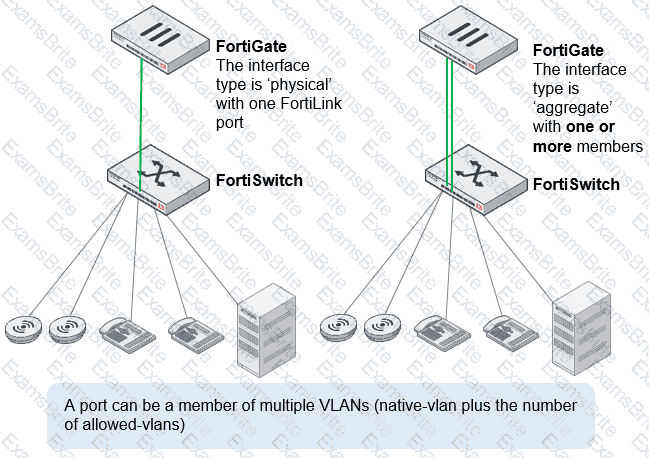
Refer to the exhibit.
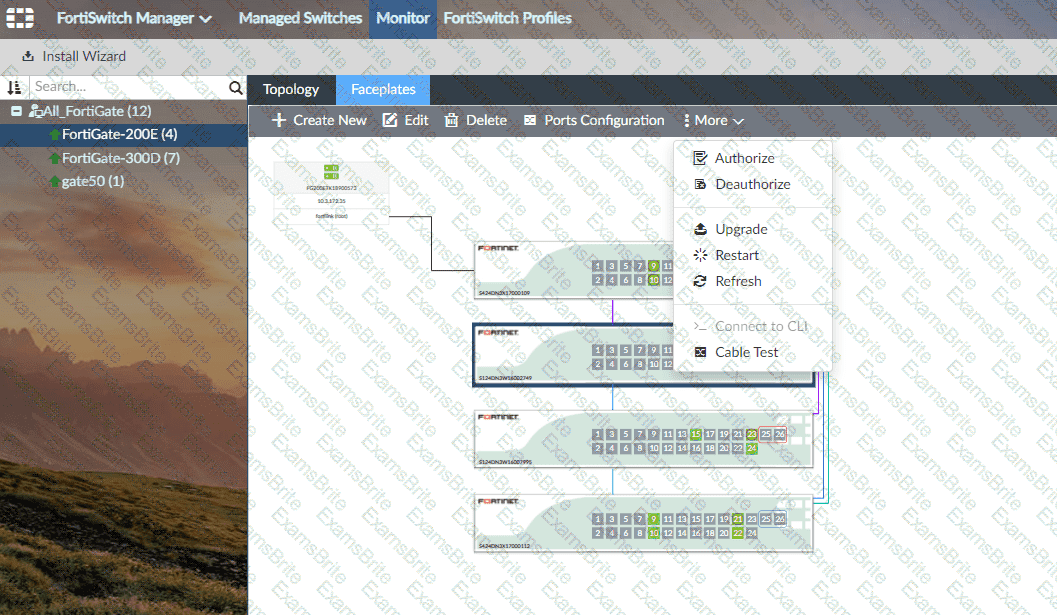
Which information does FortiGate use to generate the port details in the FortiSwitch Faceplates view? (Choose one answer)

Options:

A.  

The FortiSwitch model

B.  

The Cisco Discovery Protocol (CDP) advertisements from FortiSwitch

C.  

The LLDP advertisements received from the FortiSwitch

D.  

The FortiLink discovery frames sent by FortiSwitch

Discussion 0
Questions 3

You are deploying a small office network with a single FortiGate and a single FortiSwitch. The office currently has moderate traffic, but the IT team expects the network to grow in the near future, adding more FortiSwitch devices and endpoints. Which FortiLink configuration should you deploy to provide the best combination of current performance and scalability for future growth? (Choose one answer)

Options:

A.  

Configure FortiLink using hardware-based switch interfaces.1

B.  

Configure FortiLink using software-based switch interfaces.

C.  

Configure FortiLink as a link aggregation group (LAG) interface.

D.  

Configure FortiLink as a multichassis LAG (MCLAG) interface.2

Discussion 0
Questions 4

How are the ' by VLAN redirect MAC address quarantine ' mode and the ' by redirect MAC address quarantine ' mode on FortiGate similar?

Options:

A.  

Both modes move quarantined devices to the quarantine VLAN.

B.  

Both modes require firewall policies to block inter-VLAN traffic.

C.  

Both modes add quarantined device MAC addresses to the blocked firewall address group.

D.  

Both modes block intra-VLAN traffic by FortiGate automatically.

Discussion 0
Questions 5

What can an administrator do to maintain the existing standalone FortlSwltch configuration while changing the management mode to FortLink?

Options:

A.  

Use a migration tool based on python script to convert the configuration

B.  

Enable the Forti-link setting on FortiSwitch before the authorization process

C.  

FortiGate will automatically save the existing FortiSwitch configuration during the Forti-link management process.

D.  

Register FortiSwitch to For1ISwitch Cloud to save a copy before managing by Forti-Gate.

Discussion 0
Questions 6

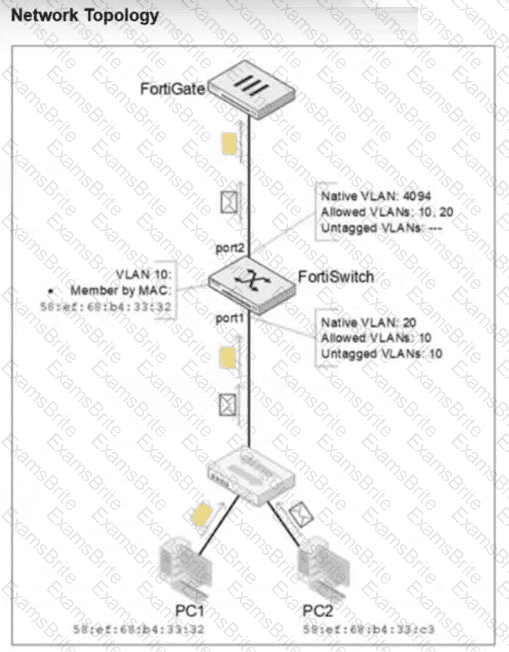
Refer to the exhibit.

PC1 and PC2 are connected to port1 on FortiSwitch. Which VLAN tags will FortiSwitch apply when forwarding PC1 and PC2 traffic out of port2? (Choose one answer)

Options:

A.  

FortiSwitch will tag PC1 and PC2 frames with VLAN 20.

B.  

FortiSwitch will tag both PC1 and PC2 frames with VLAN 10, due to MAC override.

C.  

FortiSwitch will tag PC1 frames with VLAN 10 and PC2 frames with VLAN 20.

D.  

FortiSwitch will leave PC1 frames untagged and will tag PC2 frames with VLAN 10.

Discussion 0
Questions 7

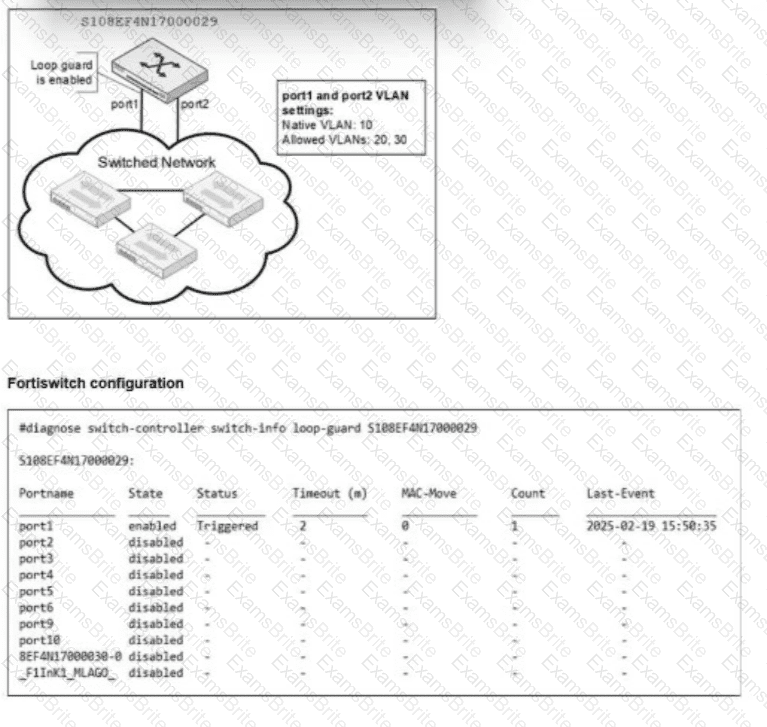
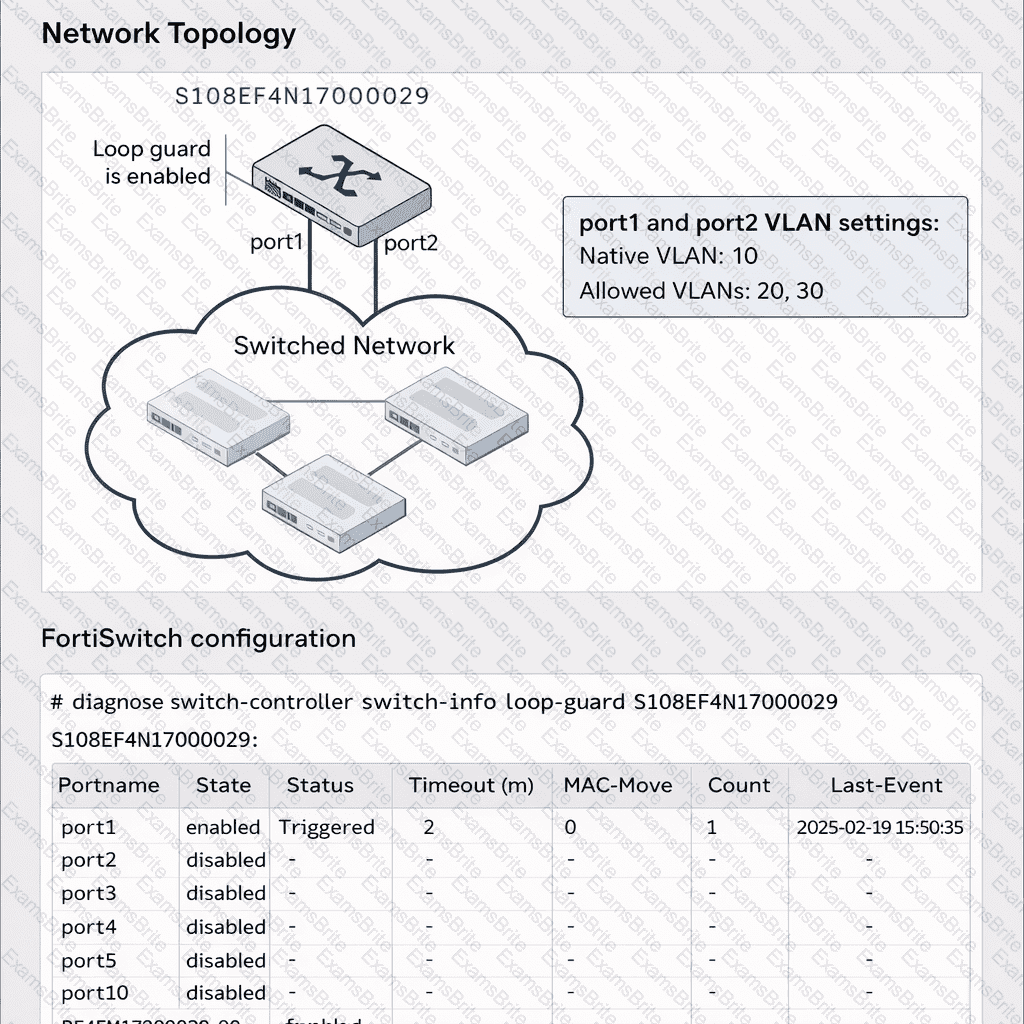
Refer to the exhibits.

You are reviewing a FortiSwitch configuration where port1 and port2 are connected to a switched network. Loop guard is enabled on port1.

The CLI output shows that the port1 status is triggered due to loop guard. Which two conditions could have caused this shutdown? (Choose two.)

Options:

A.  

A loop guard frame sent from port1 is received on port2.

B.  

A loop guard frame sent from port1 is received back on port1.

C.  

Loop guard is triggered because port2 did not send any bridge protocol data units (BPDU).

D.  

Loop guard is triggered because the port detected excessive traffic.

Discussion 0
Questions 8

In which two ways can you assign a FortiSwitch port to a VDOM using multi-tenancy setup? (Choose two.)

Options:

A.  

Switch the FortiLink interface to the target VDOM.

B.  

Remove the managed FortiSwitch and allocate ports directly on FortiSwitch.

C.  

Create a virtual port pool on the FortiGate CLI.

D.  

Assign a port to a VDOM directly on the managed FortiSwitch.

Discussion 0
Questions 9

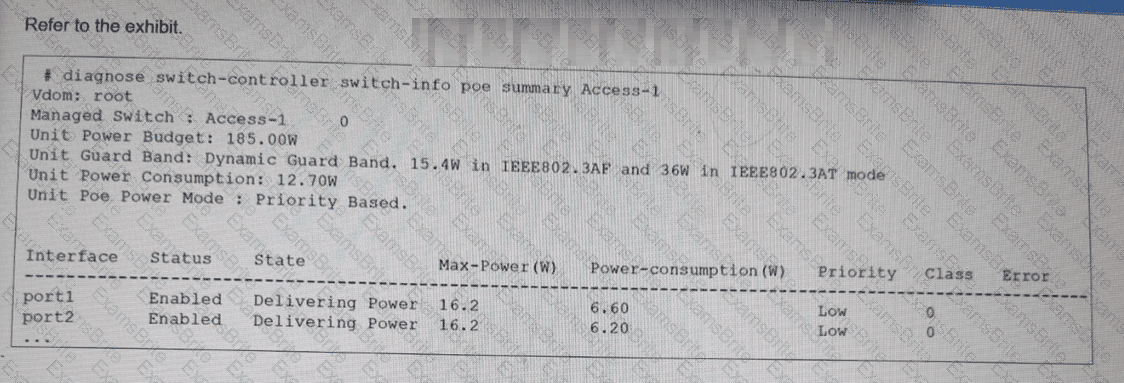
Refer to the exhibit.

The FortiSwitch CLI output of the diagnose switch-controller switch-info poe summary command for the switch Access-1 is shown. It shows that two ports have Power over Ethernet (PoE) enabled and are already in use. What is the most important consideration if you want to connect additional PoE devices to FortiSwitch? (Choose one answer)

Options:

A.  

All plugged devices use the same PoE standard: 802.3af/at.

B.  

The FortiSwitch model supports the number of PoE devices that you want to connect.

C.  

The PoE power mode matches the PoE standard of the device.

D.  

The total PoE consumption must not exceed the FortiSwitch power budget.

Discussion 0
Questions 10

(Full question statement start from here)

You enable Dynamic Host Configuration Protocol (DHCP) snooping on a VLAN and configure a FortiSwitch port astrustedfor DHCP snooping. What additional step is required to configure the port as trusted forDynamic ARP Inspection (DAI)? (Choose one answer)

Options:

A.  

Manually set the port as trusted for DAI through the CLI.

B.  

DAI implicitly trusts the port.

C.  

Enable IP Source Guard (IPSG) on the port.

D.  

Enable static MAC learning on the port.

Discussion 0
Questions 11

(Full question statement start from here)

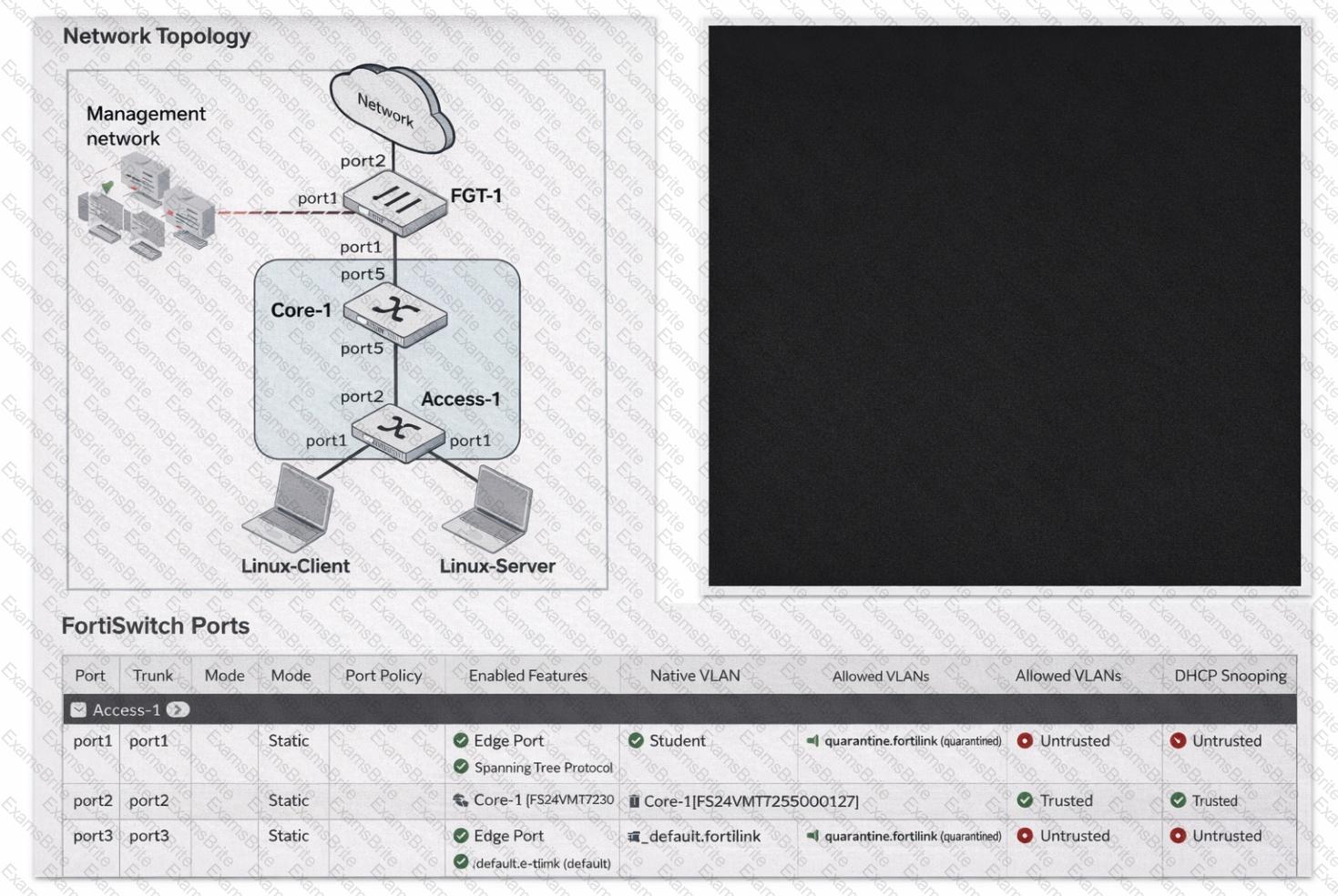
Refer to the exhibits.

You enable Dynamic Host Configuration Protocol (DHCP) snooping on the VLAN,Student. The Linux-Client VM sends DHCP requests, and tcpdump confirms the broadcasts. However, the Linux-Server VM, acting as a DHCP server, receives no DHCP traffic. What is the most likely cause of this intra-VLAN traffic being blocked? (Choose one answer)

Options:

A.  

The DHCP requests are being sent on the wrong VLAN.

B.  

Port1 is configured as an untrusted port.

C.  

Port4 is not configured as a trusted port.

D.  

The Student VLAN must be configured as an allowed VLAN on port1.

Discussion 0
Questions 12

Which two statements about DHCP snooping enabled on a FortiSwitch VLAN are true? (Choose two.)

Options:

A.  

Enabling DHCP snooping on a FortiSwitch VLAN ensures requests and replies are seen by all DHCP servers.

B.  

switch-controller-dhcp-snooping-verify-mac verifies the destination MAC address to protect against DHCP exhaustion attacks.

C.  

By default, all FortiSwitch ports are set to forward client DHCP requests to untrusted ports.

D.  

Settings related to DHCP option 82 are only configurable through the CLI

Discussion 0
Questions 13

You are deploying a multitier FortiSwitch topology with redundant links between access and aggregation switches. The team is considering Multiple Spanning Tree Protocol (MSTP) to manage spanning tree across multiple VLANs. Which two Rapid STP (RSTP) features would be useful in this deployment to ensure fast convergence and predictable port roles? (Choose two answers)

Options:

A.  

The process for selecting the root bridge

B.  

Recalculating paths after a topology change

C.  

Automatic VLAN assignment

D.  

The rules for determining port roles

Discussion 0
Questions 14

(Full question statement start from here)

Refer to the exhibit.

You run the command diagnose switch-controller switch-info loopguard access-1 and see that theMAC-Movecolumn displays a value of0forport1.

What does this indicate? (Choose one answer)

Options:

A.  

Loop guard is disabled on port1.

B.  

Port1 is not being monitored by loop guard.

C.  

The MAC move feature is not enabled.

D.  

Port1 will shut down if a loop occurs on any VLAN.

Discussion 0
Questions 15

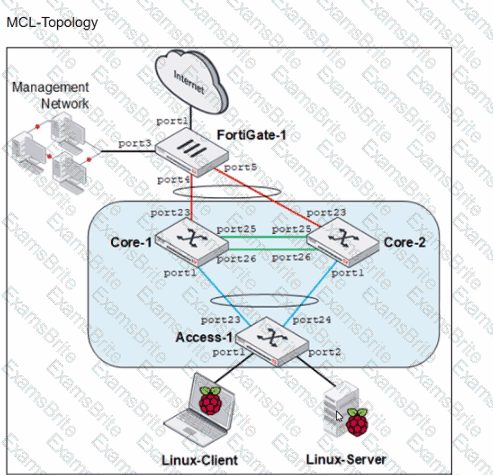
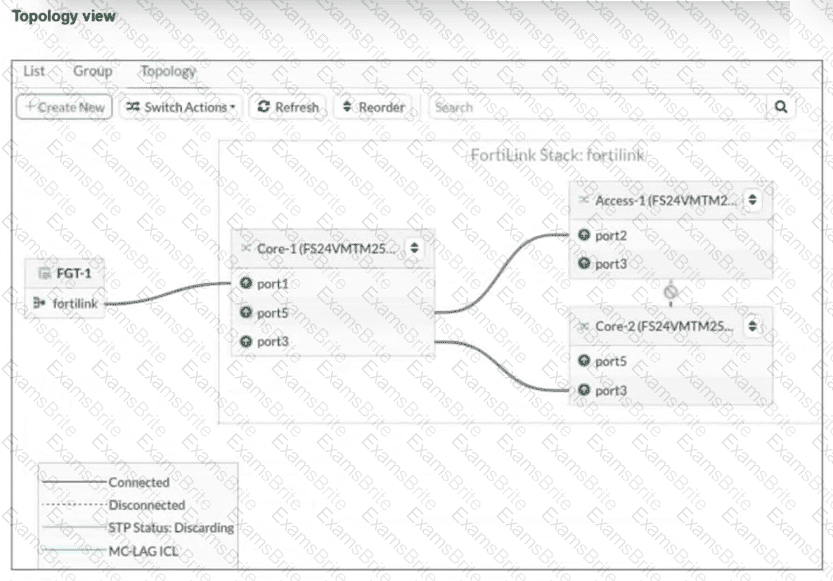
Refer to the exhibit.

Core-1 and Access-1 are managed and authorized by FortiGate-1. which uses port4 as the FortiLink interface. After FortiGate authorizes and manages Core-2. Port1 status becomes STP discarding.

Why is port1 in the discarding state?

Options:

A.  

port1 on Core-2 is discarding only management traffic.

B.  

Core-1 and Core-2 do not have MCLAG configuration.

C.  

Access-1 is the root bridge and can only have one root port.

D.  

Core-2 has the lowest bridge priority.

Discussion 0
Questions 16

Which two types of Layer 3 interfaces can participate in dynamic routing on FortiSwitch? (Choose two.)

Options:

A.  

Detected management interfaces

B.  

Loopback interfaces

C.  

Switch virtual interfaces

D.  

Physical interfaces

Discussion 0
Questions 17

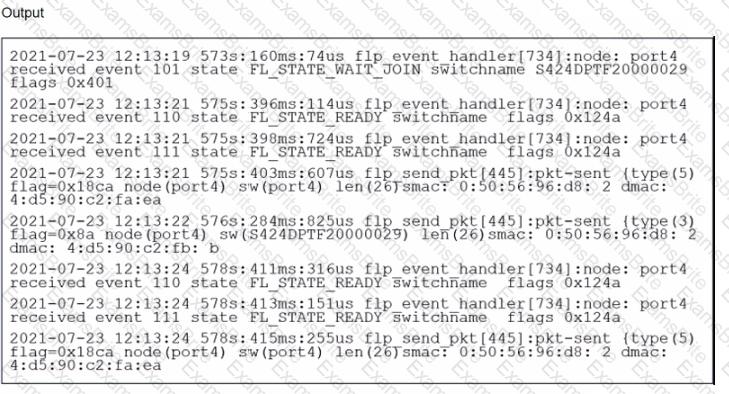
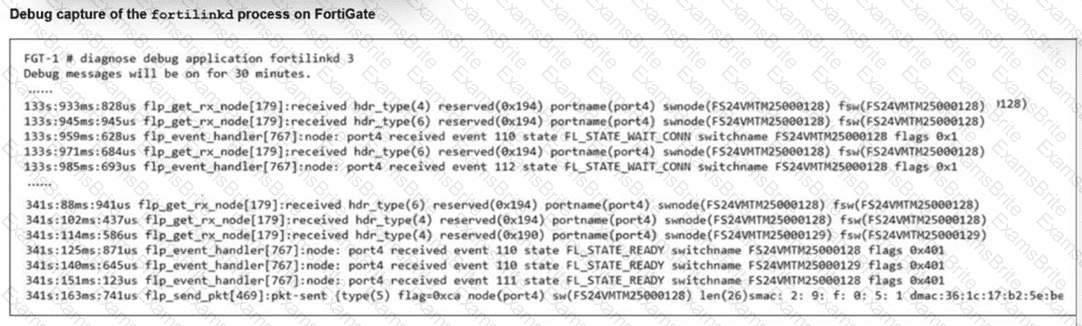
Refer to the exhibit.

Which two statements best describe what is displayed in the FortiLink debug output shown in the exhibit? (Choose two.)

Options:

A.  

FortiSwitch is sending FortiLink heartbeats to FortiGate.

B.  

FortiSwitch is discovered and authorized by FortiGate.

C.  

FortiSwitch is in a waiting state to join the stack group on FortiGate.

D.  

FortiSwitch is ready to push its new hostname to FortiGate.

Discussion 0
Questions 18

On supported FortiSwitch models, which access control list (ACL) stage is recommended for applying actions before the switch performs any layer 2 or layer 3 processing? (Choose one answer)

Options:

A.  

Ingress

B.  

Forwarding

C.  

Egress

D.  

Prelookup

Discussion 0
Questions 19

Which statement best describes a benefit of using MAC, IP address, or protocol-based VLAN assignments on FortiSwitch? (Choose one answer)

Options:

A.  

It disables 802.1X authentication while preserving user access control.1

B.  

It requires devices to authenticate through a RADIUS server before VLAN tagging.

C.  

It assigns ports to VLANs regardless of device type or traffic.

D.  

It offers dynamic segmentation benefits similar to 802.1X authentication.2

Discussion 0
Questions 20

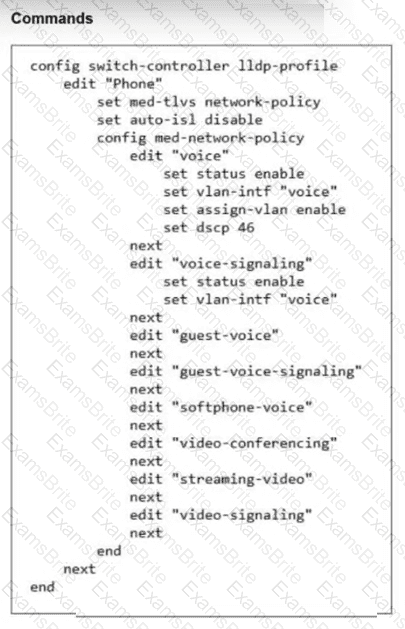
Refer to the exhibit.

The LLDP profile shown in the exhibit was configured to detect IP phones and automatically assign them to the appropriate VLAN. You apply this LLDP profile on a FortiSwitch port. Which configuration should you enable on the FortiSwitch profile to collect detailed information about all the connected IP phones? (Choose one answer)

Options:

A.  

Create a new LLDP profile to handle different LLDP-MED TLVs.

B.  

Configure a dedicated voice VLAN with DSCP 46.

C.  

Enable LLDP-MED inventory management TLVs.

D.  

Enable auto-isl.

Discussion 0
Questions 21

Which two rules used by MSTP are similar to rules used by other STP methods? (Choose two.)

Options:

A.  

MSTP uses port role election, similar to rapid STP on the instances.

B.  

MSTP uses alternate path and primary path, similar to regular STP.

C.  

MSTP uses root bridge selection, similar to rapid STP

D.  

MSTP uses timers for transitioning the ports, similar to regular STP.

Discussion 0
Questions 22

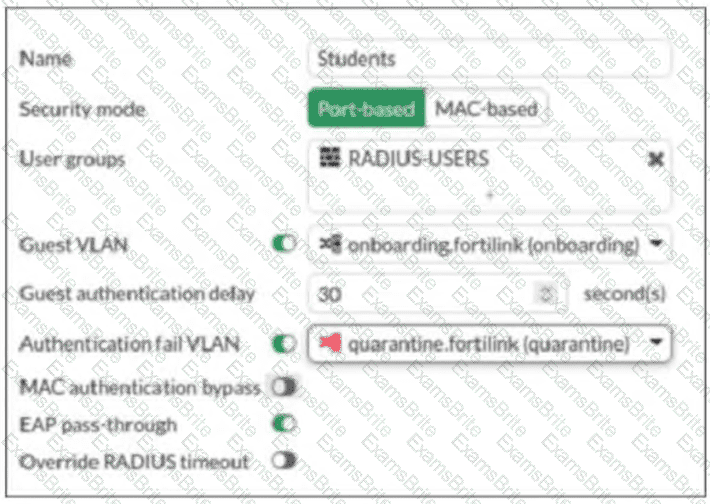
Refer to the exhibit.

The security port policy is configured as shown in the exhibit. Which behavior occurs if a device connected to the port that does not support 802.1X? (Choose one answer)

Options:

A.  

The device is blocked from accessing the network.

B.  

The device is placed into the onboarding VLAN.

C.  

The device is placed into the quarantine VLAN.

D.  

The device is assigned to the default management VLAN.

Discussion 0
Questions 23

Exhibit.

The exhibit shows the current status of the ports on the managed FortiSwitch.

Access-1.

Why would FortiGate display a serial number in the Native VLAN column associated with the port23 entry?

Options:

A.  

Port23 is a member of a trunk that uses the Access-1 FortiSwitch senal number as the name of the trunk.

B.  

Port23 is configured as the dedicated management interface.

C.  

A standalone switch with the showm serial number is connected on por123.

D.  

Ports connect to adjacent FortiSwitch devices will show their.serial number as the na-tive VLAN

Discussion 0
Questions 24

Refer to the exhibit.

You just connected three FortiSwitch devices:Core-1,Core-2, andAccess-1. Core-1 and Core-2 both connect to Access-1 for redundancy. All switches are managed by FortiGate, which uses port4 as the FortiLink interface. After you enable the uplink ports on Core-2, you notice that port3 on Access-1 enters the Discarding STP state. What is the most likely cause of this behavior? (Choose one answer)

Options:

A.  

Bridge Protocol Data Unit (BPDU) Guard is enabled, which shuts down the port after it receives BPDUs.

B.  

Access-1 is not authorized by FortiGate.

C.  

Core-2 has the lowest bridge priority.

D.  

FortiGate is not running Spanning Tree Protocol (STP) on the FortiLink interface.

Discussion 0
Questions 25

How does FortiSwitch perform actions on ingress and egress traffic using the access control list (ACL)?

Options:

A.  

Only high-end FortiSwitch models support ACL.

B.  

ACL can be used only at the prelookup stage in the traffic processing pipeline.

C.  

Classifiers enable matching traffic based only on the VLAN ID.

D.  

FortiSwitch checks ACL policies only from top to bottom.

Discussion 0
Questions 26

Which statement about the quarantine VLAN on FortiSwitch is true?

Options:

A.  

Quarantine VLAN has no DHCP server

B.  

Users who fail 802.1X authentication can be placed on the quarantine VLAN.

C.  

It is only used for quarantined devices if global setting is set to quarantine by VLAN.

D.  

FortiSwitch can block devices without configuring quarantine VLAN to be part of the allowed VLANs.

Discussion 0
Questions 27

What type of multimode transceiver can be used to split a 40G port?

Options:

A.  

QSFP+ transceiver

B.  

SFP transceiver

C.  

QSFP transceiver

D.  

SFP+ transceiver

Discussion 0
Questions 28

(Full question statement start from here)

When you change FortiSwitch management mode fromstandalonetomanaged, what happens to the existing standalone configuration? (Choose one answer)

Options:

A.  

FortiSwitch registers to FortiSwitch Cloud to save a copy before managing with FortiGate.

B.  

FortiSwitch merges the existing standalone configuration with the default FortiLink configuration.

C.  

FortiSwitch saves the standalone configuration and changes to the default FortiLink configuration.

D.  

FortiGate automatically saves the existing FortiSwitch configuration during the FortiLink management process.

Discussion 0
Questions 29

Refer to the exhibit.

A periodic heartbeat message sent from a managed FortiSwitch and corresponding acknowledgments from FortiGate is shown. What does this behavior indicate? (Choose one answer)

Options:

A.  

The FortiLink connection between FortiGate and FortiSwitch is healthy and active.

B.  

FortiGate is unable to establish a FortiLink session with FortiSwitch.

C.  

FortiSwitch is expecting an authorization from FortiGate.

D.  

FortiSwitch has not been authorized yet.

Discussion 0
Questions 30

Which two statements about the FortiLink authorization process are true? (Choose two.)

Options:

A.  

The administrator must manually pre-authorize FortiGate on FortiSwitch by adding the FortiGate serial number.

B.  

FortiSwitch requires a reboot to complete the authorization process.

C.  

A FortiLink frame is sent by FortiGate to FortiSwitch to complete the authorization.

D.  

FortiLink authorization sets the FortiSwitch management mode to FortiLink.

Discussion 0
Questions 31

Exhibit.

You need to manage three FortiSwitch devices using a FortiGate device. Two of the FortiSwitch devices initiated a reboot after the authorization process. However, the FortiSwitch device with the configuration shown in the exhibit. did not reboot All three devices completed FortiLink manage-ment authorization successfully.

Why did the FortiSwitch device shown in the exhibit not reboot to complete the authorization pro-cess?

The management mode was set to use FortiLink mode.

Options:

A.  

Switch auto-discovery is enabled.

B.  

The management mode was set to use FortiLink mode.

C.  

The FortiSwitch device is scheduled to reboot as part the authorization process

D.  

The system time is not in-sync and is using a non-default value

Discussion 0
Questions 32

You are managing FortiSwitch ports from a FortiGate device with multiple VDOMs. Which two methods can you use to assign FortiSwitch ports to VDOMs? (Choose two answers)

Options:

A.  

Assigning the port directly to a specific VDOM for dedicated physical isolation

B.  

Use FortiGate policies to control inter-VDOM traffic for FortiSwitch ports

C.  

Use interface role mapping to dynamically assign FortiSwitch ports to VDOMs based on Dynamic Host Configuration Protocol (DHCP) scope

D.  

Using a virtual port pool (VPP) to create virtualized ports that can be assigned to different VDOMs

Discussion 0
Questions 33

Refer to the exhibit.

The exhibit shows the current status of the ports on the managed FortiSwitch. Access-1.

Why would FortiGate display a serial number in the Native VLAN column associated with the port23 entry?

Options:

A.  

port23 is configured as the dedicated management interface.

B.  

Ports connected to adjacent FortiSwitch devices show their serial number as the native VLAN.

C.  

port23 is a member of a trunk that uses the Access-1 FortiSwitch serial number as the name of the trunk.

D.  

A standalone switch with the shown serial number is connected on port23.

Discussion 0
Questions 34

(Full question statement start from here)

How does enabling an IGMP snooping proxy on FortiSwitch help reduce the number of IGMP reports processed by the IGMP querier? (Choose one answer)

Options:

A.  

By converting IGMP reports into broadcast packets to reach all VLAN members

B.  

By converting IGMP traffic to unicast

C.  

By suppressing duplicate IGMP reports within the VLAN

D.  

By forwarding IGMP reports only when the first member joins and the last member leaves

Discussion 0