New Year Sale 65% Discount Offer - Ends in 0d 00h 00m 00s - Coupon code: exams65

ExamsBrite Dumps

Fortinet NSE 7 - Enterprise Firewall 7.6 Administrator Question and Answers

Fortinet NSE 7 - Enterprise Firewall 7.6 Administrator

Last Update Jan 14, 2026
Total Questions : 65

We are offering FREE FCSS_EFW_AD-7.6 Fortinet exam questions. All you do is to just go and sign up. Give your details, prepare FCSS_EFW_AD-7.6 free exam questions and then go for complete pool of Fortinet NSE 7 - Enterprise Firewall 7.6 Administrator test questions that will help you more.


FCSS_EFW_AD-7.6 pdf

FCSS_EFW_AD-7.6 PDF

$36.75  $104.99
FCSS_EFW_AD-7.6 Engine

FCSS_EFW_AD-7.6 Testing Engine

$43.75  $124.99
FCSS_EFW_AD-7.6 PDF + Engine

FCSS_EFW_AD-7.6 PDF + Testing Engine

$57.75  $164.99
Questions 1

An administrator is designing an ADVPN network for a large enterprise with spokes that have varying numbers of internet links. They want to avoid a high number of routes and peer connections at the hub.

Which method should be used to simplify routing and peer management?

Options:

A.  

Deploy a full-mesh VPN topology to eliminate hub dependency.

B.  

Implement static routing over IPsec interfaces for each spoke.

C.  

Use a dynamic routing protocol using loopback interfaces to streamline peers and routes.

D.  

Establish a traditional hub-and-spoke VPN topology with policy routes.

Discussion 0
Questions 2

Why does the ISDB block layers 3 and 4 of the OSI model when applying content filtering? (Choose two.)

Options:

A.  

FortiGate has a predefined list of all IPs and ports for specific applications downloaded from FortiGuard.

B.  

The ISDB blocks the IP addresses and ports of an application predefined by FortiGuard.

C.  

The ISDB works in proxy mode, allowing the analysis of packets in layers 3 and 4 of the OSI model.

D.  

The ISDB limits access by URL and domain.

Discussion 0
Questions 3

Refer to the exhibit.

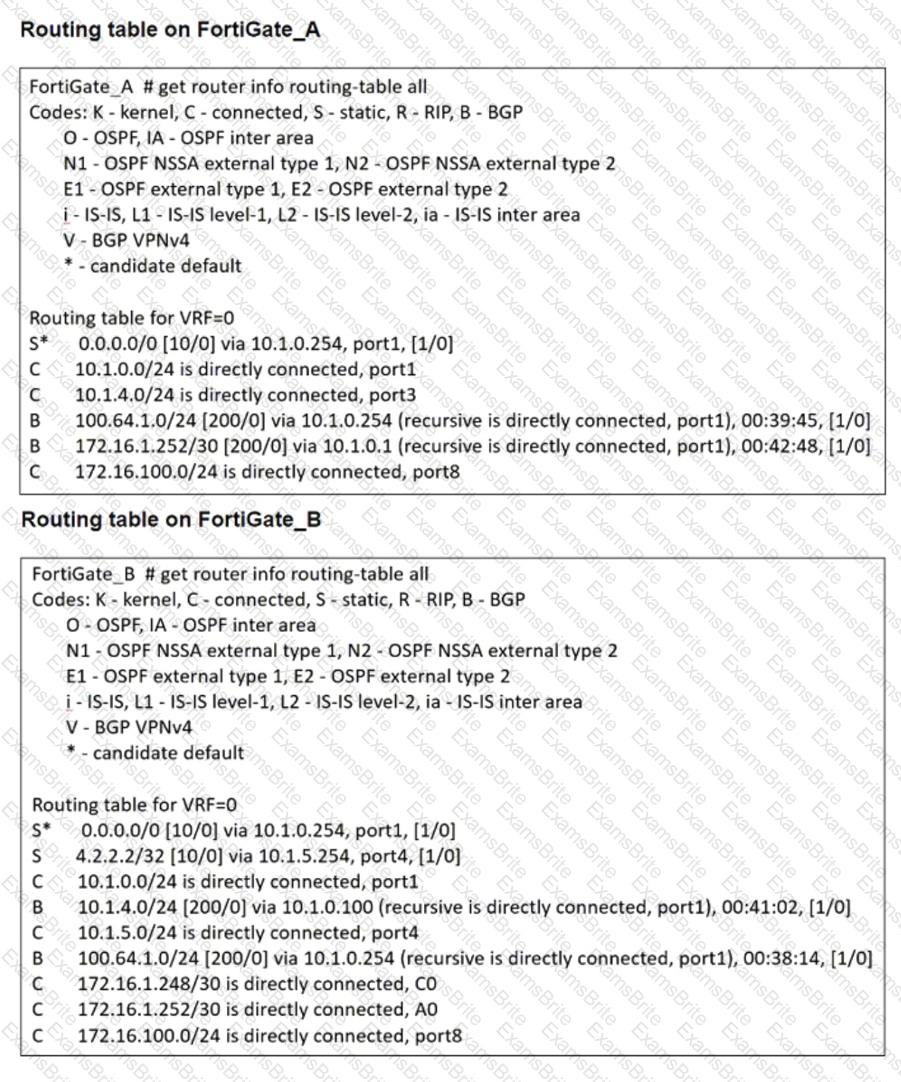
The routing tables of FortiGate_A and FortiGate_B are shown. FortiGate_A and FortiGate_B are in the same autonomous system.

The administrator wants to dynamically add only route 172.16.1.248/30 on FortiGate_A.

What must the administrator configure?

Options:

A.  

The prefix 172.16.1.248/30 in the BGP Networks section on FortiGate_B

B.  

A BGP route map out for 172.16.1.248/30 on FortiGate_B

C.  

Enable Redistribute Connected in the BGP section on FortiGate_B.

D.  

A BGP route map in for 172.16.1.248/30 on FortiGate_A

Discussion 0
Questions 4

Refer to the exhibit.

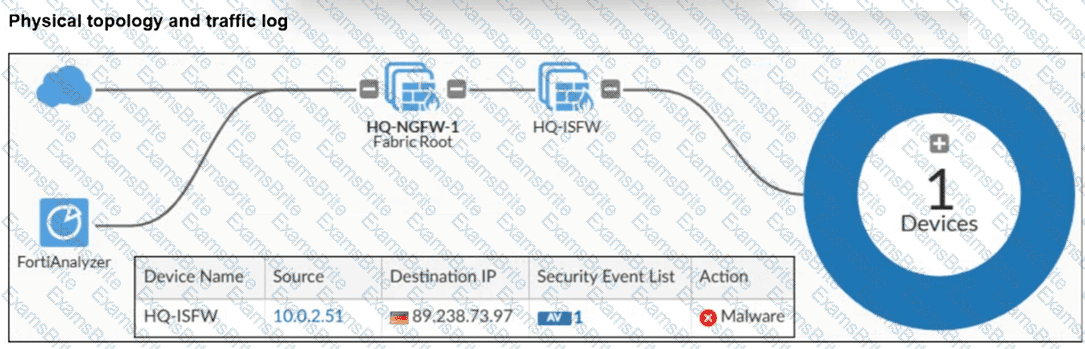
A physical topology along with a traffic log is shown. You are using FortiAnalyzer to monitor traffic from the device with IP address 10.0.2.51, which is located behind the FortiGate internal segmentation firewall (ISFW) device. Unified threat management (UTM) is not enabled in the firewall policy on the HQ-ISFW device, and you are surprised to see a log with the action Malware, as shown in the exhibit. What are two reasons why FortiAnalyzer would display this log? (Choose two answers)

Options:

A.  

HQ-ISFW is not connected to FortiAnalyzer and traffic must go through HQ-NGFW-1.

B.  

UTM is enabled in the firewall policy in HQ-NGFW-1.

C.  

HQ-ISFW is in a Security Fabric environment.

D.  

Security rating is enabled in HQ-ISFW.

Discussion 0
Questions 5

Refer to the exhibit, which shows a partial troubleshooting command output.
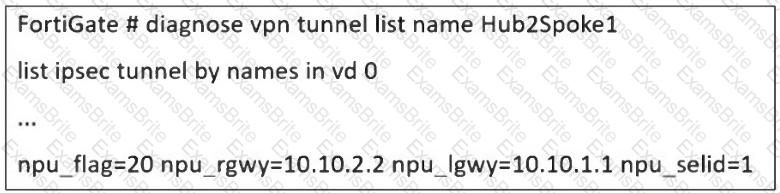
An administrator is extensively using IPsec on FortiGate. Many tunnels show information similar to the output shown in the exhibit.

What can the administrator conclude?

Options:

A.  

IPsec SAs cannot be offloaded.

B.  

The two IPsec SAs, inbound and outbound, are copied to the NPU.

C.  

Only the outbound IPsec SA is copied to the NPU.

D.  

Only the inbound IPsec SA is copied to the NPU.

Discussion 0
Questions 6

Refer to the exhibits.

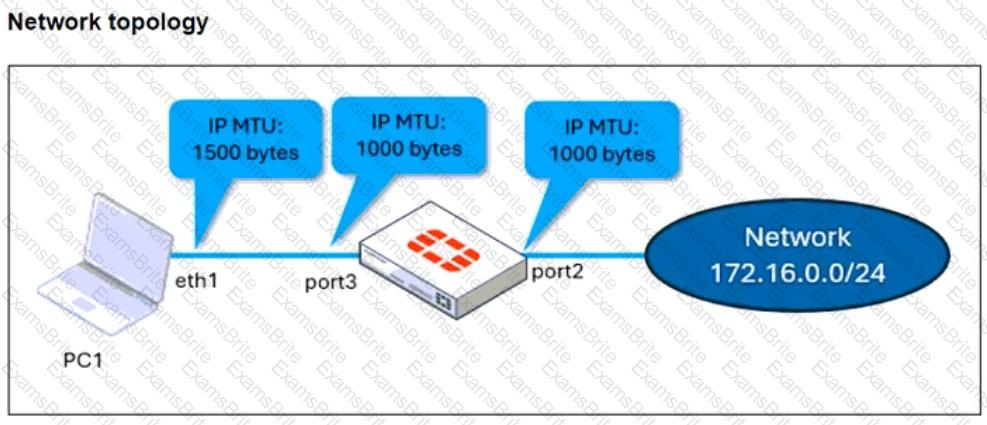
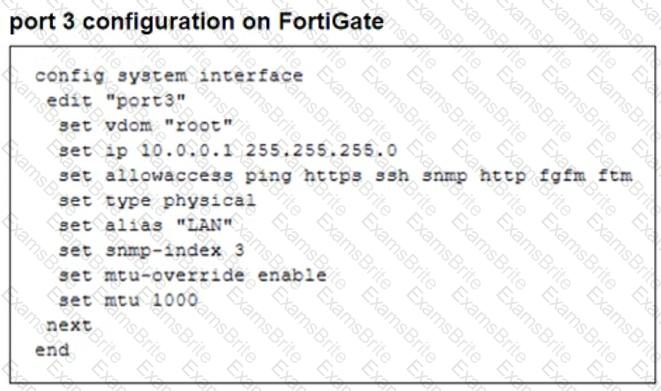
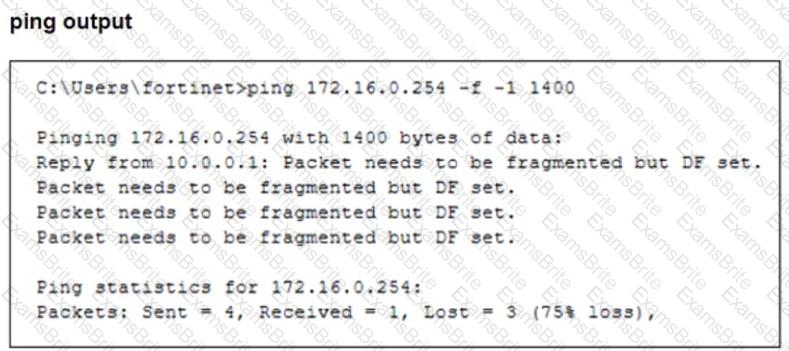
The configuration of a user's Windows PC, which has a default MTU of 1500 bytes, along with FortiGate interfaces set to an MTU of 1000 bytes, and the results of PC1 pinging server 172.16.0.254 are shown.

Why is the user in Windows PC1 unable to ping server 172.16.0.254 and is seeing the message: Packet needs to be fragmented but DF set?

Options:

A.  

Option ip.flags.mf must be set to enable on FortiGate. The user has to adjust the ping MTU to 1000 to succeed.

B.  

Fragmented packets must be encrypted. To connect any application successfully, the user must install the Fortinet_CA certificate in the Microsoft Management Console.

C.  

FortiGate honors the do not fragment bit and the packets are dropped. The user has to adjust the ping MTU to 972 to succeed.

D.  

The user must trigger different traffic because path MTU discovery techniques do not recognize ICMP payloads.

Discussion 0
Questions 7

During the maintenance window, an administrator must sniff all the traffic going through a specific firewall policy, which is handled by NP6 interfaces. The output of the sniffer trace provides just a few packets.

Why is the output of sniffer trace limited?

Options:

A.  

The traffic corresponding to the firewall policy is encrypted.

B.  

auto-asic-off load is set to enable in the firewall policy,

C.  

inspection-mode is set to proxy in the firewall policy.

D.  

The option npudbg is not added in the diagnose sniff packet command.

Discussion 0
Questions 8

Refer to the exhibit, which shows a partial enterprise network.
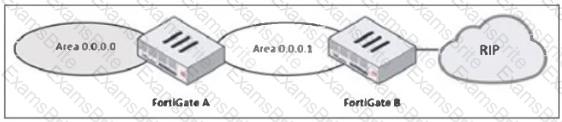
An administrator would like the area 0.0.0.0 to detect the external network.

What must the administrator configure?

Options:

A.  

Enable RIP redistribution on FortiGate B.

B.  

Configure a distribute-route-map-in on FortiGate

B.  

C.  

Configure a virtual link between FortiGate A and B.

D.  

Set the area 0.0.0.l type to stub on FortiGate A and B.

Discussion 0
Questions 9

Refer to the exhibit, which shows a command output.
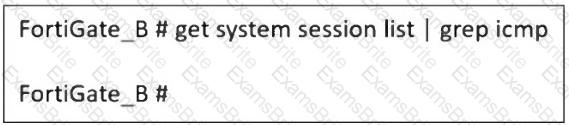
FortiGate_A and FortiGate_B are members of an FGSP cluster in an enterprise network.

While testing the cluster using the ping command, the administrator monitors packet loss and found that the session output on FortiGate_B is as shown in the exhibit.

What could be the cause of this output on FortiGate_B?

Options:

A.  

The session synchronization is encrypted.

B.  

session-pickup-connectionless is set to disable on FortiGate_

B.  

C.  

FortiGate_B is configured in passive mode.

D.  

FortiGate_A and FortiGate_B have the same standalone-group-id value.

Discussion 0
Questions 10

A company that acquired multiple branches across different countries needs to install new FortiGate devices on each of those branches. However, the IT staff lacks sufficient knowledge to implement the initial configuration on the FortiGate devices.

Which three approaches can the company take to successfully deploy advanced initial configurations on remote branches? (Choose three.)

Options:

A.  

Use metadata variables to dynamically assign values according to each FortiGate device.

B.  

Use provisioning templates and install configuration settings at the device layer.

C.  

Use the Global ADOM to deploy global object configurations to each FortiGate device.

D.  

Apply Jinja in the FortiManager scripts for large-scale and advanced deployments.

E.  

Add FortiGate devices on FortiManager as model devices, and use ZTP or LTP to connect to FortiGate devices.

Discussion 0
Questions 11

Refer to the exhibit, which shows an OSPF network.
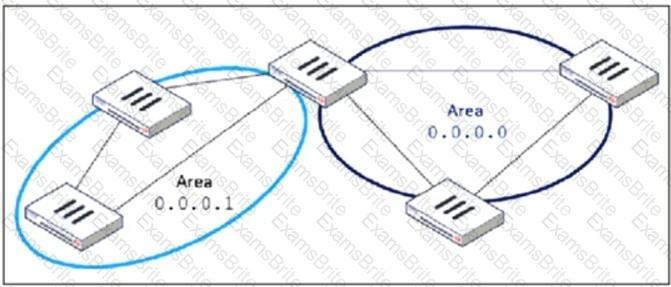
Which configuration must the administrator apply to optimize the OSPF database?

Options:

A.  

Set a route map in the AS boundary FortiGate.

B.  

Set the area 0.0.0.1 to the type STUB in the area border FortiGate.

C.  

Set an access list in the AS boundary FortiGate.

D.  

Set the area 0.0.0.1 to the type NSSA in the area border FortiGate.

Discussion 0
Questions 12

An administrator wants to scale the IBGP sessions and optimize the routing table in an IBGP network.

Which parameter should the administrator configure?

Options:

A.  

network-import-check

B.  

ibgp-enforce-multihop

C.  

neighbor-group

D.  

route-reflector-client

Discussion 0
Questions 13

Refer to the exhibit, which contains a partial VPN configuration.
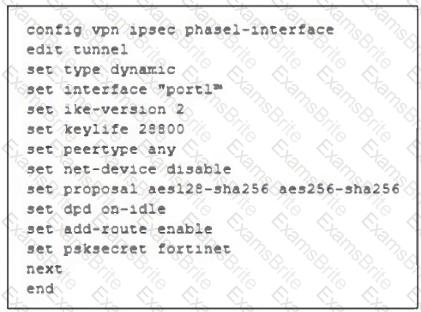
What can you conclude from this VPN IPsec phase 1 configuration?

Options:

A.  

This configuration is the best for networks with regular traffic intervals, providing a balance between connectivity assurance and resource utilization.

B.  

Peer IDs are unencrypted and exposed, creating a security risk.

C.  

FortiGate will not add a route to its routing or forwarding information base when the dynamic tunnel is negotiated.

D.  

A separate interface is created for each dial-up tunnel, which can be slower and more resource intensive, especially in large networks.

Discussion 0
Questions 14

Refer to the exhibit, which shows the VDOM section of a FortiGate device.
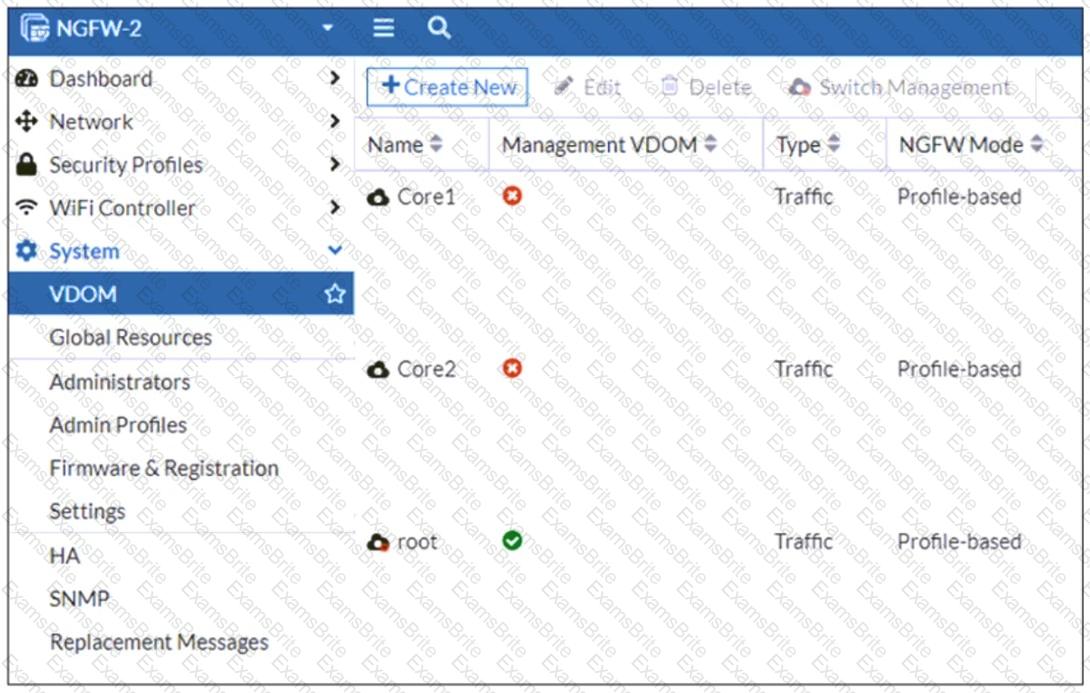
An administrator discovers that webfilter stopped working in Core1 and Core2 after a maintenance window.

Which two reasons could explain why webfilter stopped working? (Choose two.)

Options:

A.  

The root VDOM does not have access to FortiManager in a closed network.

B.  

The root VDOM does not have a VDOM link to connect with the Corel and Core2 VDOMs.

C.  

The Core1 and Core2 VDOMs must also be enabled as Management VDOMs to receive FortiGuard updates

D.  

The root VDOM does not have access to any valid public FDN.

Discussion 0
Questions 15

An administrator is setting up an ADVPN configuration and wants to ensure that peer IDs are not exposed during VPN establishment.

Which protocol can the administrator use to enhance security?

Options:

A.  

Use IKEv2, which encrypts peer IDs and prevents exposure.

B.  

Opt for SSL VPN web mode because it does not use peer IDs at all.

C.  

Choose IKEv1 aggressive mode because it simplifies peer identification.

D.  

Stick with IKEv1 main mode because it offers better performance.

Discussion 0
Questions 16

An administrator is checking an enterprise network and sees a suspicious packet with the MAC address e0:23:ff:fc:00:86.

What two conclusions can the administrator draw? (Choose two.)

Options:

A.  

The suspicious packet is related to a cluster that has VDOMs enabled.

B.  

The network includes FortiGate devices configured with the FGSP protocol.

C.  

The suspicious packet is related to a cluster with a group-id value lower than 255.

D.  

The suspicious packet corresponds to port 7 on a FortiGate device.

Discussion 0
Questions 17

Refer to the exhibit, which contains the partial output of an OSPF command.
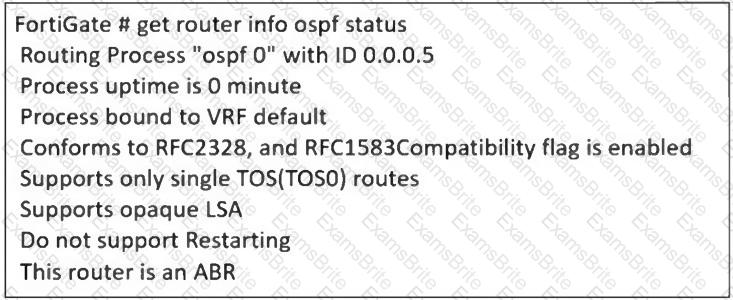
An administrator is checking the OSPF status of a FortiGate device and receives the output shown in the exhibit.

What two conclusions can the administrator draw? (Choose two.)

Options:

A.  

The FortiGate device is a backup designated router

B.  

The FortiGate device is connected to multiple areas

C.  

The FortiGate device injects external routing information

D.  

The FortiGate device has OSPF ECMP enabled

Discussion 0
Questions 18

Refer to the exhibit, which shows a LAN interface connected from FortiGate to two FortiSwitch devices.
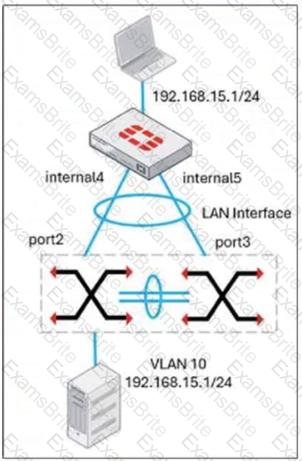
What two conclusions can you draw from the corresponding LAN interface? (Choose two.)

Options:

A.  

You must enable STP or RSTP on FortiGate and FortiSwitch to avoid layer 2 loopbacks.

B.  

The LAN interface must use a 802.3ad type interface.

C.  

This connection is using a FortiLInk to manage VLANs on FortiGate.

D.  

FortiGate is using an SD-WAN-type interface to connect to a FortiSwitch device with MCLAG.

Discussion 0
Questions 19

Refer to the exhibit.

A pre-run CLI template that is used in zero-touch provisioning (ZTP) and low-touch provisioning (LTP) with FortiManager is shown.
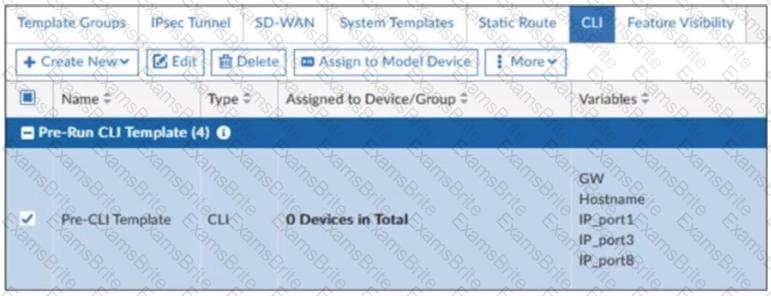
The template is not assigned even though the configuration has already been installed on FortiGate.

What is true about this scenario?

Options:

A.  

The administrator did not assign the template correctly when adding the model device because pre-CLI templates remain permanently assigned to the firewall

B.  

Pre-run CLI templates are automatically unassigned after their initial installation

C.  

Pre-run CLI templates for ZTP and LTP must be unassigned manually after the first installation to avoid conflicting error objects when importing a policy package

D.  

The administrator must use post-run CLI templates that are designed for ZTP and LTP

Discussion 0