Spring Sale 65% Discount Offer - Ends in 0d 00h 00m 00s - Coupon code: exams65

ExamsBrite Dumps

dbt Analytics Engineering Certification Exam Question and Answers

dbt Analytics Engineering Certification Exam

Last Update Feb 28, 2026
Total Questions : 65

We are offering FREE dbt-Analytics-Engineering dbt Labs exam questions. All you do is to just go and sign up. Give your details, prepare dbt-Analytics-Engineering free exam questions and then go for complete pool of dbt Analytics Engineering Certification Exam test questions that will help you more.


dbt-Analytics-Engineering pdf

dbt-Analytics-Engineering PDF

$36.75  $104.99
dbt-Analytics-Engineering Engine

dbt-Analytics-Engineering Testing Engine

$43.75  $124.99
dbt-Analytics-Engineering PDF + Engine

dbt-Analytics-Engineering PDF + Testing Engine

$57.75  $164.99
Questions 1

Which two configurations can be applied to a dbt test?

Choose 2 options.

Options:

A.  

on_schema_change

B.  

tags

C.  

enabled

D.  

materialized

E.  

persist_docs

Discussion 0
Questions 2

Your model has a contract on it.

When renaming a field, you get this error:

This model has an enforced contract that failed.

Please ensure the name, data_type, and number of columns in your contract match

the columns in your model's definition.

| column_name | definition_type | contract_type | mismatch_reason |

|-------------|------------------|----------------|-----------------------|

| ORDER_ID | TEXT | TEXT | missing in definition |

| ORDER_KEY | TEXT | | missing in contract |

Which two will fix the error? Choose 2 options.

Options:

A.  

Remove order_id from the contract.

B.  

Remove order_key from the contract.

C.  

Remove order_id from the model SQL.

D.  

Add order_key to the contract.

E.  

Add order_key to the model SQL.

Discussion 0
Questions 3

In development, you want to avoid having to re-run all upstream models when refactoring part of your project.

What could you do to save time rebuilding models without spending warehouse credits in your next command?

Options:

A.  

Replace your {{ ref() }} functions with hard-coded references.

B.  

Refer to a manifest and utilize the --defer and --state flags.

C.  

Clone your upstream models from the production schema to the development schema.

D.  

Leverage artifacts from a prior invocation by passing only the --state flag.

Discussion 0
Questions 4

Which two are true for a dbt clone command?

Choose 2 options.

Options:

A.  

It requires the reference to a manifest from a previous dbt invocation.

B.  

It allows comparison between manifests of source and target dbt runs, but does not create any objects itself.

C.  

It allows testing your code changes on downstream dependencies outside of dbt (such as a BI tool).

D.  

It can be used to replicate data across different data warehouses.

E.  

It creates new versions of your dbt models suffixed with _v#.

Discussion 0
Questions 5

Which two are true about version controlling code with Git?

Choose 2 options.

Options:

A.  

Git automatically creates versions of files with suffixes.

B.  

All the code changes along the lifecycle of a project are tracked.

C.  

When bugs are raised, email notifications are automatically sent by Git to repository users.

D.  

Git prevents any sensitive fields from being saved in code.

E.  

Code can be reverted to a previous state.

Discussion 0
Questions 6

You have just executed dbt run on this model:

select * from {{ source("{{ env_var('input') }}", 'table_name') }}

and received this error:

Compilation Error in model my_model

expected token ':', got '}'

line 14

{{ source({{ env_var('input') }}, 'table_name') }}

How can you debug this?

Options:

A.  

Incorporate a log function into your macro.

B.  

Check your SQL to see if you quoted something incorrectly.

C.  

Check your Jinja and see if you nested your curly brackets.

D.  

Take a look at the compiled code.

Discussion 0
Questions 7

Examine this query:

select *

from {{ ref('stg_orders') }}

where amount_usd < 0

You want to make this a generic test across multiple models.

Which set of two standard arguments should be used to replace {{ ref('stg_orders') }} and amount_usd? Choose 1 option.

Options:

A.  

source and column

B.  

model and column_name

C.  

model_name and column_name

D.  

model and field

Discussion 0
Questions 8

Is this materialization supported by Python models in dbt?

Ephemeral

Options:

A.  

Yes

B.  

No

Discussion 0
Questions 9

Which of the following is true about restricting the usage of models in dbt?

Choose 1 option.

Options:

A.  

Restrictions are set by defining the models and Git user groups approved for usage.

B.  

You must map your data platform roles to groups by specifying the role name in the configurations.

C.  

Model groups can limit references by other models which aren’t in the same group.

D.  

Data platform user emails can be used to determine who can reference a model.

Discussion 0
Questions 10

Which two mechanisms allow dbt to write DRY code by reusing logic, preventing writing the same code multiple times?

Choose 2 options.

Options:

A.  

Copy/pasting folders containing multiple models

B.  

Writing and using dbt macros

C.  

Creating singular tests

D.  

Using dbt packages

E.  

Changing a model materialization from view to ephemeral

Discussion 0
Questions 11

Examine model stg_customers_sales that exists in the main branch:

select

id as customer_id,

name as customer_name

from {{ source('my_data','my_source') }}

A developer creates a branch feature_a from main and modifies the model as:

select

id as customer_id,

name as customer_name,

country as customer_country

from {{ source('my_data','my_source') }}

A second developer also creates a branch feature_b from main and modifies the model as:

select

id as customer_id,

name as customer_name,

address as customer_address

from {{ source('my_data','my_source') }}

The first developer creates a PR and merges feature_a into main.

Then the second developer creates a PR and attempts to merge feature_b into main.

How will git combine the code from feature_b and the code from main, which now contains the changes from feature_a as well?

Statement:

"As feature_a is already approved and merged to main, the code for the model stg_customers_sales will stay as-is and the changes from feature_b won’t be added."

Options:

A.  

Yes

B.  

No

Discussion 0
Questions 12

Options:

Discussion 0
Questions 13

Options:

Discussion 0
Questions 14

Consider this DAG:

app_data.detail_categories -> stg_detail_categories -> skills_with_details

app_data.details -> stg_details -> lessons_with_details

What will support making this DAG more modular? Choose 1 option.

Options:

A.  

Union stg_detail_categories and stg_details in the staging layer to reduce the need for downstream joins.

B.  

Join stg_detail_categories and stg_details in the staging layer to reduce the need for downstream joins.

C.  

Consolidate the two staging models into one model and then use this downstream for both skills_with_details and curriculum_with_details.

D.  

Combine lessons_with_details and skills_with_details into one wide table called curriculum_with_details.

E.  

Examine the SQL of lessons_with_details and skills_with_details to see if there is a candidate for an intermediate model.

Discussion 0
Questions 15

32. You are creating a fct_tasks model with this CTE:

with tasks as (

select * from {{ ref('stg_tasks') }}

)

You receive this compilation error in dbt:

Compilation Error in model fct_tasks (models/marts/fct_tasks.sql)

Model 'model.dbt_project.fct_tasks' (models/marts/fct_tasks.sql) depends on a node named 'stg_tasks' which was not found

Which is correct? Choose 1 option.

Options:

Options:

A.  

stg_tasks is configured as ephemeral.

B.  

There is no dbt model called stg_tasks.

C.  

There is no stg_tasks in the data warehouse.

D.  

A stg_tasks has not been defined in schema.yml.

Discussion 0
Questions 16

You run the command:

dbt test --select 'test_type:singular'

What will the command run?

Options shown:

Options:

A.  

furniture_customers_test

B.  

furniture_customers_test

macro_stg_tpch_orders_assert_pos_price

macro_stg_tpch_suppliers_assert_pos_acct_bal

stg_tpch_orders_assert_positive_price

C.  

macro_stg_tpch_orders_assert_pos_price

macro_stg_tpch_suppliers_assert_pos_acct_bal

stg_tpch_orders_assert_positive_price

D.  

furniture_customers_test

stg_tpch_orders_assert_positive_price

Choose 1 option.

Discussion 0
Questions 17

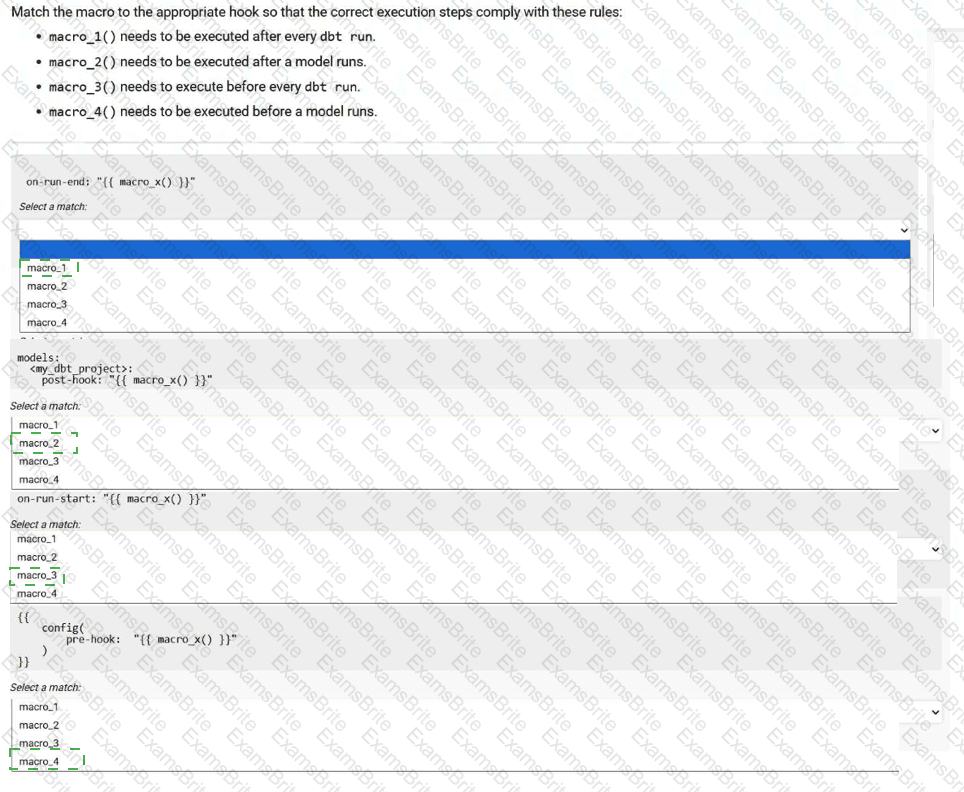
Match the macro to the appropriate hook so that the correct execution steps comply with these rules:

    macro_1() needs to be executed after every dbt run.

    macro_2() needs to be executed after a model runs.

    macro_3() needs to execute before every dbt run.

    macro_4() needs to be executed before a model runs.
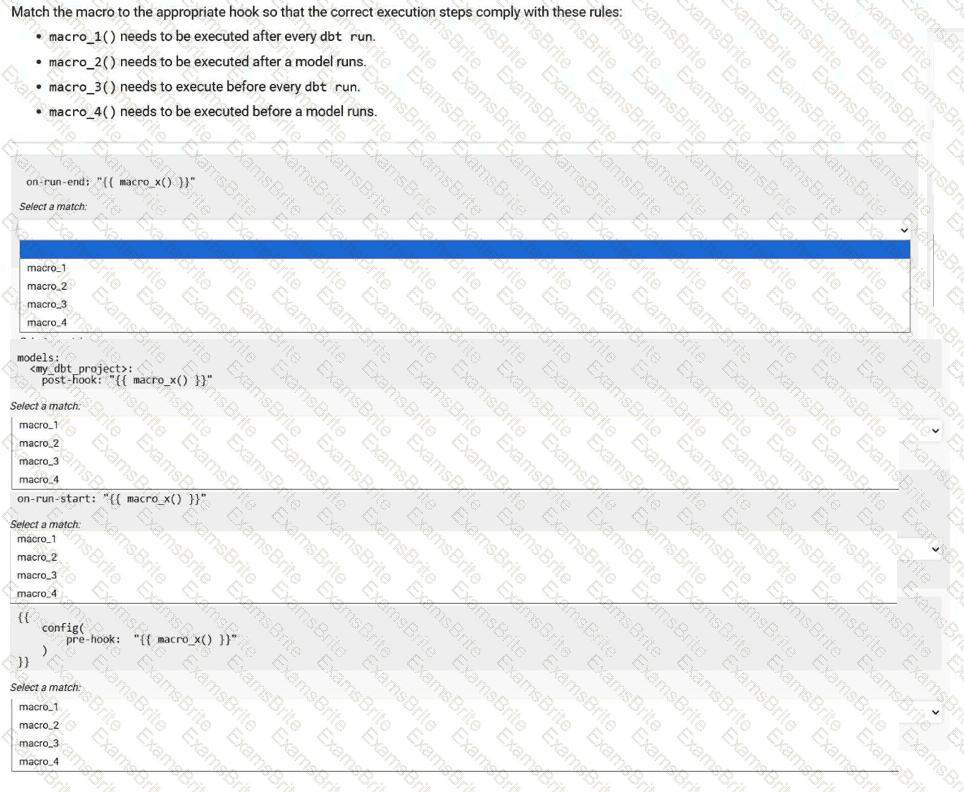
Options:

Discussion 0
Questions 18

Which two dbt commands work with dbt retry?

Choose 2 options.

Options:

A.  

run-operation

B.  

parse

C.  

debug

D.  

deps

E.  

snapshot

Discussion 0
Questions 19

You want to configure dbt to prevent tests from running if one or more of their parent models is unselected.

Which test command should you execute?

Choose 1 option.

Options:

A.  

dbt test --select "orders" --indirect-selection=empty

B.  

dbt test --select "orders"

C.  

dbt test --select "orders" --indirect-selection=buildable

D.  

dbt test --select "orders" --indirect-selection=cautious

Discussion 0