Databricks Certified Generative AI Engineer Associate
Last Update Sep 20, 2026
Total Questions : 90
We are offering FREE Databricks-Generative-AI-Engineer-Associate Databricks exam questions. All you do is to just go and sign up. Give your details, prepare Databricks-Generative-AI-Engineer-Associate free exam questions and then go for complete pool of Databricks Certified Generative AI Engineer Associate test questions that will help you more.



A Generative Al Engineer would like an LLM to generate formatted JSON from emails. This will require parsing and extracting the following information: order ID, date, and sender email. Here’s a sample email:
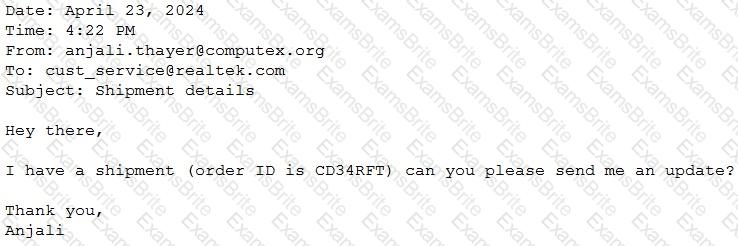
They will need to write a prompt that will extract the relevant information in JSON format with the highest level of output accuracy.
Which prompt will do that?
A Generative Al Engineer is ready to deploy an LLM application written using Foundation Model APIs. They want to follow security best practices for production scenarios
Which authentication method should they choose?
A Generative Al Engineer is building a production-ready LLM system which replies directly to customers. The solution makes use of the Foundation Model API via provisioned throughput. They are concerned that the LLM could potentially respond in a toxic or otherwise unsafe way. They also wish to perform this with the least amount of effort.
Which approach will do this?
A Generative AI Engineer has deployed a RAG application to production. Its Vector Search index is built from a Delta table that receives incremental updates every hour from an upstream ETL pipeline. The team wants the index to automatically reflect source-table changes without manual re-indexing and without changing the endpoint used by downstream applications.
Which approach should the engineer use?
A Generative AI Engineer is deploying a conversational agent that provides financial-analysis insights to internal analysts at a company. The company has standardized on Microsoft 365 for all internal communications and collaboration. The analysts are distributed across multiple time zones and primarily work within Microsoft Teams channels, where they already discuss financial data and share reports. The agent needs to integrate with the company’s existing Azure Active Directory for authentication and must respect the company’s data-governance policies. Users should be able to interact with the agent within their existing workflow without switching applications.
Which interface should the engineer implement for this agent deployment?
A Generative AI Engineer is developing an LLM application that users can use to generate personalized birthday poems based on their names.
Which technique would be most effective in safeguarding the application, given the potential for malicious user inputs?
A Generative AI Engineer is managing prompt templates using MLflow v3.x for a document summarization pipeline. A regulatory audit requires the team to demonstrate exactly which prompt version was used to generate outputs on a specific date three months ago, including the exact prompt text and any variables used at that time.
Which combination of MLflow v3.x capabilities allows the engineer to satisfy this audit requirement?
A Generative AI Engineer is designing a RAG application for answering user questions on technical regulations as they learn a new sport.
What are the steps needed to build this RAG application and deploy it?
A Generative AI Engineer is building a RAG application that will rely on context retrieved from source documents that are currently in PDF format. These PDFs can contain both text and images. They want to develop a solution using the least amount of lines of code.
Which Python package should be used to extract the text from the source documents?
A team wants to serve a code generation model as an assistant for their software developers. It should support multiple programming languages. Quality is the primary objective.
Which of the Databricks Foundation Model APIs, or models available in the Marketplace, would be the best fit?
A Generative Al Engineer is building an LLM-based application that has an
important transcription (speech-to-text) task. Speed is essential for the success of the application
Which open Generative Al models should be used?
A small and cost-conscious startup in the cancer research field wants to build a RAG application using Foundation Model APIs.
Which strategy would allow the startup to build a good-quality RAG application while being cost-conscious and able to cater to customer needs?
Databricks offers a number of built-in AI judges that provide metrics and rationale for different types of quality issues a Generative AI application may have.
Which of the following pairs of judges both require a ground-truth label in the evaluation dataset field expected_response to execute?
A Generative Al Engineer is deciding between using LSH (Locality Sensitive Hashing) and HNSW (Hierarchical Navigable Small World) for indexing their vector database Their top priority is semantic accuracy
Which approach should the Generative Al Engineer use to evaluate these two techniques?
A Generative AI Engineer is creating an agent-based LLM system for their favorite monster truck team. The system can answer text based questions about the monster truck team, lookup event dates via an API call, or query tables on the team’s latest standings.
How could the Generative AI Engineer best design these capabilities into their system?
A Generative Al Engineer has built an LLM-based system that will automatically translate user text between two languages. They now want to benchmark multiple LLM ' s on this task and pick the best one. They have an evaluation set with known high quality translation examples. They want to evaluate each LLM using the evaluation set with a performant metric.
Which metric should they choose for this evaluation?
A Generative Al Engineer has already trained an LLM on Databricks and it is now ready to be deployed.
Which of the following steps correctly outlines the easiest process for deploying a model on Databricks?
An AI developer team wants to fine-tune an open-weight model to have exceptional performance on a code generation use case. They are trying to choose the best model to start with. They want to minimize model hosting costs and are using Hugging Face model cards and spaces to explore models. Which TWO model attributes and metrics should the team focus on to make their selection?
A Generative AI Engineer is building a Databricks-hosted assistant that must (1) query Unity Catalog tables with row and column permissions enforced, and (2) avoid managing any external infrastructure. The team wants the LLM to use governed data access through tools exposed via MCP.
Which MCP server choice meets these constraints?
A Generative AI Engineer needs to allocate costs for an agent deployed via Agent Framework behind AI Gateway. The finance team requires daily reporting by workspace and endpoint, including token usage and request counts. The engineer wants to query this data with SQL and join it to an internal cost-center mapping table.
Which table type best serves their needs?
A Generative Al Engineer is developing a RAG system for their company to perform internal document Q & A for structured HR policies, but the answers returned are frequently incomplete and unstructured It seems that the retriever is not returning all relevant context The Generative Al Engineer has experimented with different embedding and response generating LLMs but that did not improve results.
Which TWO options could be used to improve the response quality?
Choose 2 answers
A Generative AI Engineer has been reviewing issues with their company ' s LLM-based question-answering assistant and has determined that a technique called prompt chaining could help alleviate some performance concerns. However, to suggest this to their team, they have to clearly explain how it works and how it can benefit their question-answering assistant. Which explanation do they communicate to the team?
What is an effective method to preprocess prompts using custom code before sending them to an LLM?
A Generative Al Engineer is tasked with developing an application that is based on an open source large language model (LLM). They need a foundation LLM with a large context window.
Which model fits this need?
A Generative AI Engineer is building a compound AI system for an organization. The goal is to automate the processing of incoming customer event reports against a coding system and corporate-guidelines documentation. The system must handle three distinct user-request types: answering questions from guidelines documents, extracting specific event codes from reviewers’ notes, and routing ambiguous requests to the appropriate specialized handler. All three capabilities must operate under a single entry point that interprets user intent and delegates accordingly.
Which Agent Brick should serve as the top-level orchestrator in this architecture?
A Generative Al Engineer needs to design an LLM pipeline to conduct multi-stage reasoning that leverages external tools. To be effective at this, the LLM will need to plan and adapt actions while performing complex reasoning tasks.
Which approach will do this?
A Generative AI Engineer is deploying a customer-facing, fine-tuned LLM on their public website. Given the large investment the company put into fine-tuning this model, and the proprietary nature of the tuning data, they are concerned about model inversion attacks. Which of the following Databricks AI Security Framework (DASF) risk mitigation strategies are most relevant to this use case?

TESTED 21 Sep 2026