Applied Financial Planning Certification Exam 1 (AFP)
Last Update Sep 20, 2026
Total Questions : 117
We are offering FREE AFP-Exam-1 CSI exam questions. All you do is to just go and sign up. Give your details, prepare AFP-Exam-1 free exam questions and then go for complete pool of Applied Financial Planning Certification Exam 1 (AFP) test questions that will help you more.



Edward is risk averse and has limited investment knowledge. He will only purchase 100% guaranteed products insured by the CDIC. Edward is meeting with his financial planner, Marissa, for the third time this year about rates, and starts the meeting by criticizing her employer for paying such low returns on GICs. Edward says he is considering taking his business elsewhere. How should Marissa respond to Edward’s comments?
Which statement best distinguishes a defined benefit pension plan from a defined contribution pension plan?
What information is least important for Harry as a financial planner in his assessment for insurance coverage for his client with respect to estate planning purposes?
What financial information would Deandra a financial planner, analyze in order to increase her client’s net worth by decreasing expenses?
A client, age 60, is in a low tax bracket today and expects a larger taxable pension after age 65. She has TFSA and RRSP room. Which contribution priority is generally more appropriate?
Henry, age 48, has been working for Bac Inc, which is a federally regulated corporation, for over eight years. He is looking to retire at age 50 and has decided to take the commuted value of his pension: $450,000, electing to transfer the eligible remainder to his RRSP (Income Tax Act maximum pension benefit transfer value of $210,000). Henry estimates he would need $1,800 (pre-tax every month) from his registered investments to meet his retirement income goal and is looking to maximize his RRSP contribution room. Assume no inflation, an average tax rate of 15%, an unused RRSP contribution room of $90,000, and a life expectancy to age 90. What would be the required rate of return to meet Henry's goals?
Leena and Harry are married and hold RRSPs with a value exceeding $500,000. They are concerned about their final tax liability and want to cover the taxes after they have both died. What would their financial planner recommend them to implement in order for the couple to achieve the objective?
Gina plans to take a one-year leave of absence from her employer without pay. Gina has a TFSA invested in equity mutual funds which is currently below book value, an RRSP invested in cash, a Nova Scotia LIRA invested in GICs, and a line of credit. Assuming all have sufficient funds, which plan should Gina access to ensure she meets her goal of budget effectiveness during this time?
A client’s portfolio target is 50% equities and 50% fixed income. After a strong equity market, the portfolio is now 68% equities. The client’s circumstances and objectives have not changed. What should the planner recommend?
If a deceased person was entitled to rights or things at death, what strategy should the estate representative use to enhance the net estate value after tax?
At the first meeting, a financial planner explains her services, compensation, responsibilities, limitations, confidentiality practices, and what information the client must provide. Which document should normally capture these matters?
Dianna is visiting with Karen, her Financial Planner, and is excited to report that she has just bought her dream home. She has also let Karen know she Is meeting with an insurance representative to purchase a whole life insurance to cover her 20-year mortgage. Why might Karen suggest Dianna consider term life insurance instead?
James is visiting Gurjeet, his financial planner, to discuss his financial affairs after the recent passing of his long-time partner Peter. James is concerned that the cost of probate will be a heavy burden. Which holdings should Gurjeet advise James are included in calculating the cost of probate?
Camila's firm recently issued their client, Shawn, an investment management fee summary on his non-registered investment portfolio for $5,000 in carrying charges. Shawn's federal tax rate is 29% and his provincial tax rate is 15%. What will be Shawn's tax savings on this investment management fee?
A client refuses to provide details about debt balances, tax returns, and monthly expenses but asks the planner to confirm whether retirement at age 55 is achievable. What should the planner do?
Ivan relocates for a new job and wants to know whether his move may qualify for the work-related moving expense deduction. What minimum distance test is generally relevant?
Bill was recently declined for a loan application at his financial institution, and he is concerned that a liability has been added to his credit bureau that does not belong to him. He asks his financial planner to review his credit bureau with him to help him identify why he may have been declined. Which area of the credit bureau might his financial planner advise Bill to review?
Rob, age 42, is married with three children in elementary school. He works as an operations supervisor at a small manufacturing company, earning $70,000 annually. Rob asks his financial planner, Wendy, to liquidate his GIC investments worth $55,000 in order to use the sale proceeds to purchase a gold stock referred to him by his friend who expects the stock to appreciate significantly. Rob has not purchased stock before. What should be Wendy's reaction to Rob's query?
A household has gross monthly income of $9,500. Their monthly mortgage payment is $2,100, property taxes are $425, heating costs are $175, car payments are $600, and minimum credit card payments are $250. What is their total debt service ratio?
Mina has $20,000 in a savings account earning 3% before tax. She also has a $9,000 credit card balance at 22%, a $7,000 unsecured line of credit at 10%, and a $14,000 car loan at 4%. Her marginal tax rate is 35%. Which liability should she target first?
Carla, a financial planner, is meeting with a long-standing client, Jonathan. Jonathan informs Carla that he is upset and disappointed with the negative returns experienced with his investment portfolio. After acknowledging Jonathan's concerns, what should Carla's first step be in addressing his complaint?
A client wants a policy that pays a lump sum if she is diagnosed with a covered serious illness and survives the required waiting period. Which product matches this need?
In which life cycle stage would a financial planner identify his client to be if they have a high mortgage balance and an unstable or lower income, and are willing to take on investment risk because of their longer time horizon?
A married couple has a $480,000 mortgage with 15 years remaining. They want the mortgage retired if either spouse dies during that period. What insurance structure best fits this objective?
Richard pays periodic spousal support and child support under a written separation agreement. Which statement is generally correct?
Ali wishes to retire in five years. His financial planner calculates that he needs to save an additional $40,000 to meet his retirement income objectives. What would Ali’s financial planner advise him to do in order to meet his retirement income objectives?
Lex's client, Phillip, has signed an agreement to purchase his uncle's business when his uncle retires in five years for $210,000. Phillip has $175,000 today, how should Lex recommend Philip invest his money?
Francois and Brigitte are meeting with their financial planner, Robin. They would like to ensure that if one of them were to die suddenly that their mortgage would be paid in full. Their current mortgage has an outstanding balance of $400,000 with 10 years remaining. The couple are in good health and have a well-balanced financial plan that focuses on debt reduction and savings. Which type of insurance policy should Robin recommend to assist the couple in meeting their objective?
Evan meets with his financial planner to review his concerns around inflation and its impact on his TFSA investment portfolio. His financial planner researches the current holdings and recommends that he sells one of the portfolio’s equity funds. Which replacement option should the financial planner recommend to Evan?
Jaycee has created an investment portfolio for his client, Adam, which is designed to achieve his long-term objectives and is consistent with his risk tolerance and constraints. It also has to be reassessed periodically to ensure that the long-term benchmark mix continues to reflect Adam’s circumstances. Which asset allocation strategy is Jaycee utilizing?
Janet's non-registered account holds the funds listed in the following table:
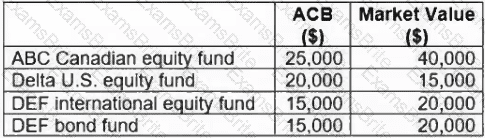
Assuming a marginal tax rate of 45%, what amount of tax payable will Janet incur if she redeems the account to fund the purchase of a new business?
Bruna is a senior financial planner. At 4 p.m. on Friday afternoon (an hour before closing), her manager asks her to complete the following:
Fix a mutual fund trade that was entered incorrectly by a junior financial planner.
Call her client to advise him that his account is overdrawn, and the bank will refuse recent payments unless he credits the account before 5 p.m.
Bruna determines she can only complete one of the two tasks before the end of the business day. How should Bruna address her supervisor's request?
A client says she can emotionally tolerate a 30% portfolio decline, but she needs the money in 18 months for a home down payment and has no other savings. What should the planner conclude?
Sarah Jones is an incorporated owner of a successful manufacturing company. She currently has a large month to month cash flow surplus. This is expected to continue until she retires in seven years. Her personal mortgage is up for renewal. She needs to borrow $50,000 so that she can replace a piece of equipment that is needed in the manufacturing process. She would like a solution that results in paying the lowest interest cost over the life of the loan. Which loan product should the financial planner recommend to Sarah? Assume monthly compounding for all products and no pre-payment options.

TESTED 20 Sep 2026