Spring Sale 65% Discount Offer - Ends in 0d 00h 00m 00s - Coupon code: exams65

ExamsBrite Dumps

Advanced VMware Cloud Foundation 9.0 vSphere Kubernetes Service Question and Answers

Advanced VMware Cloud Foundation 9.0 vSphere Kubernetes Service

Last Update Feb 28, 2026
Total Questions : 61

We are offering FREE 3V0-24.25 VMware exam questions. All you do is to just go and sign up. Give your details, prepare 3V0-24.25 free exam questions and then go for complete pool of Advanced VMware Cloud Foundation 9.0 vSphere Kubernetes Service test questions that will help you more.


3V0-24.25 pdf

3V0-24.25 PDF

$36.75  $104.99
3V0-24.25 Engine

3V0-24.25 Testing Engine

$43.75  $124.99
3V0-24.25 PDF + Engine

3V0-24.25 PDF + Testing Engine

$57.75  $164.99
Questions 1

What is a characteristic of a Kubernetes pod?

Options:

A.  

A pod is the smallest deployable unit in Kubernetes.

B.  

A pod can contain only one container.

C.  

A pod is the smallest entity managed by Docker.

D.  

A pod is deployed directly on the virtual machine.

Discussion 0
Questions 2

A cloud platform team is deploying multiple Supervisors in a VMware Cloud Foundation (VCF) environment to support a multi-tenant VKS architecture. Each Supervisor will host a distinct set of namespaces mapped to different organizational tenants such as Finance, Public Services, and R&D, where each tenant consumes resources from dedicated workload domains.

What is the purpose of the vcf context create command?

Options:

A.  

Provides authentication to the Supervisor cluster.

B.  

Creates a connection to VCF Operations for the current session.

C.  

Creates a named set of access parameters for a VKS cluster.

D.  

Creates a new storage profile for a cluster.

Discussion 0
Questions 3

An administrator is tasked with making an existing vSphere Supervisor highly available by adding two additional vSphere Zones. How should the administrator perform this task?

Options:

A.  

You cannot add an existing Supervisor to a new vSphere Zone.

B.  

Create a new multi-zone deployment and assign an existing vSphere cluster to it.

C.  

Create a new vSphere Zone and add the Supervisor to the new vSphere Zone.

D.  

Select Configure, select vSphere Zones, and click Add New vSphere Zone.

Discussion 0
Questions 4

An administrator is building a secure, multi-tenant container registry strategy for their vSphere Kubernetes Services deployment running on VMware Cloud Foundation. Each workload domain hosts a Supervisor Cluster, and multiple development teams require private repositories to store and distribute container images for Kubernetes clusters. The organization enforces strict image security posture due to compliance requirements. The operations team deploys Harbor as an add-on service through the Supervisor control plane, and developers push/pull images from Harbor through Kubernetes manifests.

What requirement describes the role and purpose of Harbor?

Options:

A.  

Harbor, formerly known as Bitnami, is an image catalog used for downloading verified open-source packages.

B.  

Harbor is an image scanner used to verify that images are free from known vulnerabilities and patches as necessary.

C.  

Harbor is an open-source registry that secures artifacts with policies and role-based access control, ensures images are scanned and free from vulnerabilities, and signs images as trusted.

D.  

Harbor is an image repository that pulls all images from GitHub.

Discussion 0
Questions 5

What component is used to provision VMware vSphere Kubernetes Service (VKS) service mesh workload clusters?

Options:

A.  

Harbor

B.  

Cert-manager

C.  

Carvel

D.  

Cluster API

Discussion 0
Questions 6

An administrator is upgrading an existing VMware vSphere Kubernetes Service (VKS) cluster and receives the following errors:

    kubectl get nodes fails with memcache.go and “server is currently unable to handle the request”

    couldn't get resource list for stats.antrea.tanzu.vmware.com/v1alpha1

    yaml: mapping values are not allowed in this context

The administrator successfully updated the Supervisor, but an attempt to update the VKS cluster failed. Based on the scenario, what is the cause of the problem?

Options:

A.  

The administrator is in the wrong cluster context.

B.  

The Kubernetes version being upgraded is no longer supported.

C.  

There was an error pulling the update image from the catalog.

D.  

The administrator does not have the appropriate permissions to upgrade the cluster.

Discussion 0
Questions 7

The DevOps engineer deployed a new application to a vSphere Kubernetes Service (VKS) cluster in a vSphere Namespace and then determined that a newer Kubernetes version was required. The vSphere administrator verified compatibility between the Supervisor and all running VKS clusters and successfully updated the vSphere Supervisor to the latest version. After the Supervisor update, the DevOps engineer still could not get the application to work.

What caused the application to fail?

Options:

A.  

The vSphere administrator updated the Supervisor control plane.

B.  

The vSphere administrator failed to complete all the pre-checks before the update.

C.  

The vSphere administrator did everything correctly and the DevOps engineer deployed the application incorrectly.

D.  

The vSphere administrator pulled the wrong version of the Supervisor.

Discussion 0
Questions 8

What three components run in a VMware vSphere Kubernetes Service (VKS) cluster? (Choose three.)

Options:

A.  

Cloud Provider Implementation

B.  

Container Network Implementation

C.  

Cloud Provider Interface

D.  

Container Storage Interface

E.  

Cloud Storage Implementation

F.  

Container Network Interface

Discussion 0
Questions 9

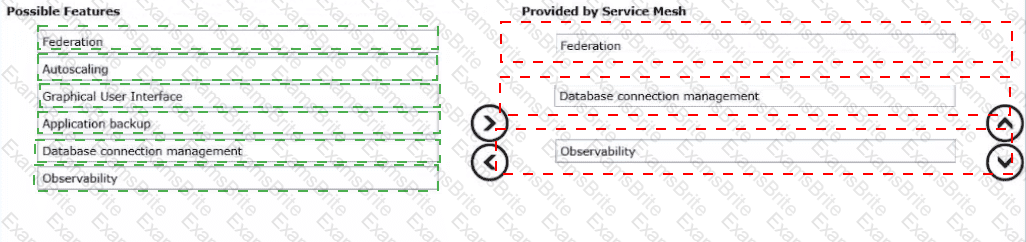
Drag and drop the three features into the correct order from Possible Features list on the left and place them into the Provided by Service Mesh on the right side. (Choose three.)
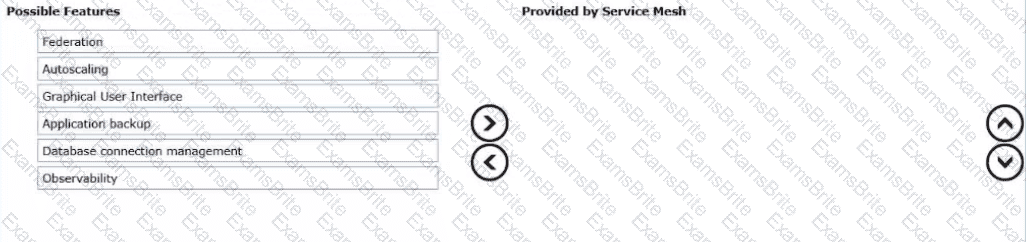

Options:

Discussion 0
Questions 10

An administrator enabled cluster scaling by running kubectl edit deployment and updating the number of replicas from 5 to 10. When the cluster was redeployed with the number of replicas set to 5, what was the result?

Options:

A.  

The cluster did not have sufficient resources to deploy the requested number of pods.

B.  

The autoscaling YAML file was not updated.

C.  

The cluster YAML file was not updated to reflect the requested number of pods.

D.  

The Supervisor YAML file was not updated to enable autoscaling.

Discussion 0
Questions 11

A company standardized on the following configurations:

• vSphere Kubernetes Service (VKS) upgrade is separate from vCenter upgrades.

• A private registry will be utilized.

How should an administrator adhere to these standards?

Options:

A.  

Issue a PowerCLI command to point to the private registry.

B.  

Issue a kubectl command pointing the service definition to the private registry.

C.  

When uploading the service definition, chooseAsynchronous Private.

D.  

When uploading the service definition, chooseAsynchronous Public.

Discussion 0
Questions 12

An administrator is upgrading an existing VMware vSphere Kubernetes Service (VKS) cluster and receives the following errors:

    kubectl get nodes fails with memcache.go and “server is currently unable to handle the request”

    couldn't get resource list for stats.antrea.tanzu.vmware.com/v1alpha1

    yaml: mapping values are not allowed in this context

The administrator successfully updated the Supervisor, but an attempt to update the VKS cluster failed. Based on the scenario, what is the cause of the problem?

Options:

A.  

The administrator is in the wrong cluster context.

B.  

The Kubernetes version being upgraded is no longer supported.

C.  

There was an error pulling the update image from the catalog.

D.  

The administrator does not have the appropriate permissions to upgrade the cluster.

Discussion 0
Questions 13

What are three benefits of VMware vSphere Kubernetes Service (VKS)? (Choose three.)

Options:

A.  

Simplifies Kubernetes management and operations.

B.  

Provides consistent Kubernetes deployment on vSphere.

C.  

Manages any Kubernetes distribution.

D.  

Leverages open-source technologies.

E.  

Enables pods to run directly on ESXi.

Discussion 0
Questions 14

What is the purpose of the VMware vSphere Kubernetes Service (VKS) Service Mesh?

Options:

A.  

Provides service discovery across multiple clusters.

B.  

Provides an infrastructure layer that makes communication between applications possible, structured, and observable.

C.  

Provides dynamic application load balancing and autoscaling across multiple clusters and multiple sites.

D.  

Provides a centralized, global routing table to simplify and optimize traffic management.

Discussion 0
Questions 15

An administrator is operating a sovereign private cloud built on VMware Cloud Foundation (VCF) and is providing isolated Supervisor Namespaces as well as associated Kubernetes clusters. The architecture must ensure consistent provisioning, management, and monitoring of these clusters across tenants while maintaining compliance with internal governance and automation frameworks, considering:

• Deploying and scaling Kubernetes clusters

• Managing Supervisor Namespaces and configurations

• Monitoring cluster health, workloads, and resources across tenants

What three clients are supported for provisioning, managing, and monitoring VMware vSphere Kubernetes Service (VKS) clusters? (Choose three.)

Options:

A.  

kubectl

B.  

Cluster API

C.  

vSphere UI

D.  

esxtop

E.  

VCF CLI

F.  

esxcli

Discussion 0
Questions 16

An administrator is maintaining several Kubernetes clusters deployed through a Supervisor Namespace in a vSphere Kubernetes Service environment. One of the micro-services (a containerized API gateway) is failing intermittently after a recent configuration update. The pod is entering aCrashLoopBackOffstate. The administrator needs to collect detailed runtime information directly from the pod, including both thestandard output (STDOUT)andstandard error (STDERR)streams, to analyze the application's behavior before the crash.

Which command produces the required output?

Options:

A.  

kubectl describe

B.  

kubectl get all

C.  

kubectl events

D.  

kubectl logs

Discussion 0
Questions 17

An administrator is updating a VMware vSphere Kubernetes Service (VKS) cluster by editing the cluster manifest. When saving, there is no indication that the edit was successful.

Based on the scenario, what action should the administrator take to edit and apply changes to the manifest?

Options:

A.  

Define the KUBE_EDITOR or EDITOR environment variable.

B.  

Verify the account editing the cluster manifest has appropriate permissions.

C.  

Ensure the file permissions are set to read-write.

D.  

Restart the VKS services and edit the file again.

Discussion 0
Questions 18

What three controllers maintain the lifecycle of VMware vSphere Kubernetes Service (VKS) clusters? (Choose three.)

Options:

A.  

Container Network Interface

B.  

Virtual Machine Service

C.  

Cloud Provider Plug-in

D.  

Container Storage Interface

E.  

Cluster API

Discussion 0