Black Friday Special: Limited Time 80% Discount Offer! Use coupon code below to save on all exam bundles! - Ends in 0d 00h 00m 00s - Coupon code: BRITE80

ExamsBrite Dumps

UiPath Agentic Automation Professional Exam Question and Answers

UiPath Agentic Automation Professional Exam

Last Update Nov 26, 2026
Total Questions : 105

We are offering FREE UiPath-AAPv1 UiPath exam questions. All you do is to just go and sign up. Give your details, prepare UiPath-AAPv1 free exam questions and then go for complete pool of UiPath Agentic Automation Professional Exam test questions that will help you more.


UiPath-AAPv1 pdf

UiPath-AAPv1 PDF

$24  $119.99
UiPath-AAPv1 Engine

UiPath-AAPv1 Testing Engine

$28  $139.99
UiPath-AAPv1 PDF + Engine

UiPath-AAPv1 PDF + Testing Engine

$36  $179.99
Questions 1

How can a UiPath process make sure that user input collected through the Properties Panel meets a specific format or set of constraints?

Options:

A.  

Capture the input and handle errors later in a separate activity

B.  

Rely on the Default Value to guide user input

C.  

Apply Validation Rules directly to the input field

D.  

Use the Input Label to describe the required format

Discussion 0
Questions 2

A team is iterating on an agent that books meeting rooms and wants to determine whether recent prompt changes have improved the agent's accuracy.

How do evaluations support this iterative development process?

Options:

A.  

Evaluations automatically roll back agent changes when the new score is lower than the previous score to maintain consistent agent quality.

B.  

Evaluations generate a detailed diff report highlighting exact prompt token changes that caused performance degradation between two agent versions.

C.  

Evaluations can be run repeatedly after each change, producing scores that allow developers to compare performance across different iterations of the agent.

D.  

Evaluations automatically apply suggested prompt improvements based on failed cases and re-run the test suite until the score improves.

Discussion 0
Questions 3

What changes would improve clarity and specificity when an agent does not escalate high-value refund requests because the prompt merely says large refunds should be "handled carefully" without defining a clear threshold?

Options:

A.  

Encourage the agent to use its judgment when determining whether a refund amount is significant.

B.  

Emphasize that large refunds require attention and rely on the agent to interpret what qualifies as large.

C.  

Add more contextual background about refund policies without specifying measurable escalation criteria.

D.  

Define a precise refund amount threshold and clearly state when escalation to a human must occur.

Discussion 0
Questions 4

In a UiPath agent evaluation, you want to assess whether the agent followed the expected behavior throughout its run history and decision-making steps, rather than comparing only final outputs.

Which evaluator type should you select?

Options:

A.  

Trajectory evaluator

B.  

Exact match

C.  

JSON similarity

D.  

LLM-as-a-Judge (semantic similarity on final output)

Discussion 0
Questions 5

When simulating agent tools, how can developers guide the LLM to generate specific tool responses?

Options:

A.  

By adjusting the agent’s input schema constraints to narrow the range of valid tool invocation arguments during simulation

B.  

By configuring escalation pathways to intercept and rewrite tool outputs before they are returned to the agent

C.  

By specifying the expected tool behavior and mock outputs within the simulation instructions so the model conditions its responses accordingly

D.  

By pre-indexing anticipated tool responses in DeepRAG so the model retrieves them deterministically during simulation

Discussion 0
Questions 6

How does Data Fabric’s integration with external data sources improve the outcomes of agentic automation?

Options:

A.  

It requires manually copying data into a centralized repository to standardize schemas before agents can access and use it.

B.  

It eliminates migrations and provides real-time, connected data so agents act on the most current business context.

C.  

It caches nightly ETL snapshots so agents work with near-real-time data without changing source systems.

D.  

It migrates selected fields on demand to reduce latency while agents operate on partially replicated data.

Discussion 0
Questions 7

Which practice best helps you iteratively improve an agent’s prompt quality through UiPath evaluations?

Options:

A.  

Increase the model temperature to its maximum to force more creative outputs.

B.  

Tune only the agent's evaluator thresholds without updating the prompt structure.

C.  

Refine the prompt based on failed debug runs and add corrected outputs to the evaluation set.

D.  

Remove evaluations with lower scores to artificially raise the agent's average.

Discussion 0
Questions 8

What is an appropriate strategy for handling ambiguous inputs in an agentic orchestration design?

Options:

A.  

Force robots to proceed using default values whenever ambiguity is detected.

B.  

Isolate ambiguous cases in a separate queue for periodic manual review without integrating the resolution outcomes back into the orchestration model.

C.  

Identify and categorize ambiguous cases, route to humans for resolution, and feed the clarified outcome back to improve the agent and robot routing.

D.  

Block all ambiguous cases permanently to keep accuracy metrics high.

Discussion 0
Questions 9

When setting up a Context Grounding index in UiPath Orchestrator, which of the following describes a correct combination of source type and required setup steps?

Options:

A.  

Choose Connector and upload data directly into the index without selecting an external storage service by dragging and dropping the documents.

B.  

Choose Storage Bucket as the data source and then select the Orchestrator folder containing the bucket and the matching file types.

C.  

Choose Storage Bucket as the source and leave the file type unspecified, since Orchestrator automatically detects all file types by default.

D.  

Choose Connector, then directly upload files into Orchestrator without selecting a connection or specifying a folder path.

Discussion 0
Questions 10

When configuring evaluation sets to compare model/temperature combinations, which evaluator categories let you select the model used for evaluation?

Options:

A.  

Trajectory evaluators only, because only trajectory grading needs a model selection while LLM-as-a-judge evaluators remain model-agnostic.

B.  

LLM-as-a-judge and Trajectory evaluators, because both are LLM-based and include a Model selection field for testing different model and temperature configurations.

C.  

Deterministic evaluators only, because their stable rule-based matching supports explicit model selection to compare model behaviors.

D.  

All evaluator categories, because model selection is available uniformly for deterministic, LLM-as-a-judge, and trajectory evaluators.

Discussion 0
Questions 11

Which of the following is a properly structured system prompt based on best practices?
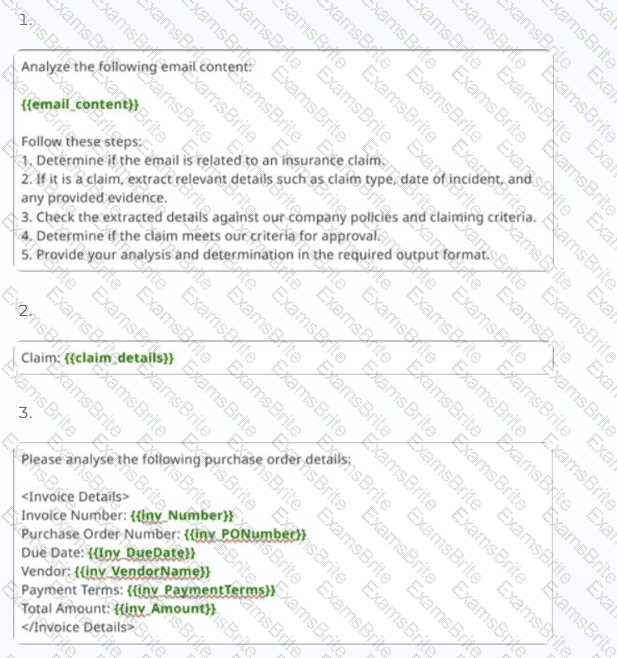
Original exhibit — Question 6, part 1
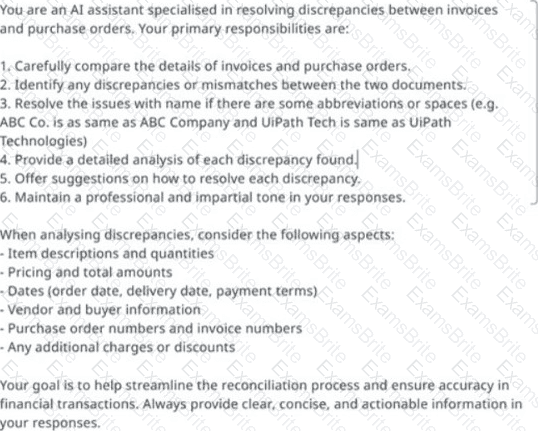
Original exhibit — Question 6, part 2

Options:

A.  

1

B.  

2 and 4

C.  

3

D.  

4

Discussion 0
Questions 12

During evaluation, an agent responsible for extracting signatures and related information from tables in approval documents produces inconsistent results and misses some signatures.

Based on iterative refinement practices, what corrective action should be taken?

Options:

A.  

Expand the contextual description of the approval workflow without modifying the extraction steps or validating improvements.

B.  

Refine the extraction instructions to clarify how signatures within tables must be identified and retest while measuring accuracy changes.

C.  

Rewrite the entire prompt structure and analyze which specific extraction instruction caused the inconsistency.

D.  

Update the argument configurations in Data Manager and refine the table parsing instructions by adding clear guidelines.

Discussion 0
Questions 13

An agent has several tools configured, but during testing it takes actions unrelated to its defined objective.

What adjustment would most effectively improve alignment with that objective?

Options:

A.  

Remove tools whose capabilities extend beyond what is required to fulfill the defined objective.

B.  

Refine the agent's instructions while keeping all existing tools available for flexibility.

C.  

Add complementary tools so the agent can better determine which action is appropriate.

D.  

Increase the detail of the objective without modifying the current tool selection.

Discussion 0
Questions 14

Which of the following options includes all formats supported by Context Grounding in the 2025.10 release?

Options:

A.  

PDF, TIFF, DOCX, CSV, XLSX, PNG files

B.  

PDF, TIFF, CSV, XLSX, DOCX, TXT files

C.  

PDF, JSON, DOCX, CSV, XLSX, PNG files

D.  

PDF, JSON, CSV, XLSX, DOCX, TXT files

Discussion 0
Questions 15

An automation developer needs an agent to extract the invoice number from incoming emails without being given any examples.

How should the zero-shot system prompt be written for this simple task?

Options:

A.  

Provide a short and direct instruction telling the agent to read the email content and return the invoice number if present.

B.  

Include multiple example emails and expected invoice numbers to demonstrate the correct extraction pattern.

C.  

Define several optional tools and escalation rules even though the task only requires simple text extraction.

D.  

Add a long explanation about different invoice formats and detailed reasoning steps for every possible variation.

Discussion 0
Questions 16

What role do humans typically play in an agentic automation model?

Options:

A.  

Limiting agent autonomy to prevent contextual adjustments

B.  

Providing judgment, oversight, and domain expertise

C.  

Operating independently from agents and orchestration flows

D.  

Executing repetitive system tasks instead of robots

Discussion 0
Questions 17

How are activity input methods configured in UiPath agent tools, and what are the main considerations for cascading fields?

Options:

A.  

Activity input methods include Prompt (default), Argument, and Static Value. Cascading fields cannot use the Prompt input method as agents cannot infer changes in field structures at runtime.

B.  

Activity input methods are mostly limited to Prompt, though in some cases Argument or Static Value can be selected depending on the connector. Cascading fields generally work with the Prompt method because agents can usually handle dynamic field updates during execution without major issues.

C.  

Activity input methods are fully automated with no optional configurations available. Cascading fields do not impact agent tool functionality in any way.

D.  

Activity input methods primarily default to Static Value for most fields to ensure predictable behavior and minimize runtime errors. Cascading fields are automatically detected and adjusted by the agent at runtime for smooth handling of dependent or conditional inputs.

Discussion 0
Questions 18

You are designing a Validate Invoice Status tool for an agent that checks invoice payment information. During testing, the agent sometimes misinterprets the results, even though the workflow runs successfully.

Which action best aligns with UiPath's best practices for improving tool reliability?

Options:

A.  

Use tool guardrails only to block unsafe inputs rather than clarifying result interpretation.

B.  

Add a detailed description listing side effects and risk factors so the agent can infer the correct interpretation.

C.  

Rely on the agent's language model to infer tool usage automatically, since example prompts are optional for well-named tools.

D.  

Include an example of the tool's input, expected output, and interpretation logic directly in the system prompt so the agent learns how to call the tool correctly.

Discussion 0
Questions 19

An insurance company needs to automate end-to-end policy validation by ingesting customer records from its CRM, invoking multiple REST APIs to verify coverage and eligibility against external data sources, and reconciling results for audit compliance. The process must handle authentication challenges, intermittent API outages, and changing response schemas, while providing clear progress and error reporting for business users.

Which workflow design approach is best?

Options:

A.  

Create a modular UiPath workflow with centralized API authentication, schema validation/adaptation for varying responses, resiliency (auto-retries, graceful outage handling), and real-time progress/error logs for business users.

B.  

Organize the workflow so each API call operates independently, with hardcoded credentials; in case of outages, aggregate error codes for later manual investigation, and generate a single compliance summary after all processing is complete.

C.  

Use separate UiPath workflows for each stage, CRM ingestion, API verification, and reconciliation, allowing manual intervention if an authentication failure or schema mismatch occurs, and emailing stakeholders occasional audit summaries for review.

D.  

Configure the workflow to only process customer records during periods of known API uptime, skipping records and deferring validation when external data sources are unavailable, then batch process any skipped validations later and compile a multi-stage report.

Discussion 0
Questions 20

An agent produces inconsistent outputs because the system prompt clearly defines the task but does not specify the format of the final answer.

How can clarity and conciseness best practices be used to resolve this issue?

Options:

A.  

Encourage the agent to structure the response in a way that seems most appropriate for each case.

B.  

Expand the explanation of the agent’s overall goal without introducing formatting constraints.

C.  

Specify the required output format, structure, and tags that the agent must follow in the final response.

D.  

Provide additional background information about the business scenario to give the agent more context.

Discussion 0
Questions 21

During a design-time Debug test run, an agent produces an incorrect output for a realistic failure scenario. The team wants to capture this scenario in the dataset with the expected outcome so it can be re-run after fixes.

According to the documentation, what is an appropriate way to create this evaluation?

Options:

A.  

Convert the run into a runtime trace and use feedback selection as the expected outcome.

B.  

Add the incorrect run to an evaluation set and keep its output as the expected outcome.

C.  

Generate an evaluation from the incorrect run and manually edit it to the expected outcome.

D.  

Add the incorrect run to an evaluation set and assign an Exact match evaluator without edits.

Discussion 0
Questions 22

Before publishing an agent to Orchestrator, which combination of checks ensures the agent meets enterprise readiness standards?

Options:

A.  

Conduct at least 50 interactive tests and confirm no regressions.

B.  

Conduct at least 30 interactive tests, validate evaluation sets with ≥70% performance.

C.  

Run smoke tests only after publishing, and make sure the provided guardrail logging is enabled.

D.  

Skip interactive testing if curated evaluations exceed 80% accuracy.

Discussion 0
Questions 23

When should a UiPath developer create evaluations for an agent?

Options:

A.  

When arguments are stable, the use case is defined and the prompt, tools, and context are finalized.

B.  

At the beginning of agent development to establish a baseline for performance before implementing any functionality.

C.  

After the agent has been deployed to production to capture real-world usage patterns for testing.

D.  

Only when errors are detected in production to reproduce and fix specific issues that users encounter.

Discussion 0
Questions 24

Which approach follows best practices for implementing a multi-agent system?

Options:

A.  

Design agents to collaborate and coordinate at runtime, using shared memory or communication layers to negotiate objectives, distribute tasks, and adapt dynamically to changing conditions.

B.  

Limit agent interaction to prevent complexity, assigning each agent a static function that never changes throughout the workflow lifecycle.

C.  

Focus on repetitive, rules-based automations where agents follow fixed, deterministic paths and do not require adaptive planning or coordination.

D.  

Define all control logic and task order during the initial design phase, ensuring agents execute a predetermined set of actions without deviation, following fixed rules and deterministic paths.

Discussion 0
Questions 25

Given the following BPMN for the "SME to review the discrepancies" task, which option should be selected in the "Action" dropdown?
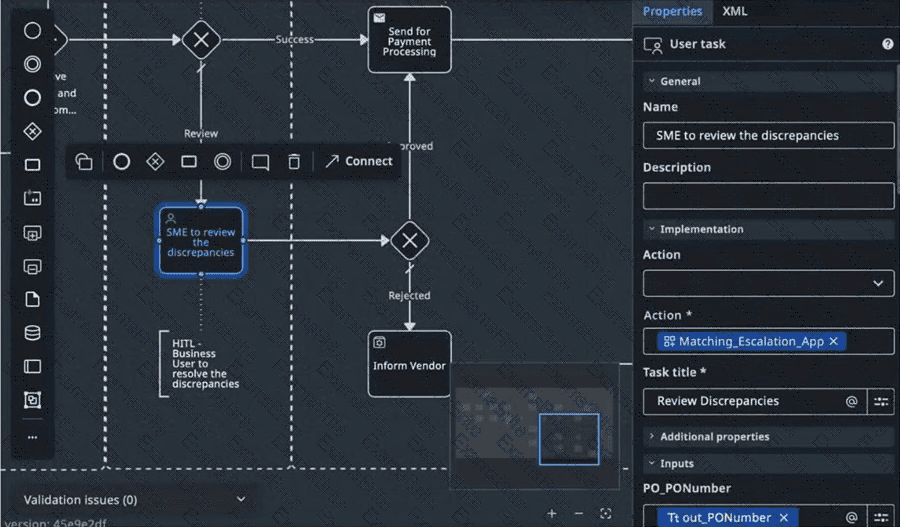
Original exhibit — Question 56

Options:

A.  

Create action app task

B.  

Create validation app task

C.  

Create and wait for action app task

D.  

Create and wait for validation app task

Discussion 0
Questions 26

A team wants an evaluation dataset that reflects real-world complexity for a multi-branch agent that uses tools and has several input parameters.

Which approach best aligns with the documented coverage principles for building evaluation cases?

Options:

A.  

Map input combinations and edge cases, then create 3-5 evaluations per logically equivalent case while prioritizing meaningful tests.

B.  

Focus on reaching 30+ evaluations by duplicating the same successful run across multiple sets to raise the Agent Score.

C.  

Create a large single set of evaluations only after production feedback arrives, so runtime traces fully replace design-time cases.

D.  

Build one evaluation per input parameter, keeping each case isolated, and avoid combining parameters to reduce variability.

Discussion 0
Questions 27

How do execution traces help identify the root cause of failed evaluations?

Options:

A.  

By showing detailed agent actions and tool interactions during the run.

B.  

By summarizing evaluation results into a single score for easy comparison.

C.  

By suggesting modifications to evaluator criteria automatically.

D.  

By aggregating failed evaluations into a new evaluation set for review.

Discussion 0
Questions 28

What is the main design goal when chaining multiple agents in one process for complex automations?

Options:

A.  

Replace all agents with a human reviewer at the final step to guarantee correctness without policies.

B.  

Centralize all decisions in a single agent and keep others idle to minimize orchestration complexity overall.

C.  

Let each agent decide freely without thresholds so execution adapts organically to changing inputs at runtime.

D.  

Establish clear handoff rules and confidence thresholds so downstream agents or robots act predictably.

Discussion 0
Questions 29

Which approach effectively balances strict and flexible assertions?

Options:

A.  

Use strict checks for essential fields and flexible checks for non-critical text

B.  

Apply strict checks uniformly to maintain consistent verification standards

C.  

Exclude assertions altogether when workflows include creative or variable outputs

D.  

Rely mainly on flexible checks to streamline evaluation and reduce maintenance effort

Discussion 0
Questions 30

A company wants to apply different Agent governance settings across multiple departments.

Which approach should it take to manage Agent access efficiently?

Options:

A.  

Create a master AI Trust Layer policy template and instruct each department administrator to clone and customize it through their local admin console.

B.  

Create an AI Trust Layer policy with the appropriate Agent settings and deploy it selectively to the tenants corresponding to each department.

C.  

Generate separate governance files from Studio for each department and upload them directly to the department's folder in Automation Cloud.

D.  

Create a single organization-wide AI Trust Layer policy and configure department-specific exceptions within the policy's advanced settings.

Discussion 0
Questions 31

When integrating UiPath Data Fabric with event-driven automation, which action causes the connector to generate an event?

Options:

A.  

Exporting entity data from Data Fabric to an external system.

B.  

Opening the Data Fabric entity configuration in the Admin section.

C.  

Assigning user permissions to the Data Fabric entity.

D.  

Creating or updating a record in the Data Fabric entity.

Discussion 0