Payroll Fundamentals 1Exam
Last Update Oct 12, 2026
Total Questions : 73
We are offering FREE PF1 National Payroll Institute exam questions. All you do is to just go and sign up. Give your details, prepare PF1 free exam questions and then go for complete pool of Payroll Fundamentals 1Exam test questions that will help you more.



An employee who lives in Ontario and reports to work at a permanent establishment of the employer in Quebec will have income tax deducted based on which province?
Michael is an employee in Alberta who is paid bi-weekly and earns $1,600.00 per pay period. He has a taxable meal allowance of $30.00 per pay period. His federal and provincial TD1s on file show a claim code 2. Michael already reached the annual maximum first and second Canada Pension Plan (CPP) contributions before this pay. Calculate his total federal and provincial income taxes.
Which of the following company-compulsory deductions would reduce the employee’s gross taxable income for purposes of withholding income taxes?
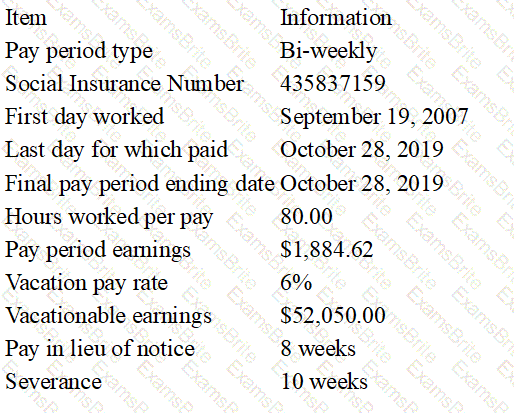
National Hardware, an Ontario organization, will be terminating the employment of Emilie St. Germain on October 28, 2019, the last day of the pay period. Emilie started with National Hardware on September 19, 2007. Complete the paper Record of Employment (ROE) for Emilie based on the information provided in the following chart.
Note: Vacationable earnings already include the pay in lieu of notice.
All dates must be entered in the format DDMMYYYY.
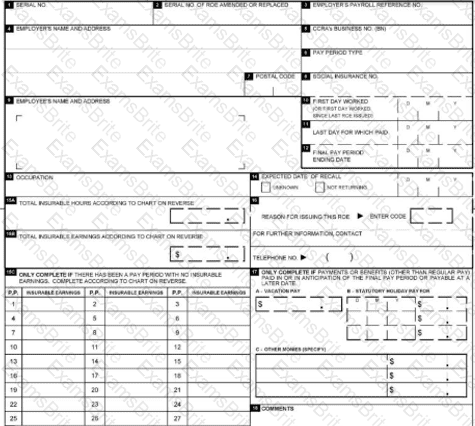
Paper ROE (Form Reference)
Complete the following paper ROE blocks for Emilie:
Block 6 – Pay period type
Block 8 – Social Insurance Number
Block 10 – First day worked
Block 11 – Last day for which paid
Block 12 – Final pay period ending date
Block 15A – Total insurable hours
Block 15B – Total insurable earnings
Block 17A – Vacation pay
Block 17C – Other monies (Pay in lieu of notice)
Block 17C – Other monies (Severance)
Step 1 — Complete Block 6
Enter the pay period type for Emilie.
Step 2 — Complete Block 8
Enter Emilie’s Social Insurance Number.
Step 3 — Complete Block 10
Enter Emilie’s first day worked in DDMMYYYY format.
Step 4 — Complete Block 11
Enter Emilie’s last day for which paid in DDMMYYYY format.
Step 5 — Complete Block 12
Enter the final pay period ending date in DDMMYYYY format.
Step 6 — Complete Block 15A
Calculate and enter total insurable hours.
Given:
Hours worked per pay period = 80.00
Bi-weekly ROE pay period chart captures 27 pay periods
Step 7 — Complete Block 15B
Calculate and enter total insurable earnings.
Given:
Pay period earnings = $1,884.62
Bi-weekly ROE pay period chart captures 27 pay periods
Step 8 — Complete Block 17A
Calculate and enter vacation pay.
Given:
Vacation pay rate = 6%
Vacationable earnings = $52,050.00
(already includes pay in lieu of notice)
Step 9 — Complete Block 17C
Enter the correct amount in 17C for “Other monies” specified as Pay in lieu of notice.
Given:
Pay in lieu of notice = 8 weeks
Use weekly earnings derived from the bi-weekly pay period earnings.
Step 10 — Complete Block 17C
Enter the correct amount in 17C for “Other monies” specified as Severance.
Given:
Severance = 10 weeks
Use the same weekly earnings used in Step 9.
By the authority of which Act can the Canada Revenue Agency garnish the wages of an employee who has failed to pay Employment Insurance premiums, Canada Pension Plan contributions, or income tax deductions?
The Canada Revenue Agency form that is completed to allow a commissioned employee to claim non-reimbursed expenses at source is a:
PF1 Exam – Net Pay Calculation (Template Worksheet)
Scenario
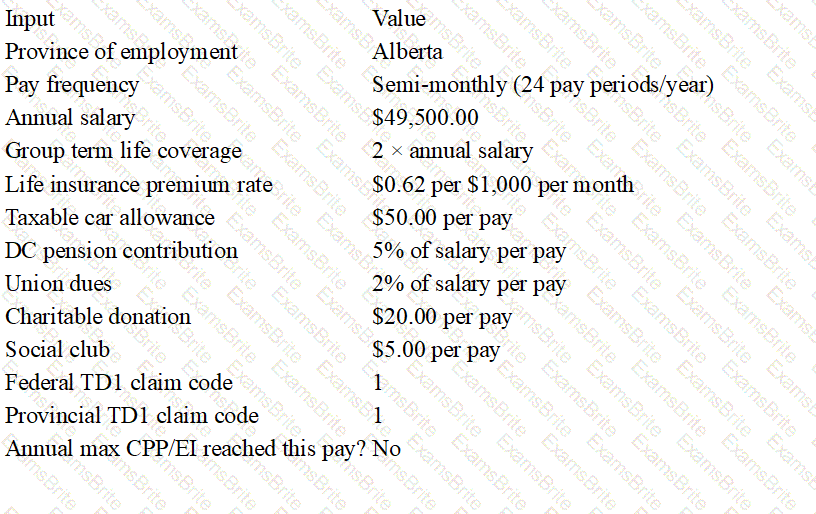
Diane Lemay works for Monarch Construction in Alberta and earns an annual salary of $49,500.00, paid on a semi-monthly basis.
The company provides its employees with group term life insurance coverage of two times annual salary and pays a monthly premium of $0.62 per $1,000.00 of coverage.
Diane uses her car to meet with clients on company business and receives a taxable car allowance of $50.00 per pay.
The company has a defined contribution pension plan to which Diane contributes 5% of her salary each pay.
Diane also contributes $20.00 to United Way and has $5.00 deducted for her social club membership each pay. She belongs to a union and pays 2% of her salary in union dues per pay period.
Diane’s federal and provincial TD1 claim codes are 1. She will not reach the first Canada Pension Plan or Employment Insurance annual maximums this pay period.
Required: Calculate the employee’s net pay, following the order of the steps in the net pay template.
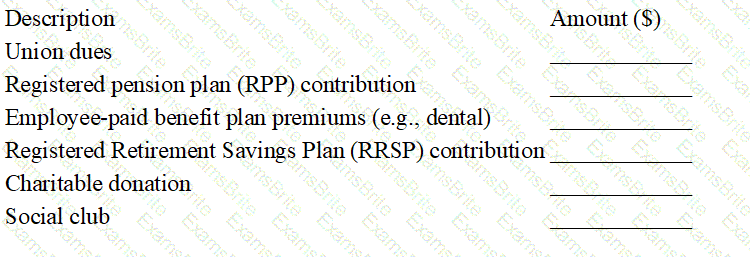
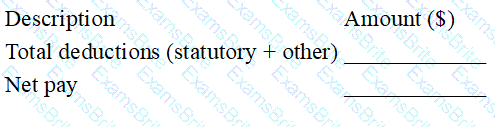
EXHIBIT A — Net Pay Template (Fill in all blanks)
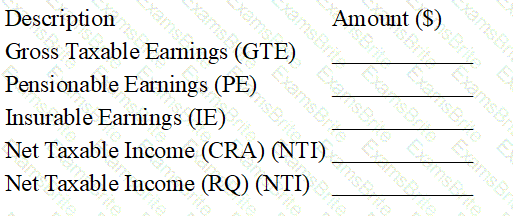
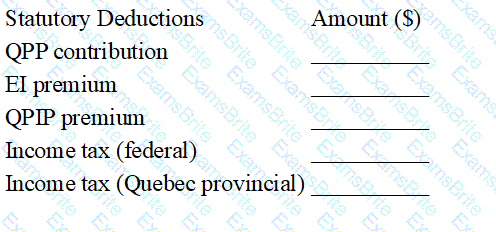
STATUTORY DEDUCTIONS
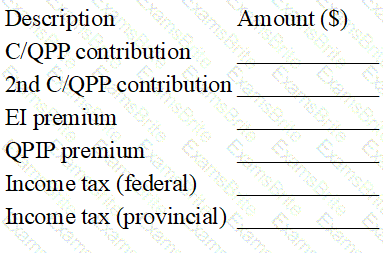
OTHER DEDUCTIONS
Given Data (Reference)
Step 1 — Calculate the employee’s gross taxable earnings (GTE) for this pay.
[ _________________________________ ]
Step 2 — Calculate the pensionable earnings (PE).
[ _________________________________ ]
Step 3 — Calculate the insurable earnings (IE).
[ _________________________________ ]
Step 4 — Calculate the net taxable income (CRA) (NTI).
[ _________________________________ ]
Step 5 — Calculate the net taxable income (RQ) (NTI).
[ _________________________________ ]
Step 6 — Calculate Diane’s Canada Pension Plan contribution.
[ _________________________________ ]
Step 7 — Calculate Diane’s Employment Insurance premium.
[ _________________________________ ]
Step 8 — Calculate Diane’s Quebec Parental Insurance Plan premium.
[ _________________________________ ]
Step 9 — Determine Diane’s federal income tax.
[ _________________________________ ]
Step 10 — Determine Diane’s provincial income tax.
[ _________________________________ ]
Step 11 — Calculate Diane’s total deductions (statutory + other).
[ _________________________________ ]
Step 12 — Calculate Diane’s net pay.
[ _________________________________ ]
Ronda earns $12.50 per hour and worked 40 hours this week. Calculate her Canada Pension Plan (CPP) contribution for this weekly pay period.
(PF1 Exam – Net Pay Calculation Template Worksheet: Quebec)
Question ID: pf1-exam-npc-q-f
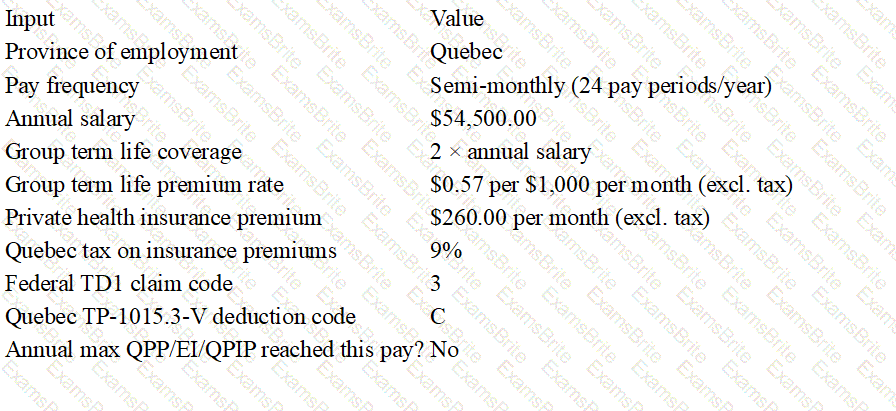
Mara Poirier works for Affordable Transport in Quebec and earns an annual salary of $54,500.00, paid on a semi-monthly basis.
In addition to her regular salary, Mara’s employer provides the following benefits:
Group term life insurance coverage through a third party of two times her annual salary.
Monthly group term life insurance premiums are $0.57 per $1,000.00 of coverage, excluding taxes.
Private health insurance benefits with a monthly premium of $260.00, excluding taxes.
The tax on insurance premiums in Quebec is 9%.
Mara’s federal TD1 claim code is 3 and her provincial TP-1015.3-V deduction code is C.
Mara will not reach the annual maximums for QPP, EI, or QPIP in this pay period.
Required: Calculate Mara’s net pay, following the order of the steps in the net pay template.
EXHIBIT A — Net Pay Template (Fill in all blanks)
Earnings / Income Bases
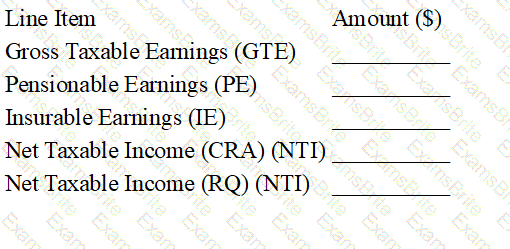
Step 1 — Calculate Mara’s gross earnings for this pay period (GTE).
[ ____________________________________________ ]
Step 2 — Calculate the pensionable earnings (PE).
[ ____________________________________________ ]
Step 3 — Calculate the insurable earnings (IE).
[ ____________________________________________ ]
Step 4 — Calculate the net taxable income (CRA) (NTI).
[ ____________________________________________ ]
Step 5 — Calculate the net taxable income (RQ) (NTI).
[ ____________________________________________ ]
Step 6 — Calculate Mara’s Quebec Pension Plan (QPP) contribution.
[ ____________________________________________ ]
Step 7 — Calculate Mara’s Employment Insurance (EI) premium.
[ ____________________________________________ ]
Step 8 — Calculate Mara’s Quebec Parental Insurance Plan (QPIP) premium.
[ ____________________________________________ ]
Step 9 — Determine Mara’s federal income tax.
[ ____________________________________________ ]
Step 10 — Determine Mara’s Quebec provincial income tax.
[ ____________________________________________ ]
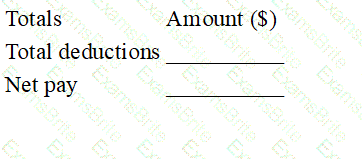
Step 11 — Calculate Mara’s total deductions.
[ ____________________________________________ ]
Step 12 — Calculate Mara’s net pay.
[ ____________________________________________ ]
Anthony earns $750.00 per week. He has a cash taxable benefit of $25.00 per week. Anthony is exempt from CPP contributions. Calculate the net taxable income for the week.
Anne Massy works for Liberty Promotions in Nunavut and is provided with a company-leased automobile. The automobile was in Anne’s possession for 365 days. Of the 34,134 kilometres driven, 15,805 kilometres were for business purposes. The monthly lease cost of the vehicle was $198.60, excluding GST calculated at 5%. Anne requested in writing that Liberty Promotions use the optional operating cost method if all conditions apply. She did not reimburse the company for any of the expenses associated with the automobile. Calculate Anne’s annual automobile taxable benefit.
A premium payment for overtime hours worked or a rate per piece of goods produced is an example of:
Which of the following deductions would be the last payroll withholding in order of priority?
Which of the following types of payments made by a private organization would not be subject to all statutory deductions?
In which province or territory is the employer-paid premium for private health insurance coverage that includes dental and prescription coverage considered to be a non-cash taxable benefit?
Paul Westin works for an Alberta organization and receives a regular salary of $1,800.00 semi-monthly. He will be receiving a payout of accrued vacation with no time taken of $1,400.00 on a separate cheque. He has federal and provincial TD1s on file with claim code 1. Calculate the income taxes to be withheld on his vacation pay.
Paula is granted a pay increase. The paperwork informing the payroll department of the pay increase is two pay periods late. What method would be used to calculate income taxes on the separate retroactive payment?

TESTED 12 Oct 2026