Pre-Summer Sale 65% Discount Offer - Ends in 0d 00h 00m 00s - Coupon code: exams65

ExamsBrite Dumps

Enterprise Routing and Switching - Professional (JNCIP-ENT) Question and Answers

Enterprise Routing and Switching - Professional (JNCIP-ENT)

Last Update Apr 15, 2026
Total Questions : 72

We are offering FREE JN0-650 Juniper exam questions. All you do is to just go and sign up. Give your details, prepare JN0-650 free exam questions and then go for complete pool of Enterprise Routing and Switching - Professional (JNCIP-ENT) test questions that will help you more.


JN0-650 pdf

JN0-650 PDF

$36.75  $104.99
JN0-650 Engine

JN0-650 Testing Engine

$43.75  $124.99
JN0-650 PDF + Engine

JN0-650 PDF + Testing Engine

$57.75  $164.99
Questions 1

Which statement accurately describes the operation of OSPF within the Junos OS?

Options:

A.  

OSPF calculates routes using a distance vector algorithm.

B.  

OSPF is used for routing information and neighbor discovery within a single autonomous system (AS).

C.  

OSPF does not automatically advertise directly connected routes.

D.  

OSPF is used for routing information and neighbor discovery between multiple autonomous systems.

Discussion 0
Questions 2

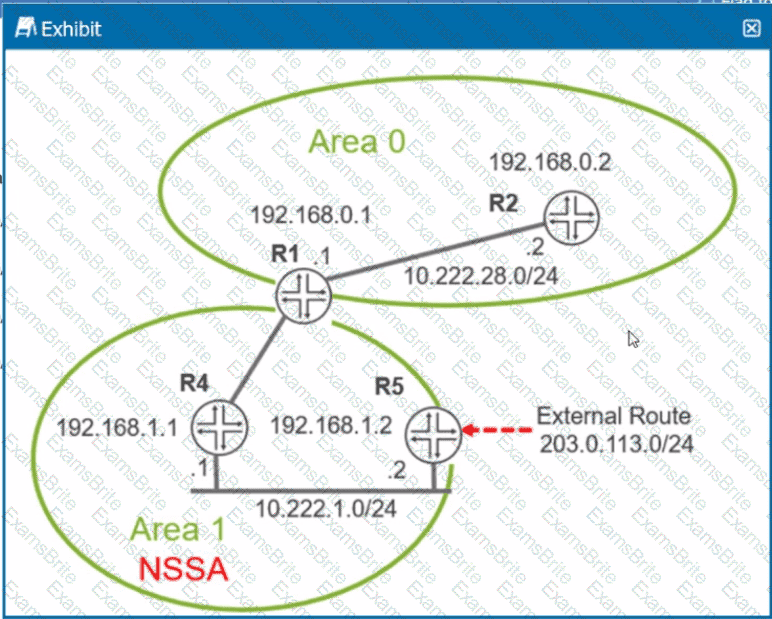
Exhibit.

Referring to the exhibit, which two statements are correct? (Choose two.)

Options:

A.  

R1 will advertise the 203 0.113.0724 route as an OSPF Type 7 LSA into Area 0.

B.  

R5 will advertise the 203 0.113 0/24 route as an OSPF Type 5 LSA into Area 1.

C.  

R1 will advertise the 203 0.113.0/24 route as an OSPF Type 5 LSA into Area 0

D.  

R5 will advertise the 203 0.113.0/24 route as an OSPF Type 7 LSA into Area 1.

Discussion 0
Questions 3

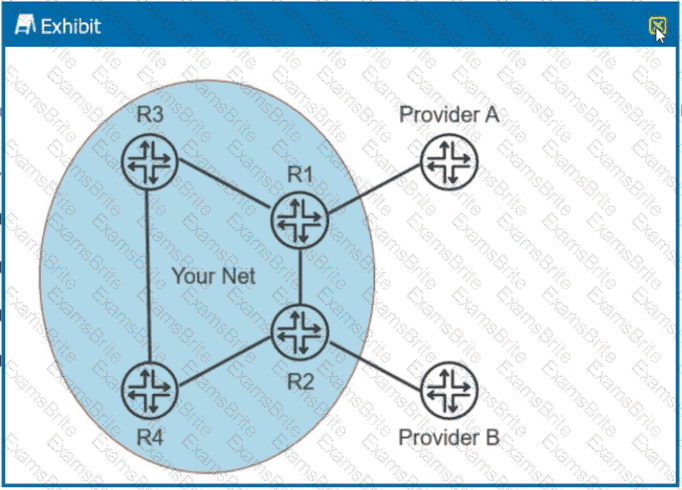
Exhibit

Your network receives the full Internet BGP routing table from two different ISPs. You want your local routers to use Provider A to forward all Internet traffic as long as Provider A is available.

Referring to the exhibit, which two actions would satisfy this requirement? (Choose two.)

Options:

A.  

Use a routing policy to set the local preference attribute value higher for the routes that are learned by R1

B.  

Use a routing policy to set the local preference attribute value higher for the routes that are learned by R2.

C.  

Use a routing policy to set the local preference attribute value lower for the routes that are learned by R2.

D.  

Use a routing policy to set the local preference attribute value lower for the routes that are learned by R1.

Discussion 0
Questions 4

You are deploying a new campus switching environment using EX Series switches. This new environment includes IP phones requiring Power over Ethernet (PoE) and end-user client PCs attached to a single switch port that will be configured with 802.1X authentication.

Considering the default configuration on an EX Series access switch and the configuration requirements to support this deployment, which two statements are correct? (Choose two.)

Options:

A.  

Configuration for the voice VLAN for all relevant access ports must be added.

B.  

Configuration for PoE on all relevant access ports must be added

C.  

Configuration for LLDP and LLDP-MED on all relevant access ports must be added.

D.  

Configuration for 802.1X on all relevant access ports must be added.

Discussion 0
Questions 5

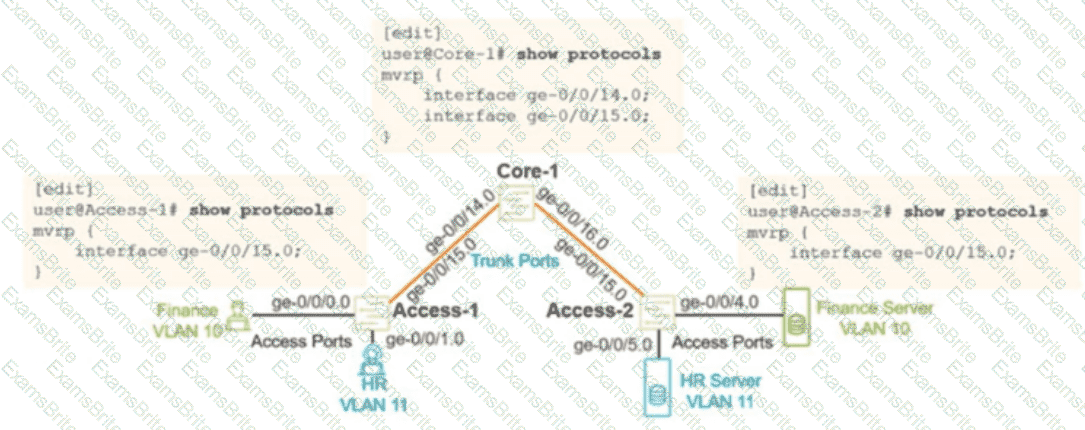
Exhibit

You configured MVRP in your Layer 2 network using the configuration shown in the exhibit. You verified that the appropnate VLANs are configured and applied on the two access switches. You are using RSTP as your loop prevention mechanism. Unfortunately, the users are not able to communicate with their corresponding server attached to the Access-2 switch.

In this scenario, what should you do to solve this problem?

Options:

A.  

Configure VSTP instead of RSTP as your loop-prevention mechanism.

B.  

Configure the access interfaces on the Access-2 switch under MVRP.

C.  

Configure the ge-070716.0 interface on the Core-1 switch under MVRP.

D.  

Configure the access interfaces on the Access-1 switch under MVRP.

Discussion 0
Questions 6

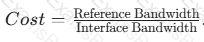
Your OSPF network consists of a mix of 1GbE and 10GbE interfaces. By default, all interfaces have the same cost in your OSPF network. You are asked to ensure that the 10GbE interfaces are more preferred when available

In this scenario, which two statements would accomplish this behavior? (Choose two.)

Options:

A.  

You should define the reference bandwidth as 10G. which will assign the 1GbE interfaces a higher cost

B.  

You should manually assign the interface metric for each 10GbE interface to be higher than the 1GbE interfaces in your OSPF network.

C.  

You should define the reference bandwidth as 1G. which will assign the 1GbE interfaces a higher cost.

D.  

You should manually assign the interface metric for each 1GbE interface to be higher than the 10GbE interfaces in your OSPF network.

Discussion 0
Questions 7

Click the Exhibit button.

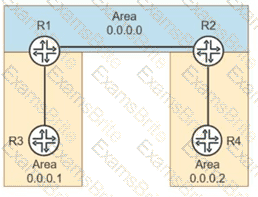
You are troubleshooting suboptimal routing in an enterprise OSPFv2 deployment:

-- R1 is an ABR between Area 0 and Area 1.

-- R2 is an ABR between Area 0 and Area 2.

-- R3 in Area 1 advertises a network that should be reachable by routers in Area 2.

-- The ABRs are connected in the backbone (Area 0).

On router R2, the show ospf database does not display router LSAs or network LSAs from Area 1, but an interarea route to R3’s network exists in the routing table. R2 does not have Type-1 or Type-2 LSAs from Area 1 in its OSPF database.

Referring to the exhibit, which statement is correct?

Options:

A.  

R2 is filtering them using the OSPF import policy.

B.  

Junos disables Type-1 and Type-2 LSAs by default in Interarea LSDBs.

C.  

R2 is running OSPFv3, which does not use Type-1 or Type-2 LSAs.

D.  

Type-1 and Type-2 LSAs are summarized into Type-3 LSAs by ABRs and do not cross area boundaries.

Discussion 0
Questions 8

Which two EVPN types advertise an ESI without advertising a MAC address? (Choose two.)

Options:

A.  

Type1

B.  

Type 2

C.  

Type 3

D.  

Type 4

Discussion 0
Questions 9

You are evaluating a BGP routing policy that has a route-filter clause that includes its own action (e.g.. accept) within the filter block. The policy is also using a then clause.

Which statement is correct in this scenario?

Options:

A.  

The policy ignores the filter action and defers to the then clause.

B.  

The filter action is treated as a suggestion and combined with the then action.

C.  

The filter action is applied only if no then action is defined

D.  

The filter ' s accept action executes immediately upon matching and the then clause is ignored.

Discussion 0
Questions 10

Which statement about LLDP and LLDP-MED operations on EX Series devices is correct?

Options:

A.  

LLDP only operates on interfaces configured for Layer 2

B.  

EX Series devices flood LLDP frames across a Layer 2 domain to calculate a network topology

C.  

EX Series devices support LLDP-MED power negotiation, enabling dynamic allocation of PoE power based on endpoint device needs.

D.  

LLDP-MED focuses on discovering network connectivity devices like routers and switches.

Discussion 0
Questions 11

You are configuring CoS throughout your enterprise network using DSCP. You have configured MF classification on your edge devices and are using BA classifiers throughout the core You are using the EZQoS template provided on your EX Series switches that are acting as your edge devices. You have loaded the configuration group and applied it to the appropriate interfaces. Classification and scheduling are working properly on your edge devices; however, traffic is not being classified correctly when it reaches your core devices

In this scenario, which statement is correct about solving this problem?

Options:

A.  

You should configure and apply a policer to the edge devices ' egress interfaces toward the core.

B.  

You must configure the core devices using the EZQoS template as well

C.  

You should configure and apply rewrite rules on the edge devices ' egress interfaces toward the core

D.  

You must configure the edge devices to use BA classifiers instead of MF classifiers

Discussion 0
Questions 12

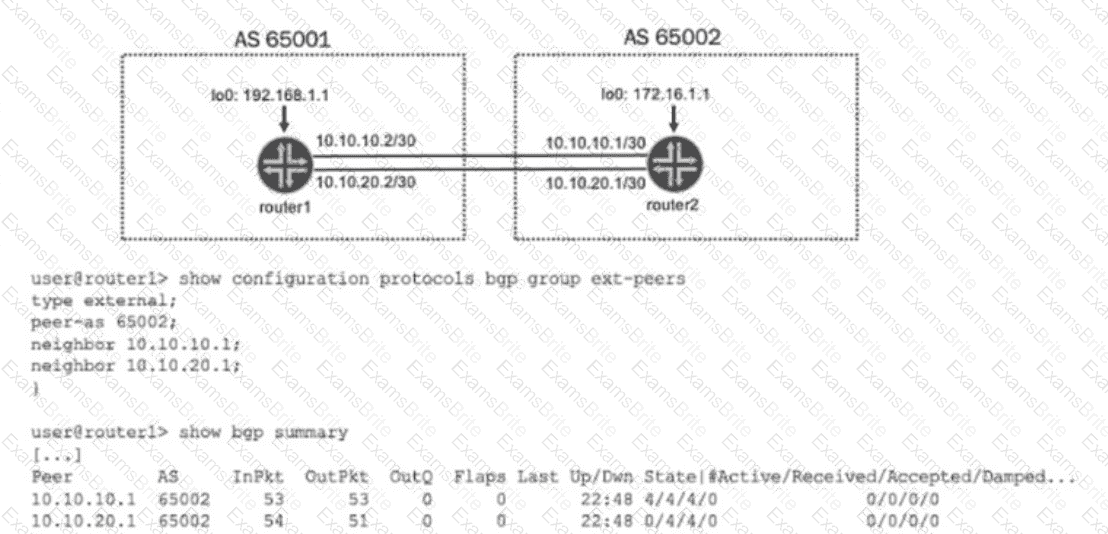
Exhibit

Referring to the exhibit, what will enable active routes from both peers?

Options:

A.  

Configure neighbor 172.16.1.1 multipath under the ext-peers hierarchy.

B.  

Configure multipath under the ext-peers hierarchy

C.  

Configure neighbor 172.16.1.1 under the ext-peers hierarchy.

D.  

Configure neighbor 10.10.20.2 multipath under the ext-peers hierarchy.

Discussion 0
Questions 13

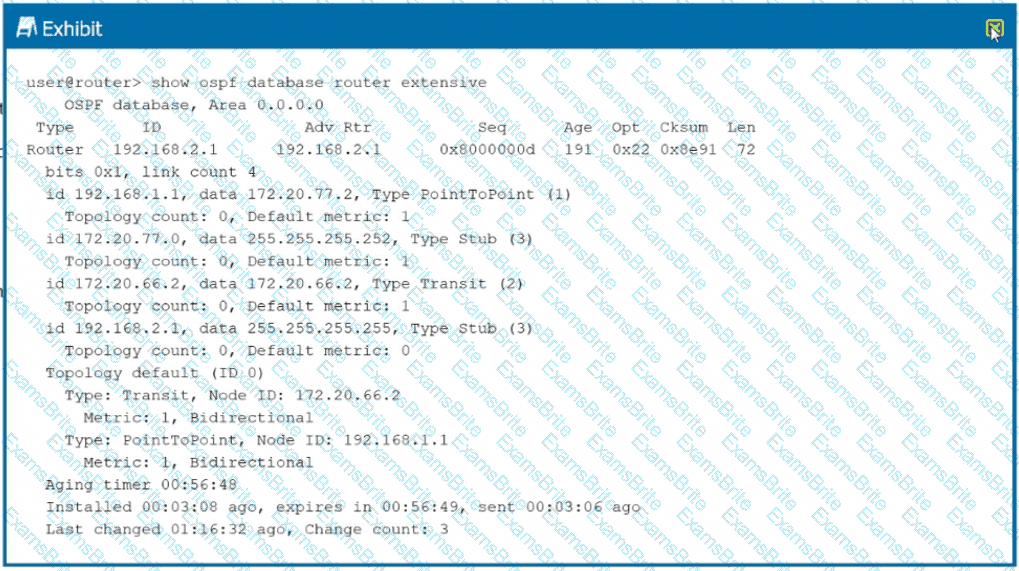
Exhibit

What is the OSPF router type shown in the exhibit for router 192.168.2.1?

Options:

A.  

neither an ABR nor an ASBR

B.  

an ASBR

C.  

both an ABR and an ASBR

D.  

an ABR

Discussion 0
Questions 14

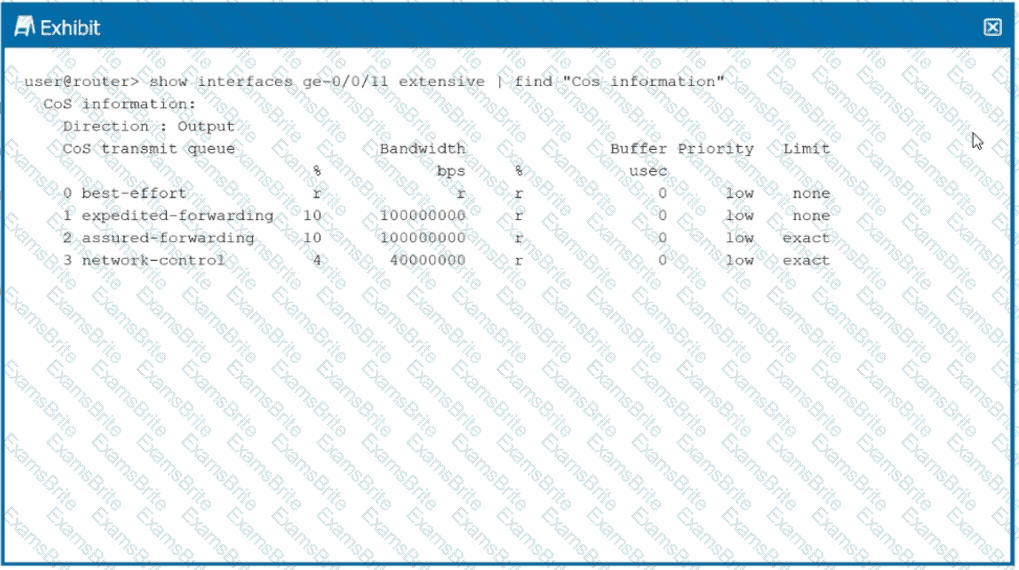
Exhibit

Referring to the exhibit, which two statements are correct? (Choose two.)

Options:

A.  

The bandwidth reservation for queue 0 is 76%.

B.  

During times of no network congestion, traffic that is placed in queue 2 will be dropped if more than 10% of the interface bandwidth is used

C.  

The bandwidth reservation for queue 0 is 100%.

D.  

During times of sustained network congestion, traffic that is placed in queue 2 will be dropped if more than 10% of the interface bandwidth is used

Discussion 0
Questions 15

Your Layer 2 network uses 802.1X to authenticate user devices connecting to the network. You are asked to include a new Layer 2 interface connection from the conference room in your network. You must ensure that only a single device is allowed to authenticate on this port at one time to avoid users from being able to plug in a rogue switch to this port.

In this scenario, which 802.1X method would you use for the new interface?

Options:

A.  

single-secure supplicant mode

B.  

multiple supplicant mode

C.  

single supplicant mode

D.  

MAC-RADIUS

Discussion 0
Questions 16

You are adding a new QFX Series switch to an EVPN-VXLAN IP fabric.

In this scenario, which two statements are correct? (Choose two.)

Options:

A.  

The encapsulation vxlan setting is configured under the protocols evpn hierarchy.

B.  

The family vpls signaling address family is configured under the BGP protocol.

C.  

The family evpn signaling address family is configured under the BGP protocol.

D.  

The loopback interface must be advertised using the BGP protocol.

Discussion 0
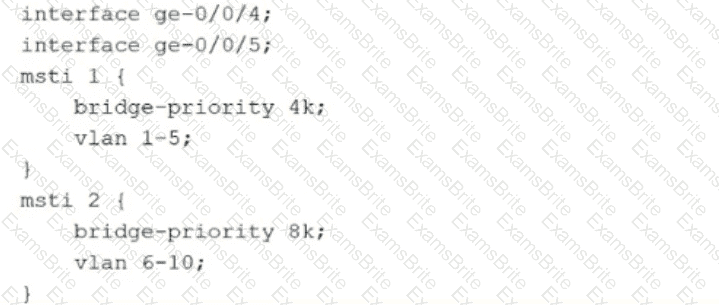
Questions 17

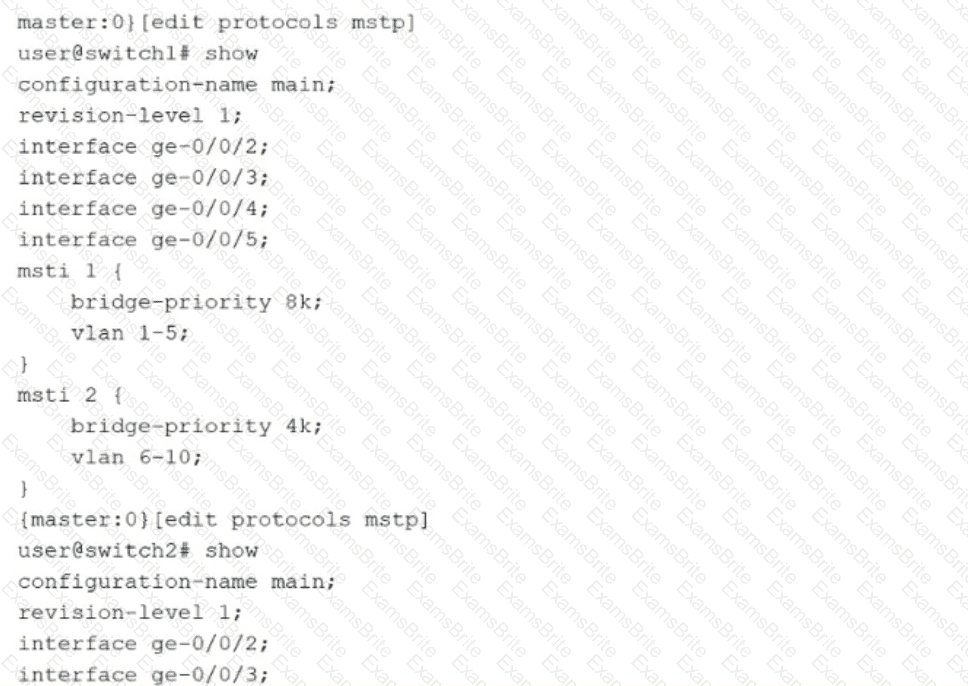
Exhibit

You are asked to configure VLAN load balancing on your network using MSTP. Referring to the exhibit, which two statements are correct? (Choose two.)

Options:

A.  

Switch1 will be the root bridge for msti 1.

B.  

Switch1 will be the root bridge for msti 2.

C.  

Switch 1 will not assume the role of root bridge for both mstil and msti2 if Switch2 goes down.

D.  

Switch1 will assume the role of root bridge for both mstil and msti2 if Switch2 goes down.

Discussion 0
Questions 18

An incorrectly configured routing policy at your service provider led to several hundred thousand routes being placed in your edge router ' s routing table In this scenario, how would you limit the number of prefixes received on a BGP peer session?

Options:

A.  

Enable the damping BGP parameter in the edge router configuration

B.  

Enable the prefix-limit BGP parameter in the edge router configuration.

C.  

Enable the graceful-restart BGP parameter in the edge router configuration.

D.  

Enable the advertise-inactive BGP parameter in the edge router configuration.

Discussion 0
Questions 19

You have several switches in your network that use Cisco ' s PVST+ protocol. You want your Juniper switches to interoperate with those devices.

In this scenario, which protocol would you use?

Options:

A.  

RPVST+

B.  

MSTP

C.  

VSTP

D.  

RSTP

Discussion 0
Questions 20

You are deploying a three-stage EVPN environment with VXLAN using EX and QFX Series switches. The leaf devices will perform the gateway services. Which two statements are correct in this scenario? (Choose two.)

Options:

A.  

Only the leaf devices must support VXLAN capabilities.

B.  

The leaf devices will function as VTEPs

C.  

Both the leaf and spine devices must support VXLAN capabilities.

D.  

The spine devices will function as VTEPs.

Discussion 0