Spring Sale 65% Discount Offer - Ends in 0d 00h 00m 00s - Coupon code: exams65

ExamsBrite Dumps

Service Provider Routing and Switching - Specialist (JNCIS-SP) Question and Answers

Service Provider Routing and Switching - Specialist (JNCIS-SP)

Last Update Feb 28, 2026
Total Questions : 65

We are offering FREE JN0-364 Juniper exam questions. All you do is to just go and sign up. Give your details, prepare JN0-364 free exam questions and then go for complete pool of Service Provider Routing and Switching - Specialist (JNCIS-SP) test questions that will help you more.


JN0-364 pdf

JN0-364 PDF

$36.75  $104.99
JN0-364 Engine

JN0-364 Testing Engine

$43.75  $124.99
JN0-364 PDF + Engine

JN0-364 PDF + Testing Engine

$57.75  $164.99
Questions 1

Exhibit:

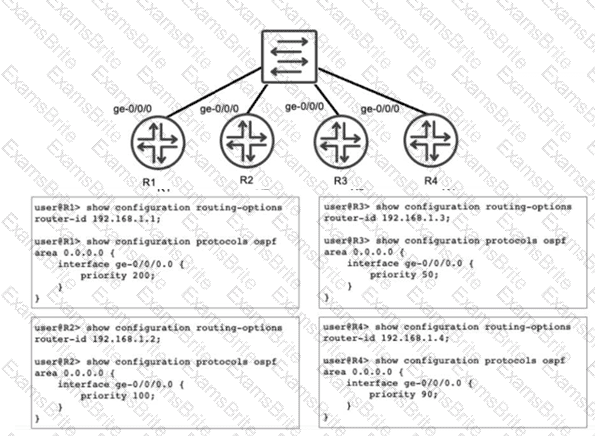
Referring to the exhibit, you have configured R1, R2, R3, and R4 to be a part of OSPF area 0 and you have connected them to a broadcast segment. Assuming all four routers come online within one minute of each other, which router becomes the DR and which router becomes the BDR?

Options:

A.  

R4 is the DR and R1 is the BDR

B.  

R1 is the DR and R4 is the BDR

C.  

R4 is the DR and R3 is the BDR

D.  

R1 is the DR and R2 is the BDR

Discussion 0
Questions 2

You are a network architect designing a brand new network. You want to deploy RSVP LSPs in this network. You are currently in the process of choosing whether to run OSPF or IS-IS as your interior gateway protocol. In this scenario, which two statements are correct about IGP traffic engineering extensions in an RSVP network? (Choose two.)
Options:

A.  

You must explicitly configure IS-IS to carry traffic engineering extensions.

B.  

In OSPF, traffic engineering extensions are enabled by default.

C.  

You must explicitly configure OSPF to carry traffic engineering extensions.

D.  

In IS-IS, traffic engineering extensions are enabled by default.

Discussion 0
Questions 3

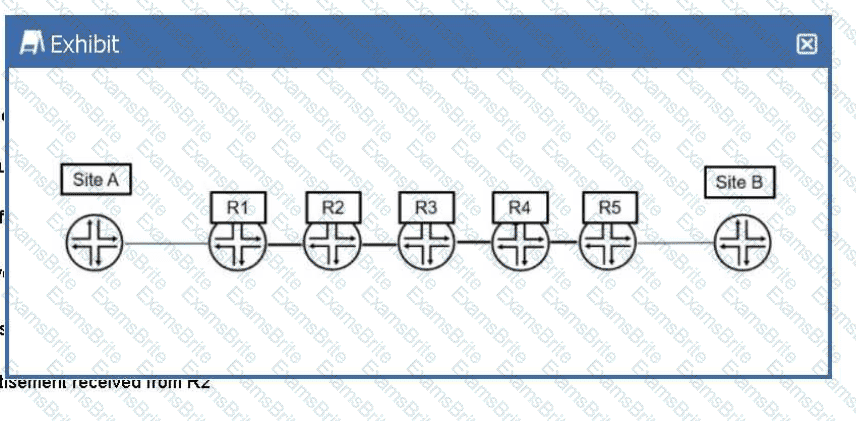
In the exhibit, Site A is sending traffic to Site B. R1 adds MPLS label 7166 to direct the traffic to R5. Which two criteria did R1 use to determine which label number to add to the traffic? (Choose two.)

Options:

A.  

the source address of the traffic

B.  

a label number received from R5

C.  

the destination address of the traffic

D.  

a label number advertisement received from R2

Discussion 0
Questions 4

Which term describes the router where traffic enters an MPLS label-switched path (LSP)?

Options:

A.  

egress router

B.  

transit router

C.  

penultimate router

D.  

ingress router

Discussion 0
Questions 5

You are configuring LDP in a service provider network. After enabling LDP on core interfaces, you notice that labels are being advertised for every loopback IPv4 address that is in your IGP. Which label distribution mode is being used in this scenario?

Options:

A.  

conservative retention

B.  

ordered control

C.  

downstream unsolicited

D.  

downstream on demand

Discussion 0
Questions 6

You are asked to configure a new network environment that will be based on IPv6 and use OSPF. In this scenario, which two statements correctly identify configuration task considerations? (Choose two.)

Options:

A.  

Participating interfaces must be configured with both IPv4 and IPv6 protocol families and addresses.

B.  

The router ID used must be based on a 128-bit identifier value.

C.  

The router ID used must be based on a 32-bit identifier value.

D.  

Participating interfaces are only required to be configured with the IPv6 protocol family and address.

Discussion 0
Questions 7

You are evaluating BGP between two Juniper routers and the BGP session is stuck in the Idle state. What would cause this behavior?

Options:

A.  

The BGP hold time is too short.

B.  

The BGP group type is set to internal instead of external.

C.  

The local AS number is missing.

D.  

The peer IP address is incorrect.

Discussion 0
Questions 8

Which two statements are correct about TLVs in IS-IS? (Choose two.)

Options:

A.  

LSPs can only contain one TLV.

B.  

TLVs only support encoding IPv4 routing information.

C.  

TLVs allow flexible encoding of routing information.

D.  

LSPs can contain multiple TLVs.

Discussion 0
Questions 9

Exhibit:

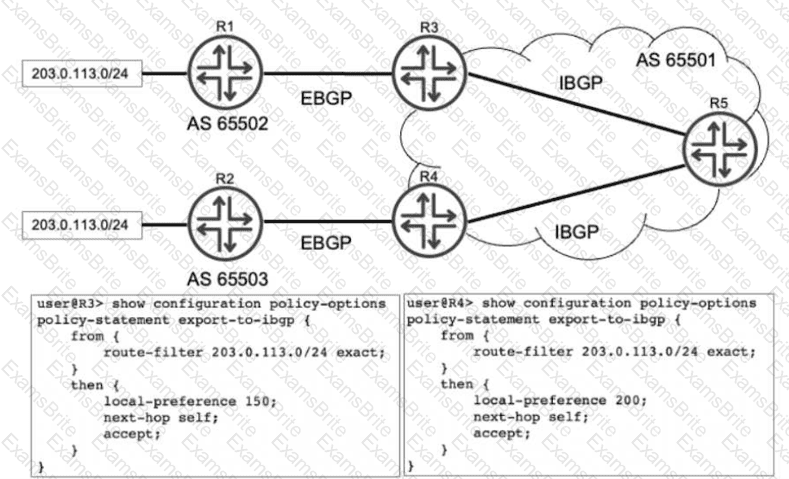
Referring to the exhibit, R1 and R2 are advertising the same prefix 203.0.113.0/24 to R3 and R4 over EBGP. R3 and R4 both advertise this prefix to R5. Which advertisement does R5 choose to install in its routing table?

Options:

A.  

The advertisement from R4 is chosen.

B.  

The advertisements from both R3 and R4, but R3 is chosen for forwarding.

C.  

The advertisement from R3 is chosen.

D.  

The advertisements from both R3 and R4, but R4 is chosen for forwarding.

Discussion 0
Questions 10

Which IS-IS packet type will establish and maintain neighbor relationships?

Options:

A.  

link-state PDU

B.  

hello PDU

C.  

partial sequence number PDU

D.  

update PDU

Discussion 0
Questions 11

Exhibit:

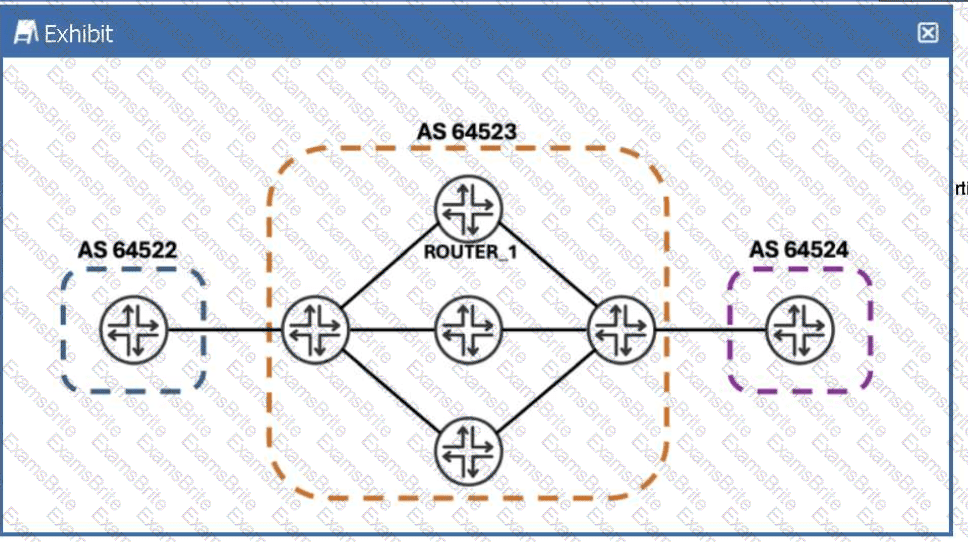
You must configure the router called ROUTER_1 to take all valid prefixes learned from internal BGP peers in AS 64523, and then re-advertise them to other internal BGP peers in the same autonomous system.

Referring to the exhibit, which configuration must you deploy on ROUTER_1 to accomplish this task?

Options:

A.  

Configure ROUTER_1's internal BGP group with a routing policy that exports prefixes learned from internal BGP.

B.  

Configure ROUTER_1's internal BGP group with the keyword cluster, followed by a unique 32-bit number.

C.  

Configure a routing policy on ROUTER_1 that removes the no-export BGP community from all received prefixes.

D.  

Configure ROUTER_1 to belong to a different autonomous system than the other BGP routers in your network.

Discussion 0
Questions 12

You are configuring BGP for IPv6 operations. In this scenario, which two statements are correct? (Choose two.)

Options:

A.  

The Autonomous System Number (ASN) must be a 64-bit value.

B.  

The router ID uses a 128-bit identifier value.

C.  

The router ID uses a 32-bit identifier value.

D.  

The Autonomous System Number (ASN) can be either a 32-bit or 64-bit value.

Discussion 0
Questions 13

You are the administrator for two Junos routers called R1 and R2. These two routers are directly connected to each other. These two routers run IS-IS and BFD. R1 is configured to send BFD packets every 300 milliseconds. R2 is configured to send BFD packets every 400 milliseconds. In this situation, what is the expected outcome?

Options:

A.  

Each router will send BFD packets at the rate that has been locally configured.

B.  

BFD will fail due to the mismatched timers.

C.  

Each router will negotiate to send BFD packets at the slowest of the two rates.

D.  

Each router will negotiate to send BFD packets at the fastest of the two rates.

Discussion 0
Questions 14

Exhibit:

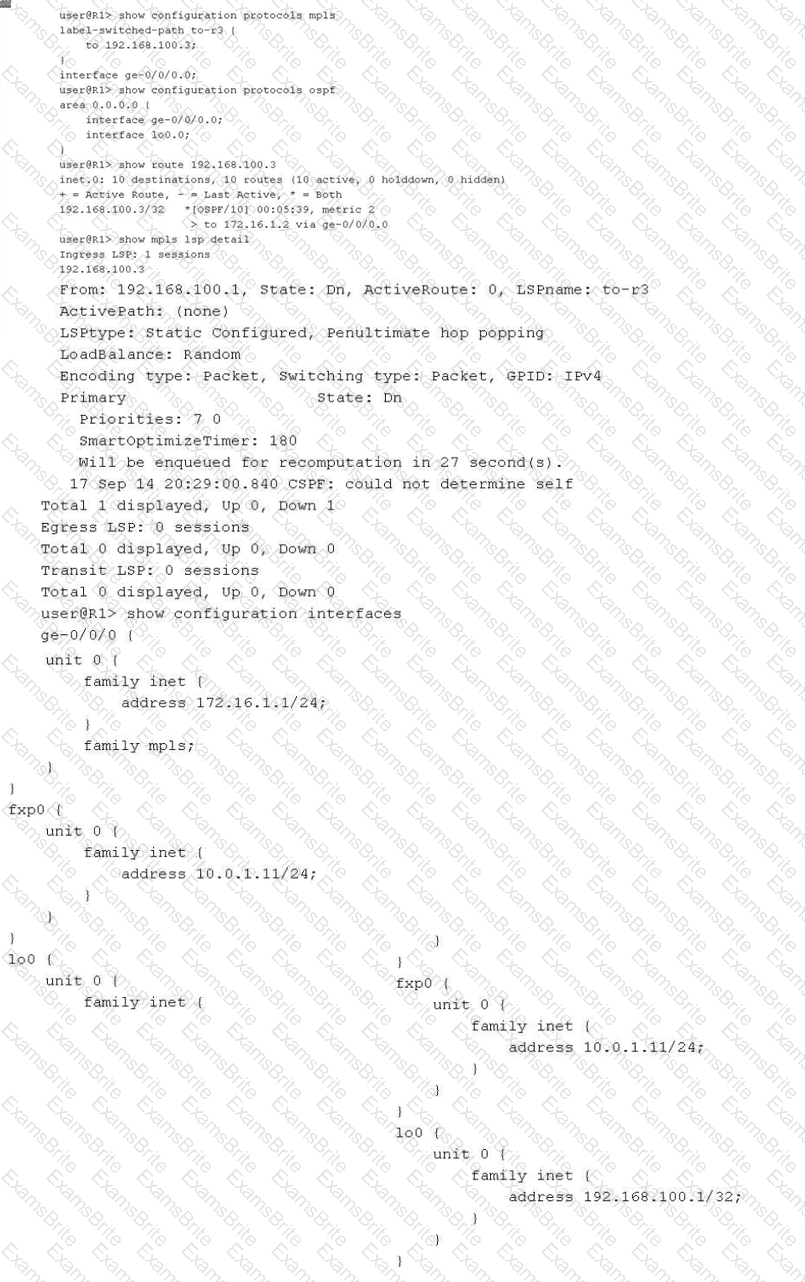
You have configured an MPLS LSP to 192.168.100.3. However, the LSP is in the down state. Referring to the exhibit, which two actions would solve this problem? (Choose two.)

Options:

A.  

Issue the set routing-options rib inet.3 static route 192.168.100.1 command and commit.

B.  

Issue the set protocols mpls label-switched-path to-r3 no-cspf command and commit.

C.  

Issue the set interfaces lo0 family mpls command on router R1 and commit.

D.  

Issue the set protocols ospf traffic-engineering command and commit.

Discussion 0
Questions 15

Exhibit:

user@Router-1> show route 172.24/16

inet.0: 9 destinations, 9 routes (9 active, 0 holddown, 0 hidden)

+ = Active Route, - = Last Active, * = Both

...

172.24.0.0/24 *[OSPF/150] 01:31:31, metric 0, tag 0

> to 172.20.0.2 via ge-0/0/2.0

to 172.20.1.2 via ge-0/0/3.0

user@Router-1> show route forwarding-table

Routing table: default.inet

Internet:

Destination Type RtRef Next hop Type Index NhRef Netif

...

172.24.0.0/24 user 0

172.20.0.2 ucst 551 2 ge-0/0/2.0

172.20.1.2 ucst 552 2 ge-0/0/3.0

Referring to the exhibit, which two statements are true? (Choose two.)

Options:

A.  

The router is performing default route load-balancing behavior.

B.  

The default route load-balancing behavior of this router has been modified.

C.  

This router will only choose the next hop with a > next to it in the routing table.

D.  

This router will choose both next hops in the routing table.

Discussion 0
Questions 16

What are three default BGP advertisement rules? (Choose three.)

Options:

A.  

EBGP peers advertise routes learned from IBGP or EBGP peers to other EBGP peers.

B.  

IBGP peers advertise routes received from EBGP peers to other IBGP peers.

C.  

IBGP peers advertise routes received from IBGP peers to other IBGP peers.

D.  

IBGP peers do not advertise routes received from IBGP peers to other IBGP peers.

E.  

IBGP peers do not advertise routes received from EBGP peers to other IBGP peers.

Discussion 0
Questions 17

Exhibit:

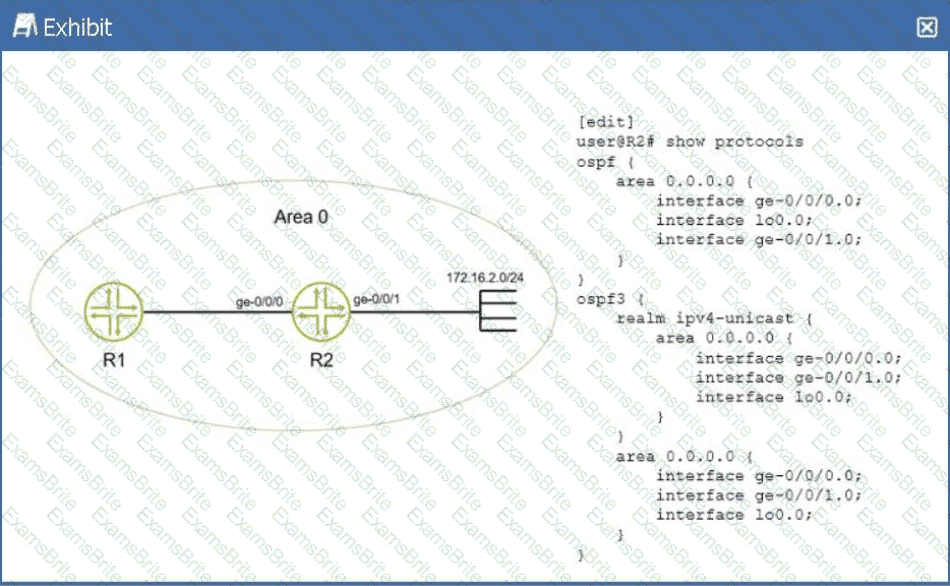
You have configured IPv4 and IPv6 in your network and all OSPF neighbors are established. You apply the configuration shown in the exhibit. Which statement is true in this scenario?

Options:

A.  

There will only be an OSPFv2 entry in R1 for network 172.16.2.0/24.

B.  

There will be an OSPFv2 and OSPFv3 entry in R1 for network 172.16.2.0/24.

C.  

There will not be a route in R1 for network 172.16.2.0/24.

D.  

There will only be an OSPFv3 entry in R1 for network 172.16.2.0/24.

Discussion 0
Questions 18

What are three extension headers supported by IPv6? (Choose three.)

Options:

A.  

destination options

B.  

hop-by-hop options

C.  

protocol

D.  

header checksum

E.  

fragment

Discussion 0
Questions 19

In an OSPF network, what is a purpose of a designated router?

Options:

A.  

to assign an OSPF router ID to all routers in the OSPF segment

B.  

to forward traffic within the configured subnet

C.  

to reduce OSPF traffic on the OSPF segment

D.  

to flood routes to all other OSPF devices in the entire domain

Discussion 0