Pre-Summer Sale 65% Discount Offer - Ends in 0d 00h 00m 00s - Coupon code: exams65

ExamsBrite Dumps

Junos - Associate (JNCIA-Junos) Junos OS 21.2 Question and Answers

Junos - Associate (JNCIA-Junos) Junos OS 21.2

Last Update May 30, 2026
Total Questions : 95

We are offering FREE JN0-106 Juniper exam questions. All you do is to just go and sign up. Give your details, prepare JN0-106 free exam questions and then go for complete pool of Junos - Associate (JNCIA-Junos) Junos OS 21.2 test questions that will help you more.


JN0-106 pdf

JN0-106 PDF

$36.75  $104.99
JN0-106 Engine

JN0-106 Testing Engine

$43.75  $124.99
JN0-106 PDF + Engine

JN0-106 PDF + Testing Engine

$57.75  $164.99
Questions 1

Which protocol is used to discover the Layer 2 (MAC) address of a next hop for IPv6 hosts?

Options:

A.  

DHCP

B.  

ARP

C.  

NDP

D.  

DNS

Discussion 0
Questions 2

You are creating a new user account on your Junos device. The user must be able to validate the routing table and interface statistics but should not be able to make any configuration changes. In this scenario, which permission flag would satisfy this requirement?

Options:

A.  

configure

B.  

all

C.  

view

D.  

network

Discussion 0
Questions 3

Which two functions are performed by the PFE? (Choose two.)

Options:

A.  

It maintains the routing table.

B.  

It implements firewall filters.

C.  

It selects active routes.

D.  

It forwards transit traffic.

Discussion 0
Questions 4

A security policy requires that a user account be created for auditing purposes. This user should only view configuration and operational data without making any changes. Which predefined login class would satisfy this requirement?

Options:

A.  

operator

B.  

unauthorized

C.  

read-only

D.  

super-user

Discussion 0
Questions 5

You asked a network engineer to configure a new logical interface on a Juniper router. The interface must use the fourth usable host address from the 172.16.40.128/29 subnet. Which IP address is correct in this scenario?

Options:

A.  

172.16.40.135

B.  

172.16.40.132

C.  

172.16.40.130

D.  

172.16.40.131

Discussion 0
Questions 6

What is the primary purpose of an IPv6 link-local address?

Options:

A.  

to provide Layer 2 connectivity

B.  

to assign a unique address for multicast traffic

C.  

to enable communication between devices on the same segment

D.  

to replace the default gateway in IPv6 networks

Discussion 0
Questions 7

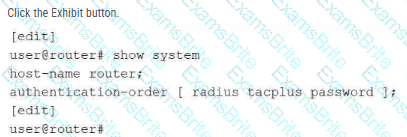
Exhibit:

You have configured multiple authentication methods on your Junos device, including RADIUS, TACACS+, and local user accounts. A user attempts to log in, but the RADIUS server is unavailable. Referring to the exhibit, which statement is correct?

Options:

A.  

The user is prompted to select a different authentication method.

B.  

The login attempt fails immediately.

C.  

Junos will continue to attempt to authenticate with the RADIUS server until it responds.

D.  

Junos attempts the next configured authentication method.

Discussion 0
Questions 8

Click the Exhibit button.

Referring to the exhibit, which two actions will occur when a packet matches the firewall filter? (Choose two.)

Options:

A.  

A counter will be incremented.

B.  

The packet will be discarded.

C.  

The packet will be forwarded.

D.  

An ICMP destination unreachable message will be returned.

Discussion 0
Questions 9

Which two statements are correct about SNMPv3? (Choose two.)

Options:

A.  

It uses plain-text community strings.

B.  

It protects against tampering and eavesdropping.

C.  

It is simpler to configure than SNMPv2c.

D.  

It provides encrypted passwords for secure communication.

Discussion 0
Questions 10

A network administrator must set up the initial configuration of the out-of-band management interface on a new Juniper router to ensure management traffic is isolated from the default routing table (inet.0). In this scenario, which configuration step is required to accomplish this task in Junos OS?

Options:

A.  

Configure an IP address on interface ge-0/0/0.0 and enable ethernet-switching family.

B.  

Configure the lo0.0 loopback interface with a management IP and apply it to the [edit system services] hierarchy.

C.  

Assign an IP address to the me0.0 interface and set the routing-options to instance-type virtual-router.

D.  

Assign an IP address to interface fxp0.0 or em0.0 and use the command set system management-instance to enable the management routing instance.

Discussion 0
Questions 11

You must add a large hierarchical configuration to your Junos device. You also want to completely replace the existing candidate configuration with a new configuration file. Which command would allow you to accomplish these tasks?

Options:

A.  

load merge terminal

B.  

load override terminal

C.  

load factory default

D.  

load set terminal

Discussion 0
Questions 12

An administrator wants to set up a remote user authentication service for the many users that access a Juniper security device. In this scenario, what are two supported authentication protocols? (Choose two.)

Options:

A.  

RADIUS

B.  

TACACS+

C.  

SHA

D.  

IPsec

Discussion 0
Questions 13

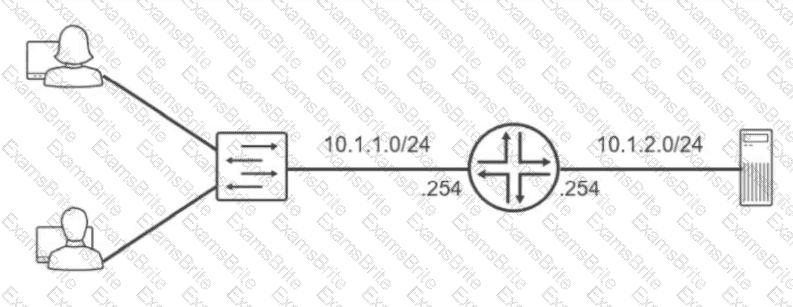
Exhibit:

Referring to the exhibit, which routing configuration is required for these two users to access the remote server?

Options:

A.  

Users and the server require a default gateway.

B.  

Trunk ports must be enabled on the switch.

C.  

Users must connect directly to the router.

D.  

A routing protocol must be enabled on the router.

Discussion 0
Questions 14

Which interface type prefix represents a 10-Gigabit Ethernet interface?

Options:

A.  

ge

B.  

xe

C.  

et

D.  

fe

Discussion 0
Questions 15

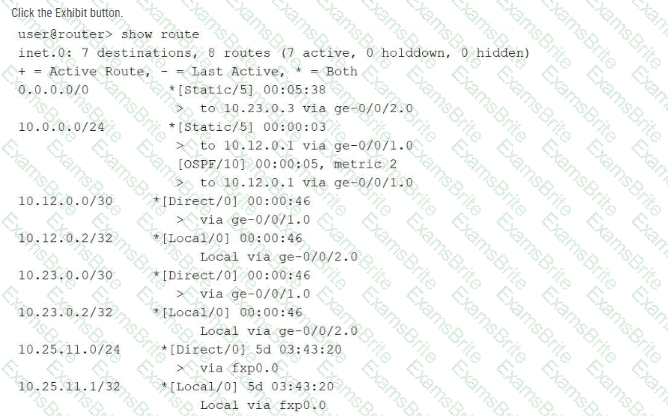
Exhibit:

Referring to the exhibit, what is the next hop for IP address 10.0.0.9?

Options:

A.  

192.168.2.1

B.  

192.168.1.1

C.  

192.168.3.1

D.  

192.168.0.1

Discussion 0
Questions 16

Which statement accurately describes the purpose of route preference in Junos OS?

Options:

A.  

It sets the metric for forwarding traffic through the Packet Forwarding Engine.

B.  

It determines which route is selected as active when multiple routes to the same destination exist.

C.  

It controls the redistribution of routes between routing instances.

D.  

It determines the maximum number of routes that can be installed in the routing table.

Discussion 0
Questions 17

How are the Routing Engine and the Packet Forwarding Engine components connected?

Options:

A.  

They use shared memory access.

B.  

They use external breakout cables.

C.  

They use an MPLS connection.

D.  

They use an internal Ethernet link.

Discussion 0
Questions 18

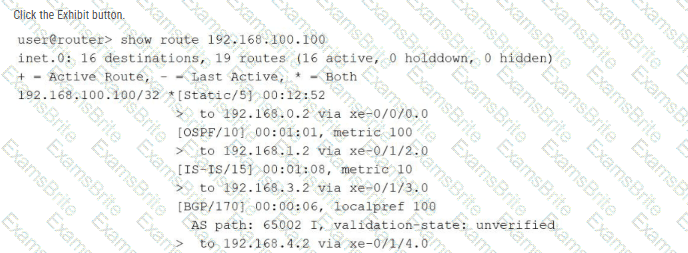
Referring to the exhibit using the show route 192.168.100.100 command output, over which interface will the traffic be forwarded?

Options:

A.  

xe-0/1/3.0

B.  

xe-0/0/0.0

C.  

xe-0/1/4.0

D.  

xe-0/1/2.0

Discussion 0
Questions 19

Which two statements are examples of exception traffic? (Choose two.)

Options:

A.  

An IP packet with the Router Alert option set in the IP options field.

B.  

SSH traffic to the local Junos OS device.

C.  

An IP packet that has the IP precedence CoS bits of 111 in the ToS field.

D.  

SSH traffic to a remote server on the Internet.

Discussion 0
Questions 20

Which IPv4 address and subnet mask combination represents a point-to-point link with only two usable host addresses?

Options:

A.  

192.168.1.0/30

B.  

192.168.1.0/29

C.  

192.168.1.0/24

D.  

192.168.1.0/28

Discussion 0
Questions 21

Which statement is correct when Router R1 receives a packet from User A destined for User B as shown in the exhibit?

Options:

A.  

Router R1 replaces the destination IP address in the packet with the IP address of Router R2.

B.  

Router R1 leaves the packet unchanged.

C.  

Router R1 replaces the destination MAC address in the packet with the MAC address of Router R2.

D.  

Router R1 replaces the destination MAC address in the packet with the MAC address of User B.

Discussion 0
Questions 22

Which two statements accurately describe the relationship between the routing table and the forwarding table on a Junos device? (Choose two.)

Options:

A.  

The routing table resides in the data plane for fast lookups.

B.  

The routing table selects the best route based on routing information.

C.  

The forwarding table is built from the routing table.

D.  

The routing table is built from the forwarding table.

Discussion 0
Questions 23

Options:

A.  

Configure an NTP server.

B.  

Configure a DNS server.

C.  

Set the date and time setting manually.

D.  

Reboot the device.

Discussion 0
Questions 24

Which protocol provides secure remote CLI access to a Junos device?

Options:

A.  

FTP

B.  

SNMP

C.  

Telnet

D.  

SSH

Discussion 0
Questions 25

What are two fiber-optic connector types? (Choose two.)

Options:

A.  

LC

B.  

RJ-45

C.  

SC

D.  

BNC

Discussion 0
Questions 26

What is the main function of the forwarding table on a Junos device?

Options:

A.  

It contains only active routes used to forward packets through the PFE.

B.  

It advertises routes to neighboring routers.

C.  

It stores all learned routes from routing protocols.

D.  

It determines the best route based on route preference.

Discussion 0
Questions 27

Which two statements about route preference in Junos are correct? (Choose two.)

Options:

A.  

Both direct and static routes have the same preference.

B.  

Both direct and local routes have the same preference.

C.  

Both OSPF internal and OSPF AS external routes have the same preference.

D.  

Both EBGP and IBGP routes have the same preference.

Discussion 0
Questions 28

Referring to the exhibit, which command would be used to view the IP subnet addresses associated with prefix-list DIRECT-IP?

Options:

A.  

show policy-options prefix-list DIRECT-IP

B.  

show configuration policy-options prefix-list DIRECT-IP

C.  

show configuration policy-options prefix-list DIRECT-IP | display inheritance

D.  

show configuration policy-options prefix-list DIRECT-IP apply-path

Discussion 0