QMS ISO 9001:2015 Lead Auditor Exam
Last Update Oct 15, 2026
Total Questions : 267
We are offering FREE ISO-9001-Lead-Auditor PECB exam questions. All you do is to just go and sign up. Give your details, prepare ISO-9001-Lead-Auditor free exam questions and then go for complete pool of QMS ISO 9001:2015 Lead Auditor Exam test questions that will help you more.

Which one of the following options best describes the purpose of a Stage 1 third-party audit?
Scenario 6: Davis Clinic (DC) is an American medical center focused on integrated health care. Since its establishment DC was committed to providing qualitative services for its clients, which is the reason why the company decided to implement a quality management system (QMS) based on ISO 9001. After a year of having an active QMS in place, DC applied for a certification audit.
A team of five auditors, from a well-known certification body, was selected to conduct the audit. Eva was appointed as the audit team leader. After three days of auditing, the team gathered to review and examine their findings. They also discussed the audit findings with DC ' s top management and then drafted the audit conclusions.
In the closing meeting, which was held between the audit team and the top management of DC. Eva presented two nonconformities that were detected during the audit. Eva stated that the company did not retain documented information regarding its outsourced services for an analysis laboratory and regarding the conducted management reviews. During the closing meeting, the audit team required from DCs top management to come up with corrective action plans within two weeks. Although the top management did not agree with the audit findings, the audit team insisted that the auditee must submit corrective actions within the given time frame in order for the audit activities to continue.
Once the action plans were evaluated, the audit team began preparing the audit report. Eva required from the team to provide accurate descriptions of the audit findings and the audit conclusions. The report was then distributed to all the interested parties involved in the audit, including the certification body Based on the report, the certification body together with Eva, as the audit team leader, made the certification decision.
Based on the scenario above, answer the following question:
Is it acceptable for the certification body and Eva to make the certification decision together?
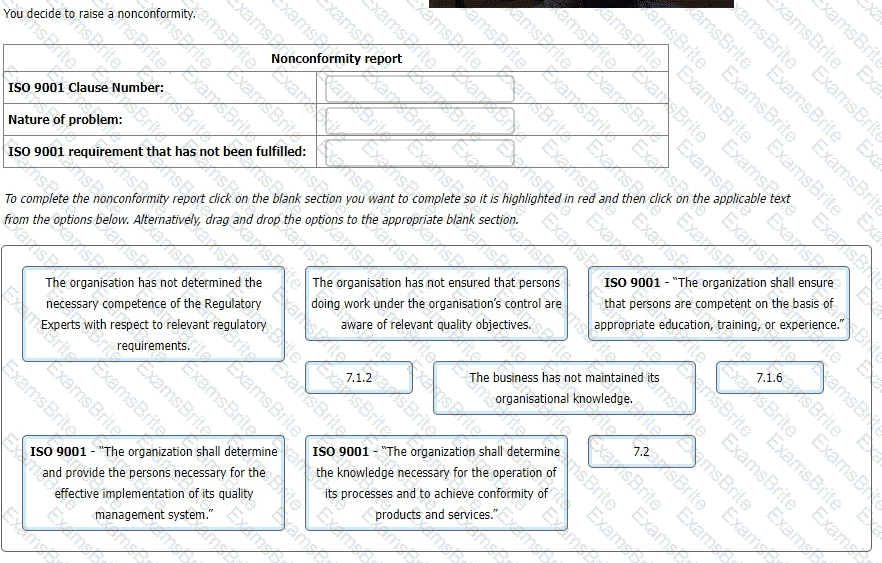
You are carrying out an audit to ISO 9001 at an organisation which offers regulatory consultancy services to manufacturers of cosmetics.
You are interviewing the Technical Director (TD), who manages a team of regulatory experts responsible for providing regulatory services to customers.
You: " How do you ensure your regulatory team ' s competence concerning regulatory requirements is maintained? "
TD: " The two Regulatory Experts we employ full-time have years of experience of working in the cosmetics industry. "
You: " How is their regulatory competence maintained? "
TD: " They are dedicated individuals with lots of contacts in the sector. "
You: " How does the business enable them to maintain their understanding of current regulatory requirements? "
TD: " We leave that up to them. "
An ISO 9001 certified organization sells packaged food. To maximize the benefits of third-party certification to the organization and stakeholders, the organization has labelled their product ' ISO 9001 certified product ' and is selling it as ' quality food ' .
Which TWO of the following describes this situation in the context of the purpose and benefits of third-party ISO 9001 certification?
Scenario 6: Davis Clinic (DC) is an American medical center focused on integrated health care. Since its establishment DC was committed to providing qualitative services for its clients, which is the reason why the company decided to implement a quality management system (QMS) based on ISO 9001. After a year of having an active QMS in place, DC applied for a certification audit.
A team of five auditors, from a well-known certification body, was selected to conduct the audit. Eva was appointed as the audit team leader. After three days of auditing, the team gathered to review and examine their findings. They also discussed the audit findings with DC ' s top management and then drafted the audit conclusions.
In the closing meeting, which was held between the audit team and the top management of DC. Eva presented two nonconformities that were detected during the audit. Eva stated that the company did not retain documented information regarding its outsourced services for an analysis laboratory and regarding the conducted management reviews. During the closing meeting, the audit team required from DCs top management to come up with corrective action plans within two weeks. Although the top management did not agree with the audit findings, the audit team insisted that the auditee must submit corrective actions within the given time frame in order for the audit activities to continue.
Once the action plans were evaluated, the audit team began preparing the audit report. Eva required from the team to provide accurate descriptions of the audit findings and the audit conclusions. The report was then distributed to all the interested parties involved in the audit, including the certification body Based on the report, the certification body together with Eva, as the audit team leader, made the certification decision.
Based on the scenario above, answer the following question:
According to Scenario 6, the audit team required DC’s top management to submit corrective action plans within two weeks. Is this action acceptable?
Select one option that must be considered when determining the scope of a QMS to ISO 9001.
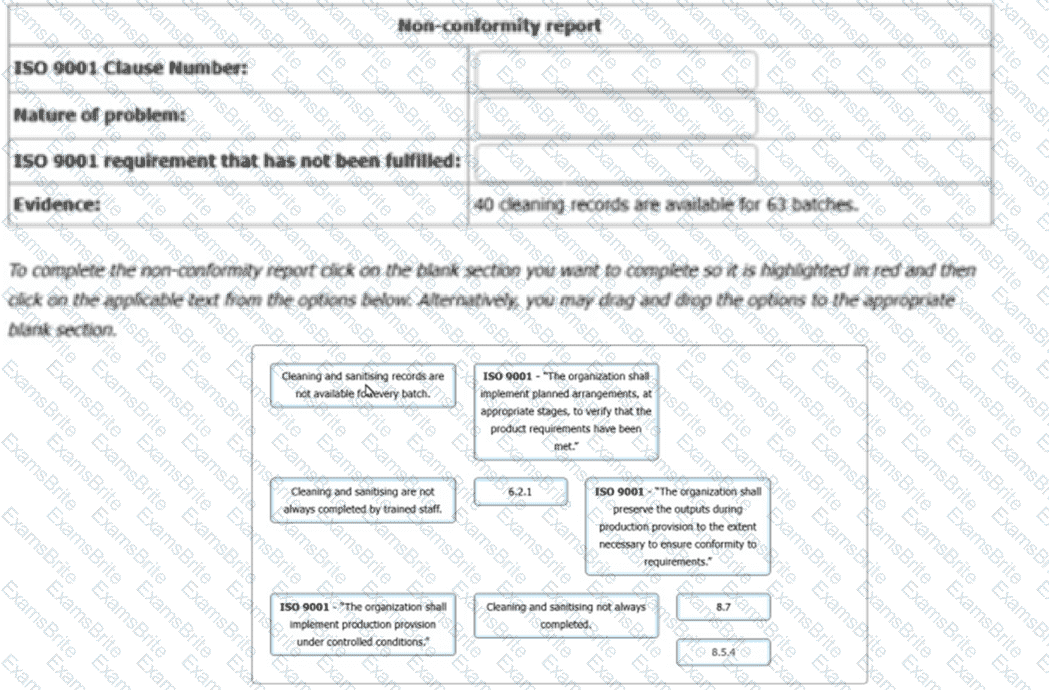
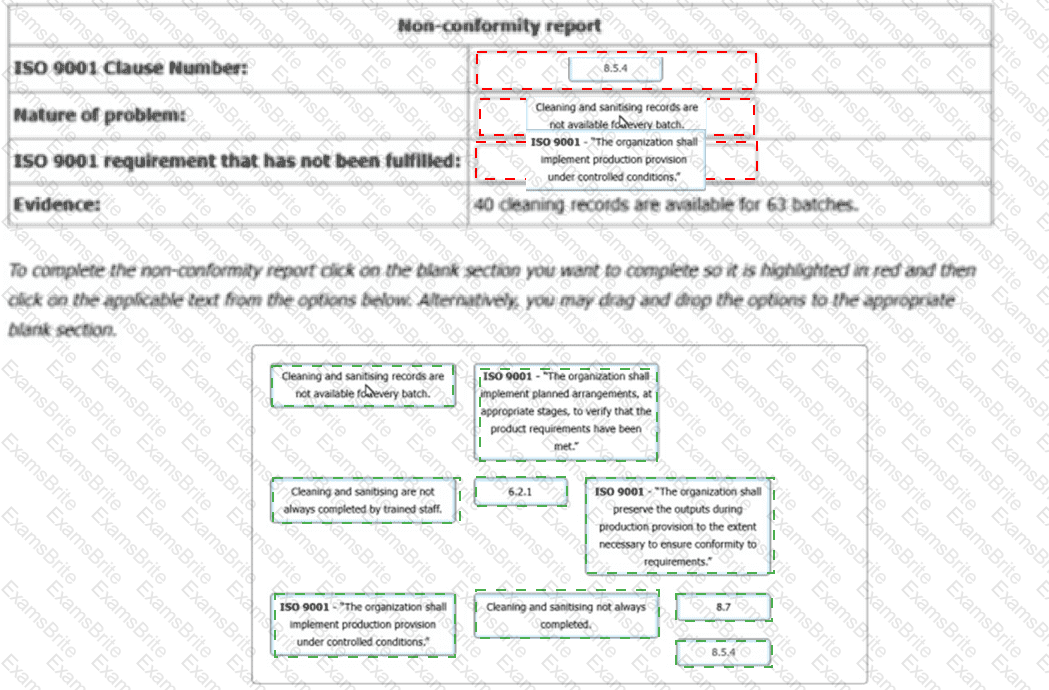
You are carrying out an audit at a single-site organisation seeking certification to ISO 9001 for the first time. The organisation manufactures cosmetics for major retailers.
You are interviewing the Manufacturing Manager (MM).
You: " I would like to begin by looking at the cleaning controls. "
MM: " We record the cleaning of the equipment at the end of every batch. This document details the minimum cleaning frequency and the procedures to follow for all areas and each item of equipment. The person who carries out the cleaning puts their initial on the document and records the time and date alongside. "
Narrative: You sample production records over 3-days and note down evidence of nonconformity as per the table below.
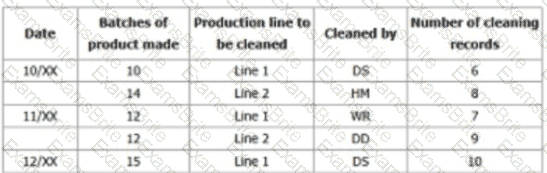
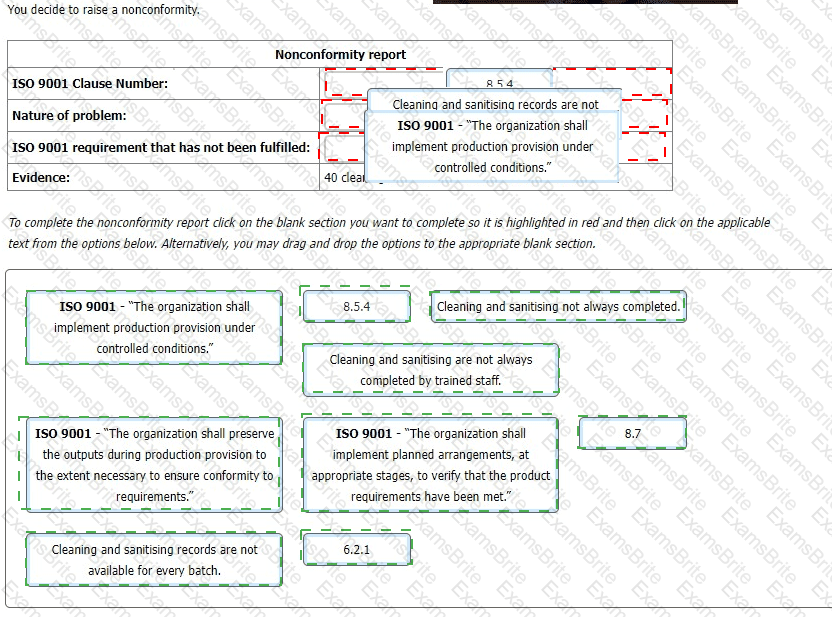
You decide to raise a non-conformity.
" A set of interrelated or interlacing elements of an organization to establish policies and objectives, and processes to achieve those objectives " is the definition of a/an:
You work for an organisation which provides packaged food to the public. You are asked to lead a team (you as the leader and two other auditors) of a one-day audit of HMB, a supplier of hamburgers. It is 4 pm, and the audit is coming to an end. You are having an internal meeting with the team to decide what will be presented to the auditee during the closing meeting. The closing meeting is scheduled for 5 pm.
You, as the audit team leader, audited HMB’s Top Management and the two production lines of hamburger production (PL1 and PL2).
Auditor 1 audited the laboratory.
You to Auditor 1: “What findings would you report?”
Auditor 1: “When reviewing the laboratory records, I noticed that during the whole morning, HMB’s supervisors of each production line sent samples to be analysed by the laboratory. The samples from PL1 included the reference to the raw meat batch being used and the name of the sub-supplier, while the reports from PL2 referred only to the name of the sub-supplier. HMB’s Procedure P-02 Rev.3 says that samples sent to the laboratory have to include reference to the raw meat batch being used, to ensure traceability of the products.”
You to Auditor 2: “OK, what do you think?”
Auditor 2: “I think that this is a non-conformity.”
You to Auditor 1: “OK. How would you describe the evidence on which the non-conformity will be based?”
Identify which one of the following statements best describes the identified evidence.
The procedures of an organisation require that all purchase orders have to be signed by the Purchasing Manager, or, in her absence, by the Production Manager. During an audit carried out in November 2020, an auditor determined that during three weeks in February 2020, the purchase orders were not signed. You raise a nonconformance under Clause 8.4.3 of ISO 9001:2015.
Which one of the following answers would you accept as a ' correction ' from the Purchasing Manager?
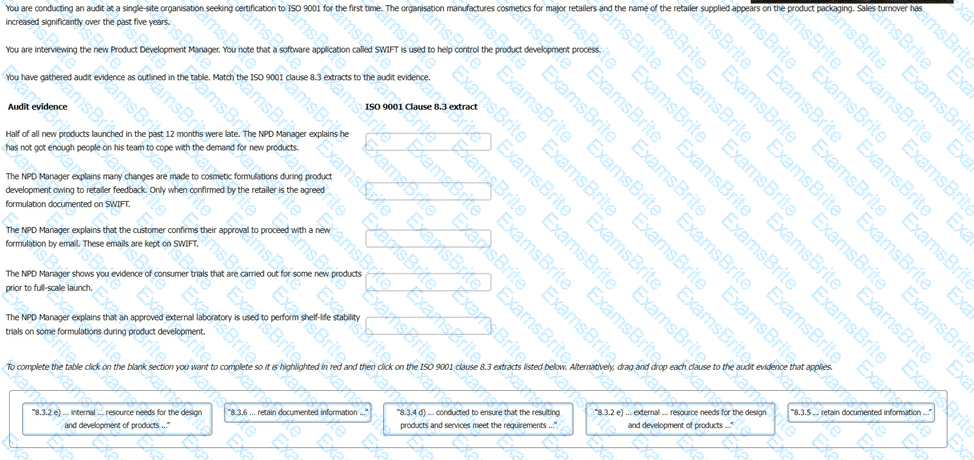
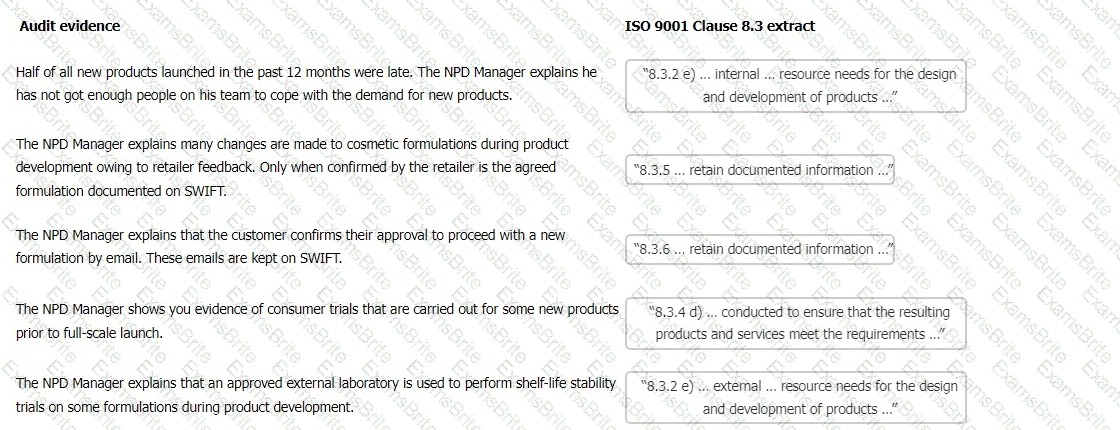
You are conducting an audit at a single-site organisation seeking certification to ISO 9001 for the first time. The organisation manufactures cosmetics for major retailers and the name of the retailer supplied appears on the product packaging. Sales turnover has increased significantly over the past five years
You are interviewing the new Product Development Manager. You note that a software application called SWIFT is used to help control the product development process.
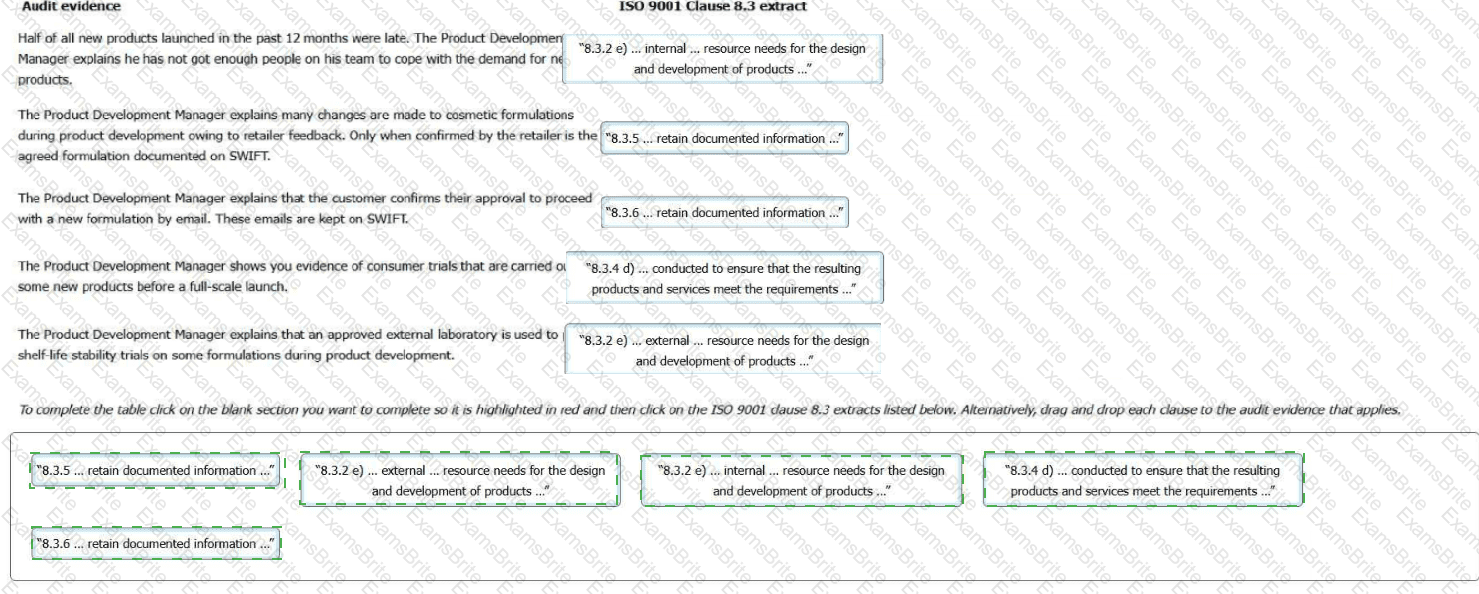
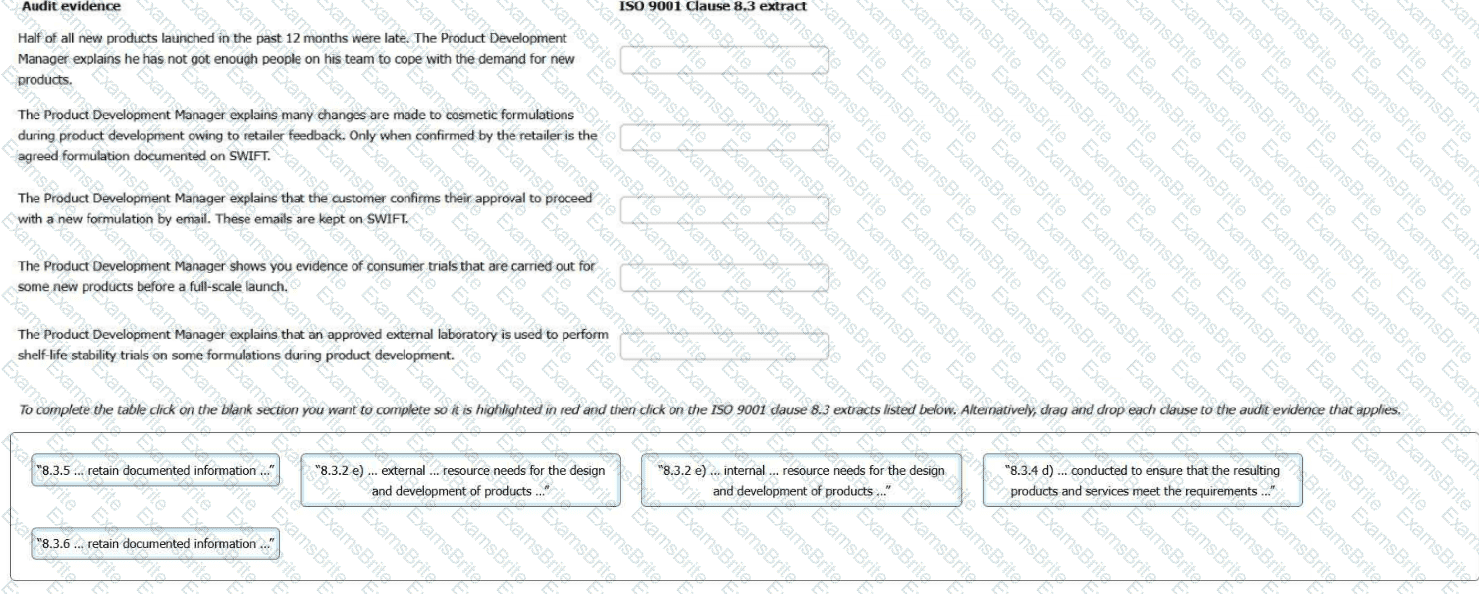
You have gathered audit evidence as outlined in the table. Match the ISO 9001 clause 8.3 extracts to the audit evidence.
Noitol is an organisation specialising in the design and production of e-learning training materials for the insurance market. During an ISO 9001 audit of the development department, the auditor asks the Head of Development about the process used for validation of the final course design. She states that they usually ask customers to validate the product with volunteers. She says that the feedback received often leads to key improvements.
The auditor samples the design records for a recently completed course for the 247 Insurance organisation. Design verification was carried out but there was no validation report. The Head of Development advises that this customer required the product on an urgent basis, so the validation stage was omitted. When asked, the Head estimates that this occurs about 50% of the time. She confirms that they always ask for feedback and often make changes. There is no record of feedback in the design file for the course.
The auditor decides to review the training course design process in more depth.
Select three options that provide a meaningful audit trail for this process.
You are conducting a Stage 2 audit at an organisation that services refrigeration equipment for a large customer base. The scope of certification is “Provision of refrigeration equipment maintenance and repair services”. You are interviewing the Managing Director to learn more about the organisation and to explore how the requirements for policy, objectives, and risks and opportunities in ISO 9001 are addressed.
The Managing Director explains that they only use sub-contract refrigeration engineers and do not have any full-time refrigeration engineers, which helps to optimise overhead costs.
The Managing Director adds that the ISO 9001 requirements for the competence of personnel extend to both sub-contract and full-time staff.
You then asked 2 of the sub-contract engineers what they could do to contribute to the effectiveness of the quality management system, they replied stating that “we are not really sure as we have not been told how we could contribute”. The Managing Director added that this is not applicable as they only use sub-contractors who operate ISO 9001 certificated quality management systems. The documented information provided to the auditor confirms this.
Which clause in ISO 9001 has not been fulfilled in this instance?
The Closing meeting of a second-party audit was planned for 6 pm with the general manager and the quality manager.
At 6 pm, when the audit team enters the meeting room, only the Quality Manager is present and walting for them.
The dialogue among them is as follows:
Auditor team leader: " Good evening, could you please inform the general manager that we are ready to start with the closing meeting? "
Quality manager: " Good evening. I am sorry to inform you that the general manager will not be able to attend the meeting. He will try to
participate virtually to make some closing remarks. "
Auditor team leader: " OK. We identified seven nonconformities - these are the reports. Could you please review them and sign them? "
Quality manager: " OK. As you know, I reviewed them after yesterday ' s meeting and accept of all them, where shall I sign? "
General manager (from speakers in the room and addressing the quality manager): " Hold on! Do not sign the two nonconformities related to ABC
Bank! I have just checked, and we did not provide any services to ABC Bank during September! You can sign the remaining five nonconformities. "
How would you proceed with the audit? Select one.
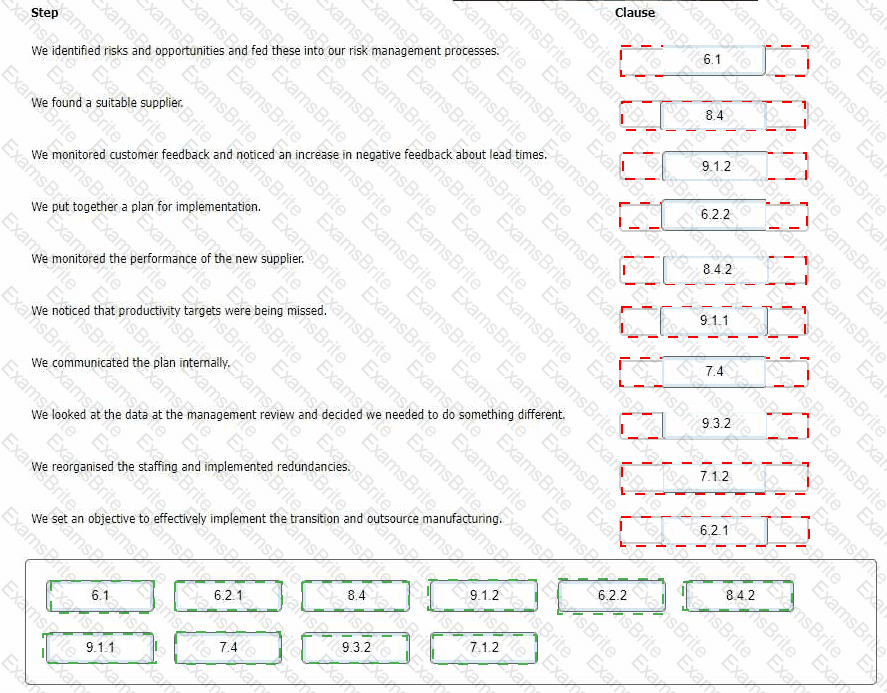
You, as auditor, are in dialogue with the quality lead and managing director of a small business that supplies
specialist laboratory equipment and furniture.
You: " I ' d like to look at how you manage change in the organisation. What changes have you made as a
business, say, over the last 12 months? "
Auditee: " We have made some strategic changes, the main one being that we no longer manufacture our
own products in house. "
You: " That sounds like quite a significant change. What has been the impact of that? "
Auditee: " We now mainly sell other manufacturers ' products, under their brand names, and have outsourced
manufacture of our own brand products to one of our suppliers. Unfortunately, we had to make six members
of our staff redundant. This represents about 20% of our workforce, so this has been quite a challenging
time. "
You: " I ' m sure. What were the reasons for making the change? "
Auditee: " Our manufacturing section was a small operation, and we struggled to cope with fluctuations in
demand. During busy periods, we found it hard to meet lead times, and in quiet periods we had staff with
little to do. This was having an impact on customer satisfaction and meant we had to charge premium prices
that made our product uncompetitive. "
You: " How did you go about the change? "
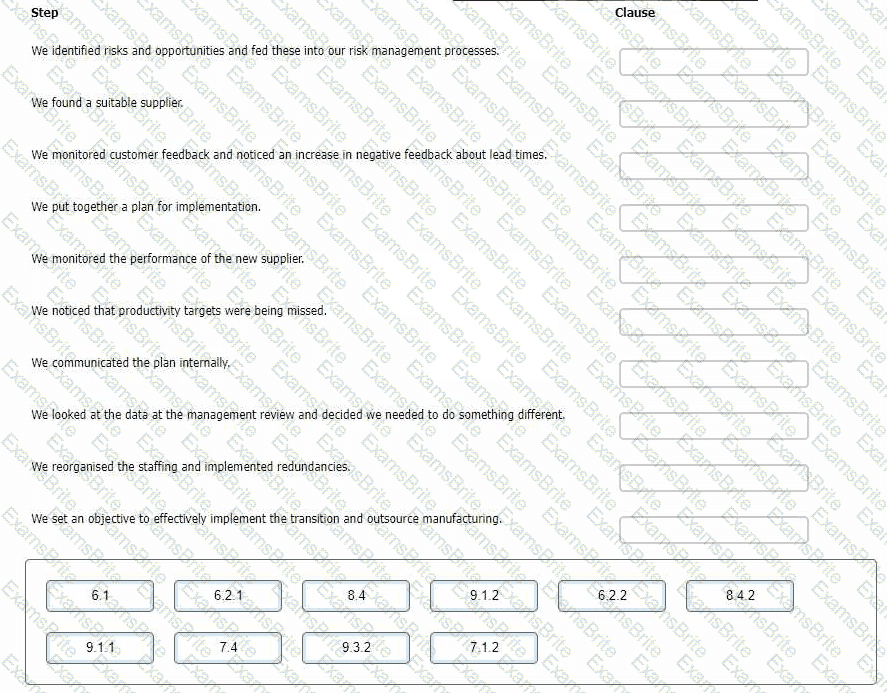
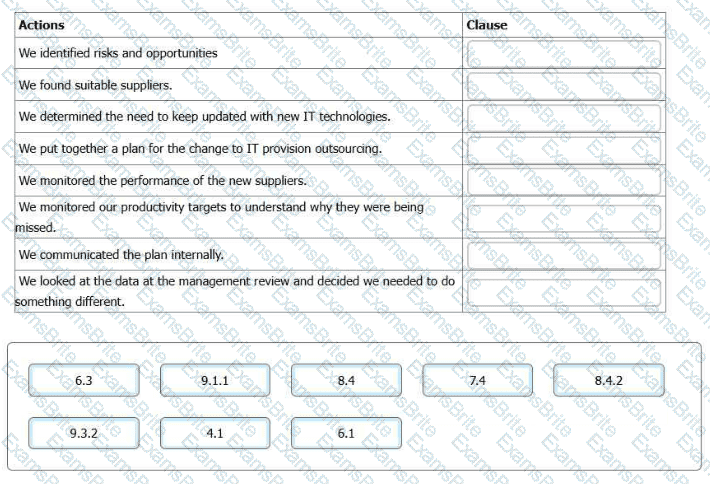
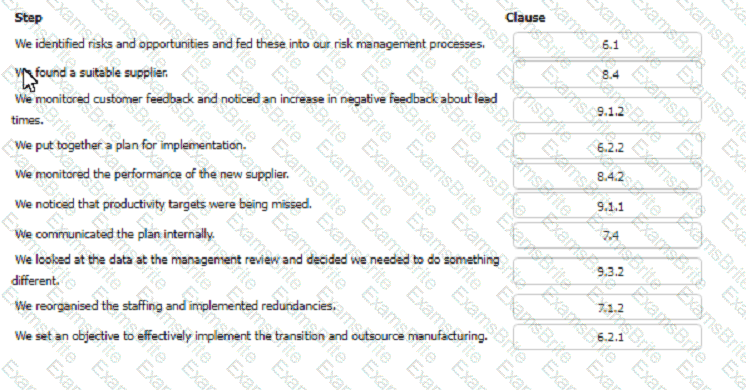
In relation to the auditor ' s question about how the change was managed, the auditee mentions the steps
listed below. Match the ISO 9001 clauses to the steps.
To complete the table, click on the blank section you want to complete so it is highlighted in red and then
click on the ISO 9001 clauses listed below. Alternatively, drag and drop each clause to show which step the
requirement applies to.
Scenario 2:
Bell is a Canadian food manufacturing company that operates globally. Their main products include nuts, dried fruits, and confections. Bell has always prioritized product quality and has maintained a good reputation for many years. However, the company ' s production error rate increased significantly, leading to more customer complaints.
To increase efficiency and customer satisfaction, Bell implemented a Quality Management System (QMS) based on ISO 9001. The top management established a QMS implementation team comprising five middle managers from various departments, including Leslie, the quality manager.
Leslie was responsible for assigning responsibilities and authorities for QMS-related roles. He also suggested including a top management representative in the QMS team, but top management declined due to other priorities.
The team defined the QMS scope as:
" The scope of the QMS includes all activities related to food processing. "
Leslie established a quality policy and presented it to the team for review before top management approval. Top management also proposed a new strategy for handling customer complaints, requiring biweekly customer surveys to monitor customer perceptions.
Which situation presented in scenario 2 is NOT compliant with ISO 9001?
Knowledge and skills are requirements of the auditor ' s competence. Select two from the following topics of knowledge that apply to every member of an audit team auditing an ISO 9001 quality management system.
Which one of the following is not an ISO 9000:2015 quality management principle?
(When raising a non-conformity during an audit, which two of the following items should you include in the non-conformity statement?)
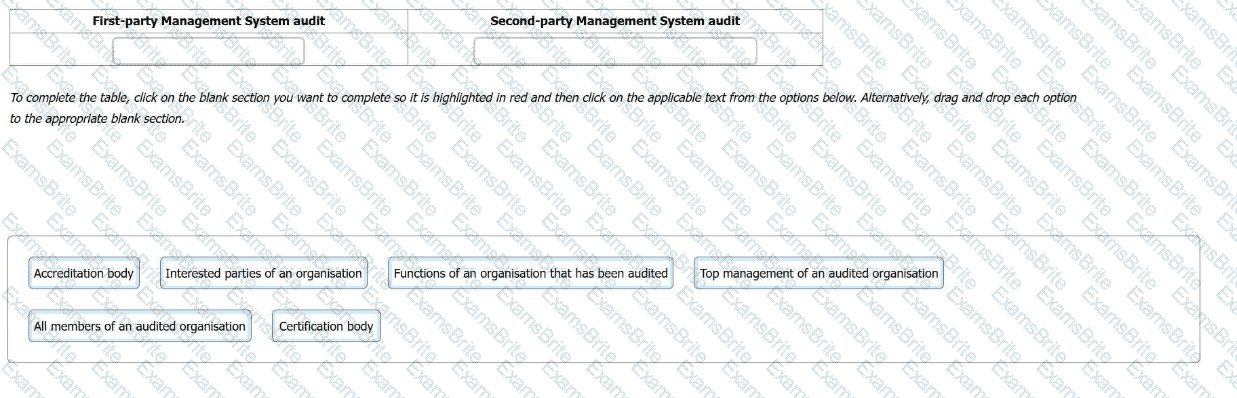
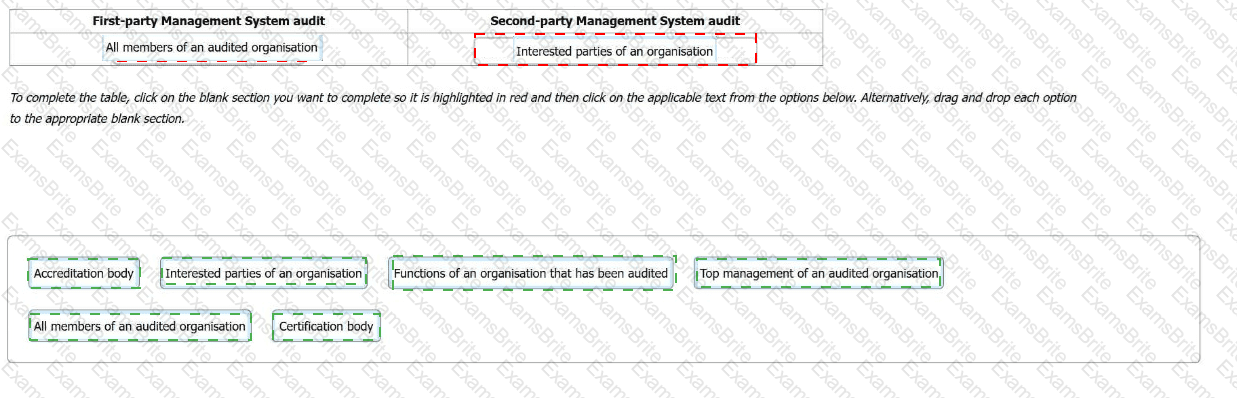
Which two of the following auditors would not participate in a first-party audit?
You are preparing an audit plan for a third-party ISO 9001 audit of organisation ABC that extracts lithium from mines in Bolivia.
ABC’s head office is in Lima, Peru, and it outsources all processes related to Production, Maintenance, Procurement and Human Resources to local Bolivian companies. ABC personnel manage in Bolivia only the Planning function.
Your plan starts in Lima, then you decide to go to Bolivia and fly back to Lima to audit the Quality Function and Top Management and conduct the closing meeting.
What would be your best decision when planning the audit in Bolivia?
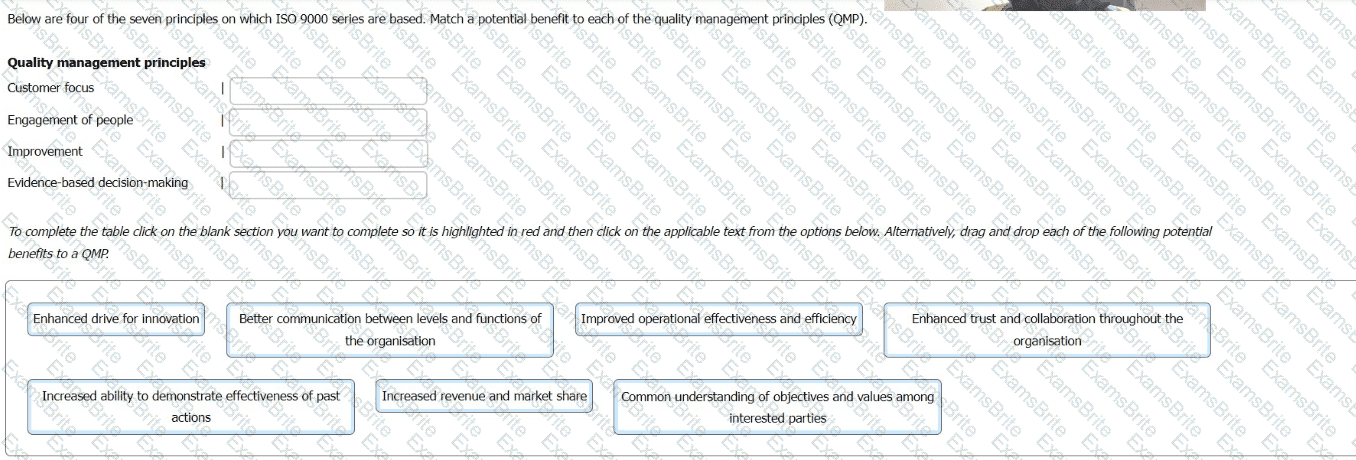
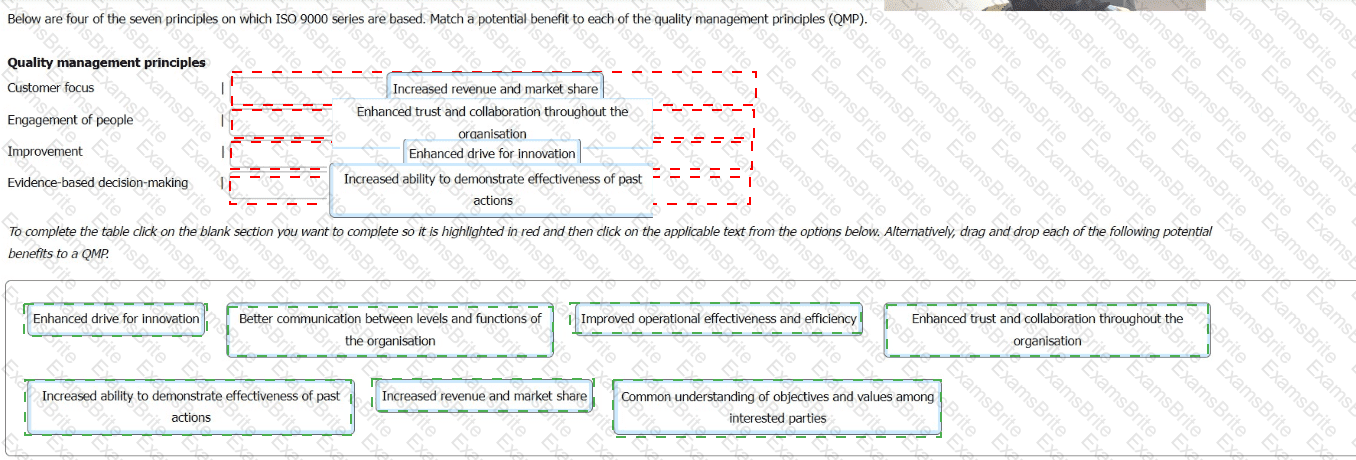
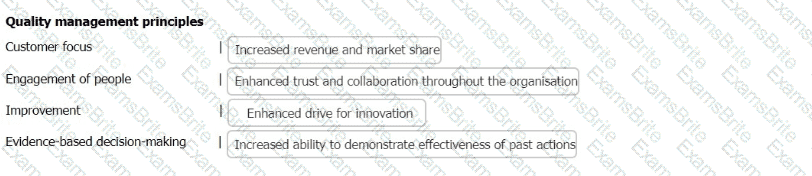
Below are four of the seven principles on which ISO 9000 series are based. Match a potential benefit to each of the quality management principles (QMP).
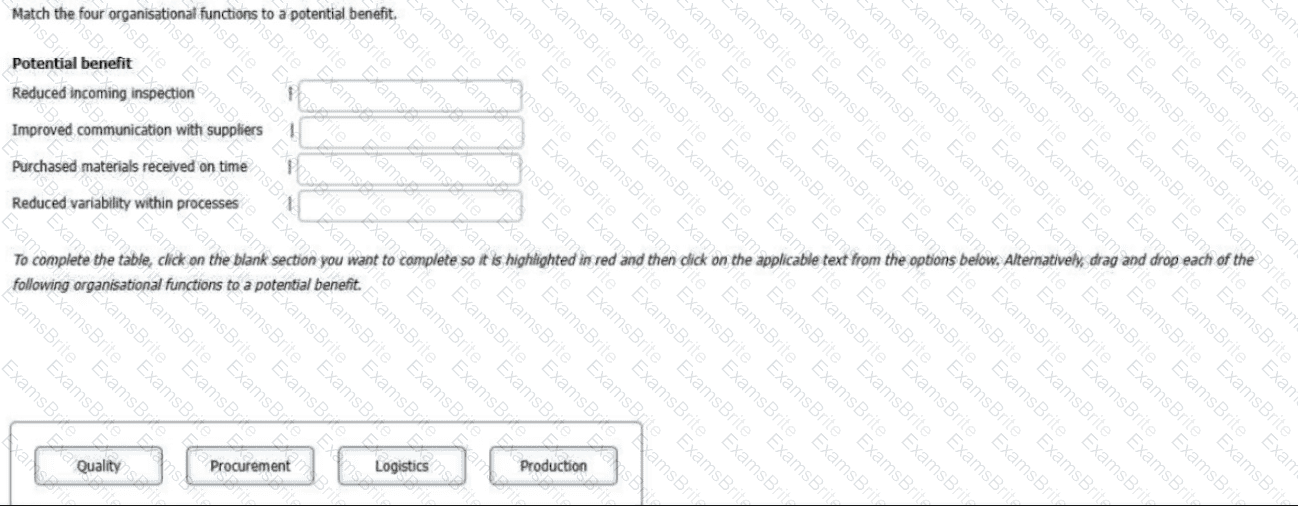
An organisation decides to purchase products and services only from ISO 9001 certified suppliers.
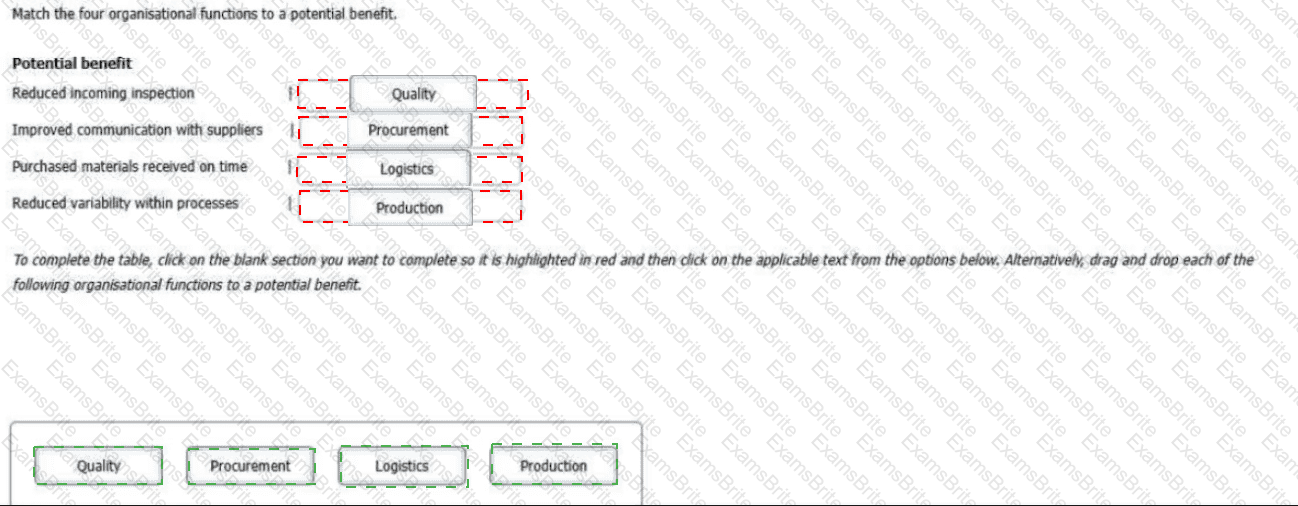
Match the four organisational functions to a potential benefit.
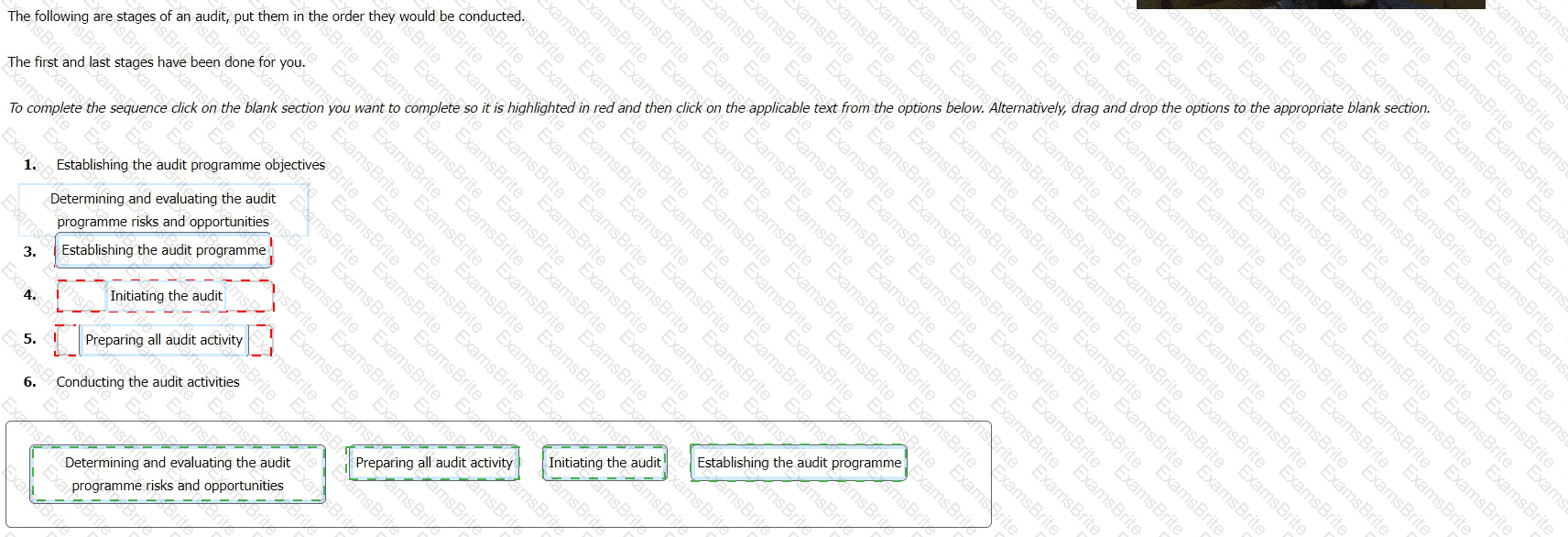
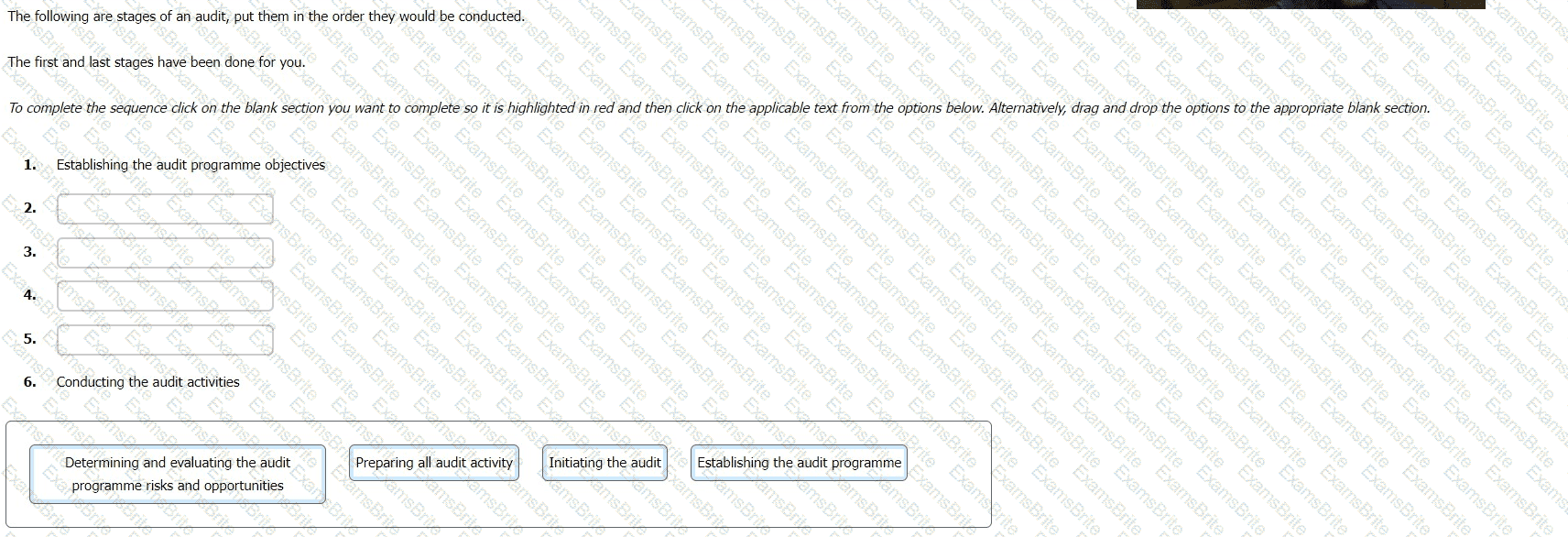
The following are stages of an audit, put them in the order they would be conducted.
Noitol is an organisation specialising in the design and production of e-learning training materials for the insurance market. During an ISO 9001 audit
of the development department, the auditor asks the Head of Development about the process used for validation of the final course design. She states that they usually ask customers to validate the product with volunteers. She says that the feedback received often leads to key improvements.
The auditor samples the design records for a recently completed course for the 247 Insurance organisation. Design verification was carried out but there was no validation report. The Head of Development advises that this customer required the product on an urgent basis, so the validation stage
was omitted. When asked, the Head estimates that this occurs about 50% of the time. She confirms that they always ask for feedback and often make changes. There is no record of feedback in the design file for the course.
The auditor raises a nonconformity against ISO 9001. Which one of the following options is the basis for the nonconformity?
Whistlekleen is a national dry cleaning and laundry company with 50 shops. You are conducting a surveillance audit of the Head Office and are sampling customer complaints. You find that 80% of complaints originate from five shops in the same region. Most of these complaints relate to damage to customer laundry. The Quality Manager tells you that these are the oldest shops in the company. The cleaning equipment needs replacing but the company cannot afford it at the moment. You learn
that the shop managers were told to dismiss most of the claims on the basis of the poor quality of the laundered materials.
On raising the matter with senior management, you are told that there are plans to replace the equipment in these shops over the next five years.
When reviewing the customer complaint file, you find that the organisation is facing a legal dispute with a customer over damage to an expensive cashmere coat.
Select the best option for how this should be handled by the Quality Management System.
Scenario 5: Mechanical-Electro (ME) Audit Stages
Mechanical-Electro, better known as ME, is an American company that provides mechanical and electrical services in China. Their services range from air-conditioning systems, ventilation systems, plumbing, to installation of electrical equipment in automobile plants, electronic manufacturing facilities, and food processing plants.
Due to the fierce competition from local Chinese companies and failing to meet customer requirements, ME ' s revenue dropped significantly. In addition, customers ' trust and confidence in the company decreased, and the reputation of the company was damaged.
In light of these developments, the top management of ME decided to implement a quality management system (QMS) based on ISO 9001. After having an effective QMS in place for over a year, they applied for a certification audit.
A team of four auditors was appointed for the audit, including Li Na as the audit team leader. Initially, the audit team conducted a general review of ME ' s documents, including the quality policy, operational procedures, inventory lists, QMS scope, process documentation, training records, and previous audit reports.
Li Na stated that this would allow the team to maintain a systematic and structured approach to gathering documents for all audit stages. While reviewing the documented information, the team observed some minor issues but did not identify any major nonconformities. Therefore, Li Na claimed that it was not necessary to prepare a report or conduct a meeting with ME ' s representatives at that stage of the audit. She stated that all areas of concern would be discussed in the next phase of the audit.
Following the on-site activities and the opening meeting with ME ' s top management, the audit team structured an audit test plan to verify whether ME’s QMS conformed to Clause 8.2.1 (Customer Communication) of ISO 9001.
To do so, they gathered information through group interviews and sampling. Li Na conducted interviews with departmental managers in the first group and then with top management. In addition, she chose a sampling method that sufficiently represented customer complaints from both areas of ME ' s operations.
The team members were responsible for the sampling procedure. They selected a sample size of 4 out of 45 customer complaints received weekly for electrical services and 2 out of 10 complaints for mechanical services.
Afterward, the audit team evaluated the evidence against the audit criteria and generated the audit findings.
According to scenario 5, Li Na conducted group interviews with departmental managers and top management by herself. Is this in accordance with audit best practices?
You are carrying out an audit at a single-site organisation seeking certification to ISO 9001 for the first time. The organisation manufactures
cosmetics for major retailers.
You are interviewing the Manufacturing Manager (MM).
You: " I would like to begin by looking at the cleaning controls. "
MM: " We record the cleaning of the equipment at the end of every batch. This document details the minimum cleaning frequency and the
procedures to follow for all areas and each item of equipment. The person who carries out the cleaning puts their initial on the document and records
the time and date alongside. "
Narrative: You sample production records over 3-days and note down evidence of nonconformity as per the table below.
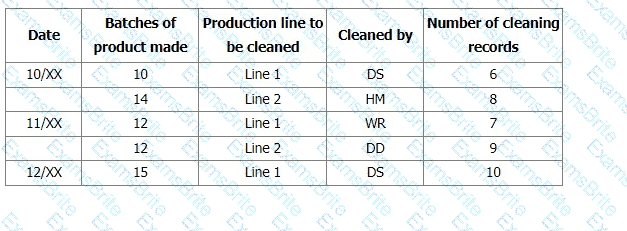
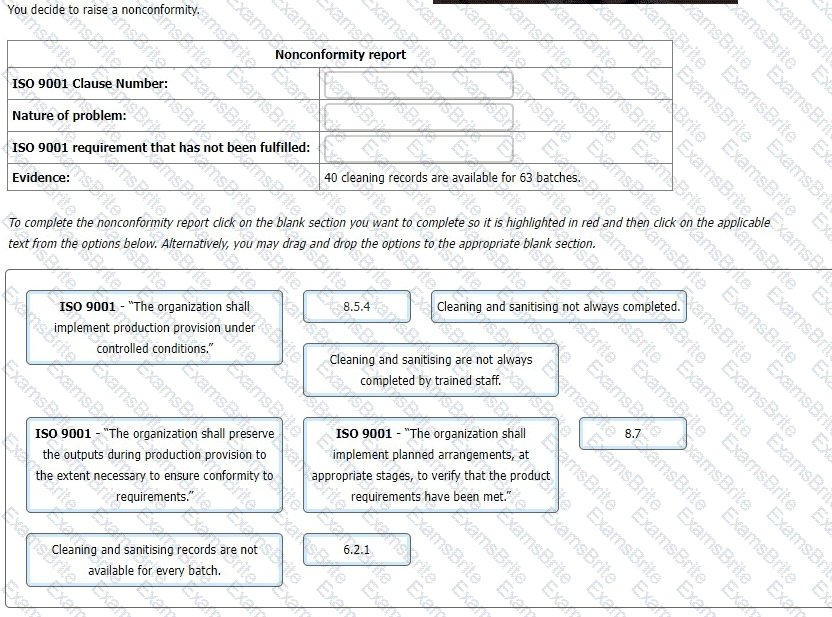
(As the audit team leader, you are planning an audit at an organisation that is seeking certification to ISO 9001. You have confirmed and agreed on the audit scope and audit date with the auditee. The audit team comprises of you and one other auditor. The auditee has two sites and one of these sites is the Head Office where the top management team are based.
The other site is referred to as Site 1, which is located in another country. Apart from that, each site is essentially similar in terms of customer service provision. The other auditor has been selected to audit Site 1 as she lives nearby.
Select four issues you need to finalise before documenting the audit plan.)
Scenario 7: POLKA is a car manufacturing company based in Stockholm, Sweden. The company has around 14,000 employees working in different sectors which help with the design, painting, assembling, and test drives of the final product. The company is widely known for its qualitative products and affordable prices. In order to retain their reputation, POLKA implemented a quality management system (QMS) based on ISO 9001.
Before applying for certification, the company decided to conduct an internal audit to check whether there are any nonconformities in their QMS and if the requirements of ISO 9001 are being fulfilled. The top management appointed Sean, the internal auditor, as the team leader of the internal audit team. Sean required from the top management to have unrestricted access to the employees and executives of POLKA and to the documented information. Furthermore, Sean required to establish a team with a large number of auditors, considering the size and the complexity of the organization. The top management of POLKA agreed with Sean ' s requirements.
The top management, in cooperation with Sean, assigned 10 more employees to the audit team. Following that. Sean planned the audit activities and assigned the roles and responsibilities to each auditor. They began by interviewing employees of different manufacturing departments to check whether they are aware of the process of the QMS implementation. While conducting these activities, one of the auditors asked Sean for permission to audit the department in which he worked on a daily basis, as he was very familiar with the processes of the department.
Along the way, the teams findings showed that the staff were trained, documented information was updated, and the QMS fulfilled the requirements of ISO 9001. The internal audit took three weeks to complete, and on the last week the audit team held a final meeting
The team shared their results and together drafted the audit report This report was submitted to the top management of the company. The report was maintained as documented information, and was available to the relevant interested parties.
Based on the scenario above, answer the following question:
Sean requested unrestricted access to the employees, executives, and documented information of POLKA. Is this in accordance with audit best practices?
Scenario 1: AL-TAX is a company located in California which provides financial and accounting services. The company manages the finances of 17 companies and now is seeking to expand their business even more The CEO of AL-TAX, Liam Durham, claims that the company seeks to provide top-notch services to their clients Recently, there were a number of new companies interested in the services provided by AL-TAX.
In order to fulfill the requirements of new clients and further improve quality, Liam discussed with other top management members the idea of implementing a quality management system (QMS) based on ISO 9001. During the discussion, one of the members of the top management claimed that the size of the company was not large enough to implement a QMS. In addition, another member claimed that a QMS is not applicable for the industry in which AL TAX operates. However, as the majority of the members voted for implementing the QMS. Liam initiated the project.
Initially, Liam hired an experienced consultant to help AL-TAX with the implementation of the QMS. They started by planning and developing processes and methods for the establishment of a QMS based on ISO 9001. Furthermore, they ensured that the quality policy is appropriate to the purpose and context of AL TAX and communicated to all employees. In addition, they also tried to follow a process that enables the company to ensure that its processes are adequately resourced and managed, and that improvement opportunities are determined.
During the implementation process, Liam and the consultant focused on determining the factors that could hinder their processes from achieving the planned results and implemented some preventive actions in order to avoid potential nonconformities Six months after the implementation of the QMS. AL-TAX conducted an internal audit. The results of the internal audit revealed that the QMS was not fulfilling all requirements of ISO 9001. A serious issue was that the QMS was not fulfilling the requirements of clause 5.1.2 Customer focus and had also not ensured clear and open communication channels with suppliers.
Throughout the next three years, the company worked on improving its QMS through the PDCA cycle in the respective areas. To assess the effectiveness of the intended actions while causing minimal disruptions, they tested changes that need to be made on a smaller scale. After taking necessary actions, AL-TAX decided to apply for certification against ISO 9001.
Based on the scenario above, answer the following question:
The CEO of AL-TAX hired an experienced consultant to help with the implementation of the QMS. Is this required from ISO 9001?
An audit team of three people is conducting a Stage 2 audit to ISO 9001 of an engineering organisation that manufactures sacrificial anodes for the oil and gas industry in marine environments. These are aluminium products designed to prevent corrosion of submerged steel structures. You, as one of the auditors, find that the organisation has shipped anodes for Project DK in the Gulf of Mexico before the galvanic efficiency test results for the anodes have been fully analysed and reported as required by the customer. The Quality Manager explains that the Managing Director authorised the release of the anodes to avoid late delivery as penalties would be Imposed. The customer was not informed since the tests very rarely fall below the required efficiency. You raise a nonconformity against clause 8.6 of ISO 9001.
At the Closing meeting, the audit team leader presents the findings of the audit and comes to the above
nonconformity. The Quality Manager produces the test report for Project DK, which shows an acceptable galvanic efficiency, and presents an email from the customer confirming acceptance of the anodes. He asks that the nonconformity be withdrawn.
Which two of the following responses by the audit team leader would be acceptable?
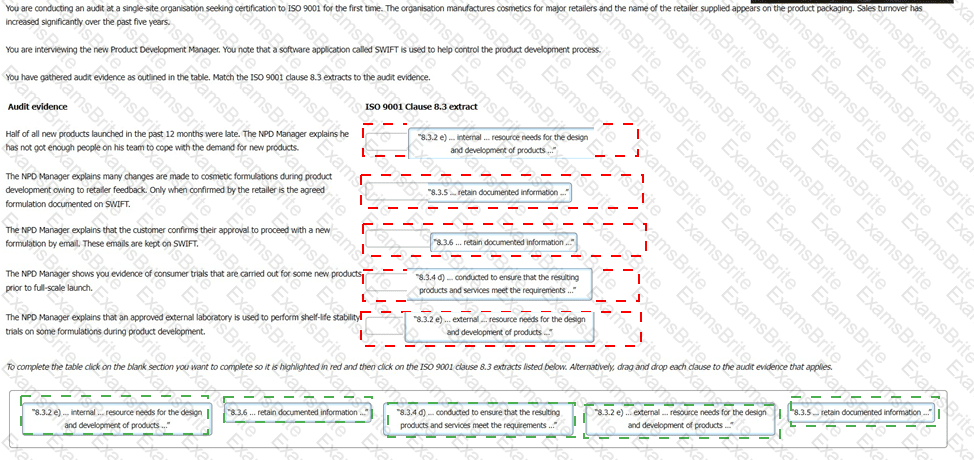
You are conducting an audit at a single-site organisation seeking certification to ISO 9001 for the first time. The organisation manufactures cosmetics for major retailers and the name of the retailer supplied appears on the product packaging. Sales turnover has increased significantly over the past five years.
You are interviewing the new Product Development Manager. You note that a software application called SWIFT is used to help control the product development process.
You have gathered audit evidence as outlined in the table. Match the ISO 9001 clause 8.3 extracts to the audit evidence.
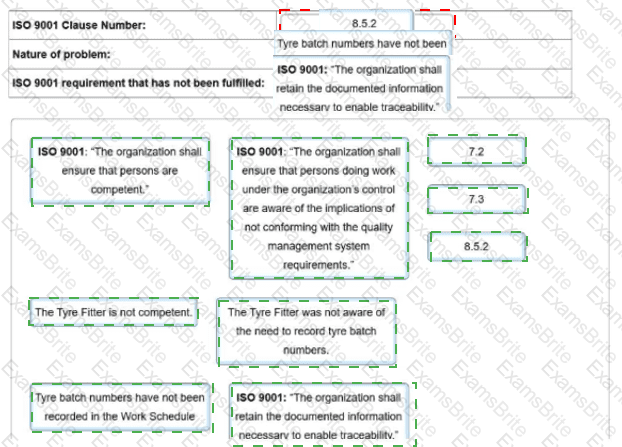
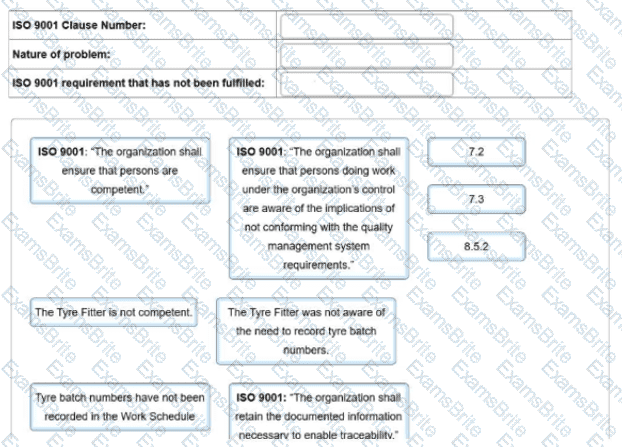
To complete the non-conformity report, click on the blank section you want to complete so it is highlighted in red and then click on the applicable text from the options below. Alternatively, drag and drop the options to the appropriate blank section.
You are a member of the audit team of a second-party audit of an organisation with 625 employees. The audit procedure recommends using sampling criteria which requires the review of the documented competence for 25 personnel. The audit team leader developed an audit plan allocating one hour to audit the Human Resources department (from 11:30 am to 12:30 pm). She told you that she could not allocate any additional time.
What would you do?
You are conducting a Stage 1 audit at an organisation that services refrigeration equipment for a large customer base. The scope of certification is “Provision of refrigeration equipment maintenance and repair services”. You are interviewing the Managing Director to learn more about the organisation and to explore how the requirements for policy, objectives, and risks and opportunities in ISO 9001 are addressed.
The Managing Director explains that they only use sub-contract refrigeration engineers and do not have any full-time refrigeration engineers, which helps to optimise overhead costs. The full-time staff employed are essentially a small team of office staff who process customer enquiries, schedule jobs and process invoices.
The Managing Director adds that the ISO 9001 requirements for competence of personnel extends to both sub-contract and full-time staff. He also states that the full-time staff are aware of the Quality Policy, objectives and plans to address risk and opportunities.
You ask if the sub-contract engineers have been informed of the Quality Policy, objectives and plans to address risks and opportunities, to which the Managing Director replies that this is not applicable as they only use sub-contractors who operate ISO 9001 certificated quality management systems. The documented information provided to the auditor confirms this.
Which clause in ISO 9001 is most likely not to have been fulfilled in this instance?
An audit team leader arrives at a printing organisation to carry out a Stage 2 audit for a certification body. At a meeting with the Quality Manager, she is told that they have won their biggest contract from a computer
manufacturer to print and compile computer documentation packages. They have leased the unit next door for space reasons but have never worked in this sector before. The Quality Manager wants the ISO 9001
certificate to cover the new contract.
Which one of the options is the correct response by the auditor?
(A third-party audit has been planned at a single-site organisation. The audit team comprises one audit team leader, one auditor and one auditor who is undertaking his first third-party audit.
During the on-site audit, the auditor who is undertaking his first third-party audit shall...)
In a third-party audit to ISO 9001, select two options of when the organisation is required to act in response to reported findings.
How can an organization ensure the objectivity and impartiality of the internal audit function?
You are an auditor and are in dialogue with the quality manager and the managing director of a small business that supplies specific IT
hardware and software for manufacturers of medical equipment.
You: " I would like to look at how you manage the design and development of your products.
Auditee: " We have made some strategic changes, the main one being that since last month we no longer produce the software of our
products in-house. "
You: " What has been the impact of that? "
Auditee: " We now subcontract the provision of the software needed for our hardware. This allowed us to concentrate our efforts on
the hardware and let specialised organisations develop the software. For the time being, we have subcontracted our software
requirements to three different organisations.
You: " What were the reasons for making the change? "
Auditee: " Our IT software section was a small operation, and we struggled to cope with new technologies. During busy periods, we
found it hard to meet lead times, and in quiet periods, we had staff with little to do. This was having an impact on customer
satisfaction. "
You: " How did you go about the change? "
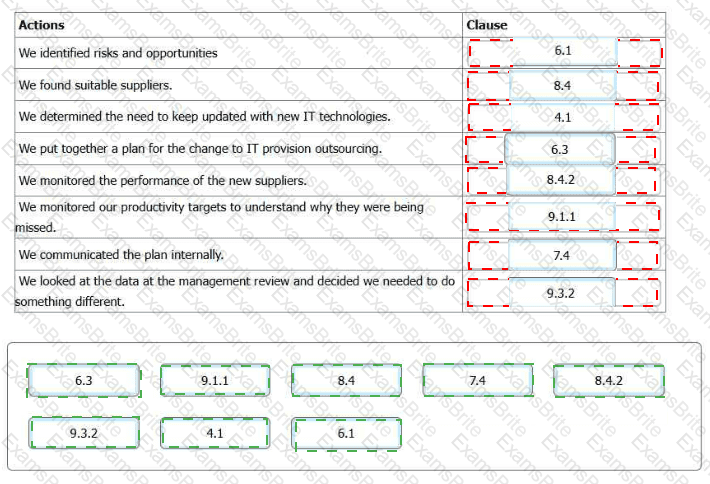
In relation to the auditor ' s question about how the change was managed, the auditee mentions the actions listed
below. Match the ISO 9001 clauses to show which action the requirement applies to.
To complete the table, click on the blank section you want to complete so it is highlighted in red and then click on the
ISO 9001 clauses listed below. Alternatively, drag and drop each clause to show which clause the action applies to.
A person who provides specific knowledge or expertise to the audit team during the audit is known as a/an:
You are carrying out an annual audit at an organisation that has been certificated to ISO 9001 for two years. The organisation offers home security
services. The scope of the quality management system covers alarm installation, alarm servicing, alarm monitoring and response. The business
operates from a single office and employs subcontract installers and service technicians across the country.
You have just completed the opening meeting. You are interviewing the Managing Director (MD).
You: " I would like to gain an understanding of how the quality management system has been supporting your business and its strategic direction. "
MD: " We are continuing to face difficult times. The market is extremely competitive, and customers typically look for the least expensive option when
choosing home security services. We have not yet seen any business benefit from our quality management system. "
You: " Tell me how you determine external and internal issues. "
MD: " We use SWOT analysis (Strengths Weaknesses, Opportunities, Threats). "
You: " How have the outputs from your SWOT been used? "
Select two of the following audit trails would you take to explore the extent to which the SWOT analysis and the outputs from this
have been used to enable the business to achieve the intended results(s) of its quality management system according to ISO 9001.
Scenario 3:
Fin-Pro is a financial institution in Austria offering commercial banking, wealth management, and investment services. The company faced a significant loss of customers due to failing to improve service quality as they expanded.
To regain customer confidence, top management implemented a QMS based on ISO 9001. After a year, they contacted ACB, a local certification body, to pursue ISO 9001 certification.
The audit team was led by Emilia, an experienced lead auditor, and included three auditors. After an agreement was reached, ACB sent the audit objectives to the audit team.
The audit team began by gathering information about Fin-Pro’s understanding of ISO 9001 requirements. While reviewing documented information, they noticed missing records of training and awareness sessions. They conducted employee interviews to verify attendance.
The team also reviewed the organizational chart and job descriptions to confirm employee competence. They observed the company’s working environment (social, psychological, and physical conditions).
The audit team analyzed the evidence and prepared an audit report with findings and conclusions.
In scenario 3, the audit team required access to see the organizational chart and job descriptions to verify the employees’ competence. Based on audit best practices, is this acceptable?
Scenario 3:
Fin-Pro is a financial institution in Austria offering commercial banking, wealth management, and investment services. The company faced a significant loss of customers due to failing to improve service quality as they expanded.
To regain customer confidence, top management implemented a QMS based on ISO 9001. After a year, they contacted ACB, a local certification body, to pursue ISO 9001 certification.
The audit team was led by Emilia, an experienced lead auditor, and included three auditors. After an agreement was reached, ACB sent the audit objectives to the audit team.
The audit team began by gathering information about Fin-Pro’s understanding of ISO 9001 requirements. While reviewing documented information, they noticed missing records of training and awareness sessions. They conducted employee interviews to verify attendance.
The team also reviewed the organizational chart and job descriptions to confirm employee competence. They observed the company’s working environment (social, psychological, and physical conditions).
The audit team analyzed the evidence and prepared an audit report with findings and conclusions.
Which statement below represents the level of responsibility demonstrated by the audit team in scenario 3?
(Select two applicable benefits of third-party certification of ISO 9001 quality management systems for an organisation:)
ABC is a fast food shop that receives orders by phone or the internet. The normal menu includes 15 different types of hamburgers; however, in the
last two days, due to a shortage of a special type of meat, they can only prepare six of the 15 varieties.
You are performing a third-party audit of ABC; you observed that the menu offering food on the website is still the normal one, with 15 different
hamburgers. During a 30-minute period, you observed several customers reluctantly accepting other than the hamburger they preferred. You decided
to raise the following nonconformity as follows:
" There is evidence that ABC has not reviewed the ability to provide customers the offered products " .
The restaurant manager does not accept the nonconformity. She says that ABC had an extensive training programme for all personnel, which you have already seen when auditing Human Resources. This shortage of some hamburgers cannot be considered a management system failure.
Which one would be your answer from the following options?
TIX provides services to the informatic equipment of large organisations. They operate an ISO 9001:2015 QMS that is being audited by an important
customer (second-party audit). During the audit, the audit team has identified two nonconformities. When preparing the Closing meeting, the audit
team discussed and agreed both nonconformities with TIX ' s quality manager. The Closing meeting was planned for 6pm with the general manager,
quality manager and service manager at the meeting room.
At 6pm, when the audit team enters the meeting room, only two people are present and waiting for them: the Health and Safety supervisor and the
warehouse supervisor. Neither have participated in the audit.
The dialogue among them is as follows:
Audit team leader: " Good evening, could you please inform the three managers that we are ready to start with the Closing meeting? "
Health and Safety supervisor: " Good evening. We are sorry to inform you that the general manager was involved in a serious car accident, and
the other two managers have had to leave urgently to attend the emergency. "
Warehouse supervisor: " They have asked us to listen to what you need to say and to sign whatever we need to sign. We also have a message
from them about the two nonconformities. They wanted us to ask you if you could contact them in a couple of days to determine how to proceed. "
Which one of the following options would be your preferred response to the final comment made by the warehouse manager?
(Select one option which defines the purpose of a second-party audit to ISO 9001.)
Select six tasks you would expect to be completed at the audit team meeting of a third-party audit team leader and his audit team in preparation for a Closing meeting for a four-day initial certification audit.
You are leading a Stage 2 certification audit of a multi-site organisation and have received the audit schedule below;
Head Office and Site 1 – Day 1
Site 2 (150 km from HQ) – Days 2 and 3
During Day 1 of the audit, the client informs you that the laboratory at Site 2 has been closed for decontamination due to a serious outbreak of an infectious disease among workers. In Site 2, all other functions could be audited as planned.
As the audit team leader, what would you do?
Choose the best acceptable action you could take:
Scenario 5: Mechanical-Electro (ME) Audit Stages
Mechanical-Electro, better known as ME, is an American company that provides mechanical and electrical services in China. Their services range from air-conditioning systems, ventilation systems, plumbing, to installation of electrical equipment in automobile plants, electronic manufacturing facilities, and food processing plants.
Due to the fierce competition from local Chinese companies and failing to meet customer requirements, ME ' s revenue dropped significantly. In addition, customers ' trust and confidence in the company decreased, and the reputation of the company was damaged.
In light of these developments, the top management of ME decided to implement a quality management system (QMS) based on ISO 9001. After having an effective QMS in place for over a year, they applied for a certification audit.
A team of four auditors was appointed for the audit, including Li Na as the audit team leader. Initially, the audit team conducted a general review of ME ' s documents, including the quality policy, operational procedures, inventory lists, QMS scope, process documentation, training records, and previous audit reports.
Li Na stated that this would allow the team to maintain a systematic and structured approach to gathering documents for all audit stages. While reviewing the documented information, the team observed some minor issues but did not identify any major nonconformities. Therefore, Li Na claimed that it was not necessary to prepare a report or conduct a meeting with ME ' s representatives at that stage of the audit. She stated that all areas of concern would be discussed in the next phase of the audit.
Following the on-site activities and the opening meeting with ME ' s top management, the audit team structured an audit test plan to verify whether ME’s QMS conformed to Clause 8.2.1 (Customer Communication) of ISO 9001.
To do so, they gathered information through group interviews and sampling. Li Na conducted interviews with departmental managers in the first group and then with top management. In addition, she chose a sampling method that sufficiently represented customer complaints from both areas of ME ' s operations.
The team members were responsible for the sampling procedure. They selected a sample size of 4 out of 45 customer complaints received weekly for electrical services and 2 out of 10 complaints for mechanical services.
Afterward, the audit team evaluated the evidence against the audit criteria and generated the audit findings.
After reviewing the documented information, Li Na claimed that it was not necessary to report the minor nonconformities that were identified; instead, they would be discussed in the next audit phase. Is this acceptable?
The certification body has not been able to verify the implementation of corrective actions for any identified major nonconformity within six months after the last day of the Stage 2 audit. What must the certification body do in this case?
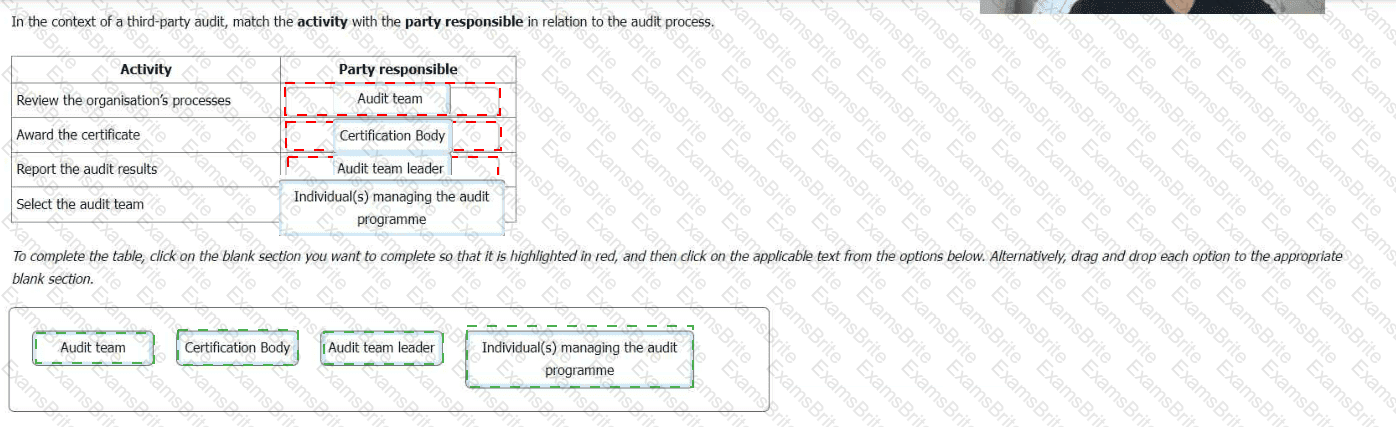
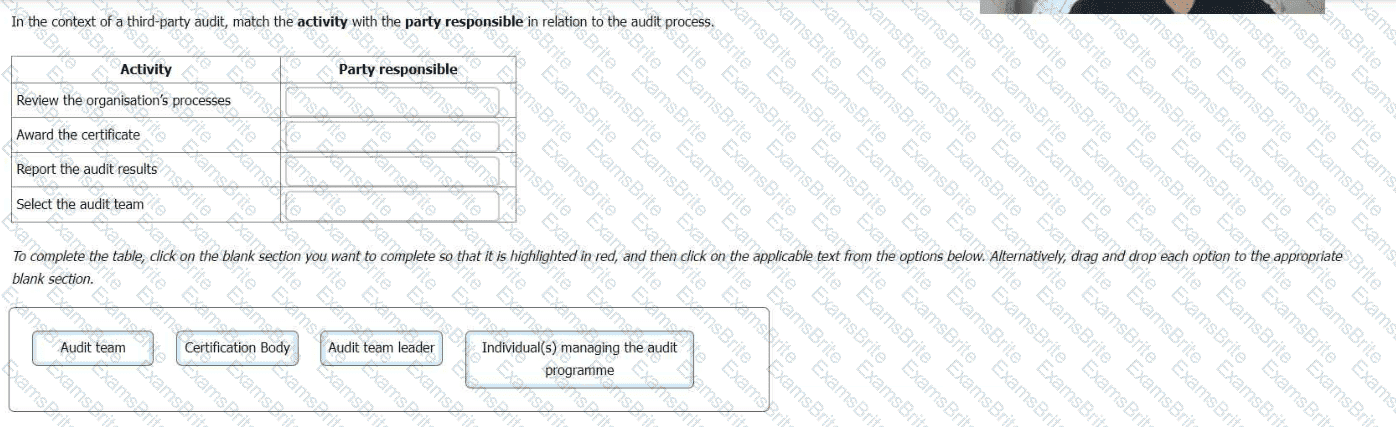
In the context of a third-party audit, match the activity with the party responsible in relation to the audit process.
(Which of the following two options could be considered the most likely potential threats to impartiality in an audit context?)
Scenario 7: POLKA is a car manufacturing company based in Stockholm, Sweden. The company has around 14,000 employees working in different sectors which help with the design, painting, assembling, and test drives of the final product. The company is widely known for its qualitative products and affordable prices. In order to retain their reputation, POLKA implemented a quality management system (QMS) based on ISO 9001.
Before applying for certification, the company decided to conduct an internal audit to check whether there are any nonconformities in their QMS and if the requirements of ISO 9001 are being fulfilled. The top management appointed Sean, the internal auditor, as the team leader of the internal audit team. Sean required from the top management to have unrestricted access to the employees and executives of POLKA and to the documented information. Furthermore, Sean required to establish a team with a large number of auditors, considering the size and the complexity of the organization. The top management of POLKA agreed with Sean ' s requirements.
The top management, in cooperation with Sean, assigned 10 more employees to the audit team. Following that. Sean planned the audit activities and assigned the roles and responsibilities to each auditor. They began by interviewing employees of different manufacturing departments to check whether they are aware of the process of the QMS implementation. While conducting these activities, one of the auditors asked Sean for permission to audit the department in which he worked on a daily basis, as he was very familiar with the processes of the department.
Along the way, the teams findings showed that the staff were trained, documented information was updated, and the QMS fulfilled the requirements of ISO 9001. The internal audit took three weeks to complete, and on the last week the audit team held a final meeting
The team shared their results and together drafted the audit report This report was submitted to the top management of the company. The report was maintained as documented information, and was available to the relevant interested parties.
Based on the scenario above, answer the following question:
According to Scenario 7, one of the auditors requested permission from Sean to audit the department in which he worked on a daily basis. Should Sean grant the auditor permission?
A Health Trust has contracted with Servitup, a catering services company certified to ISO 9001, for one year. You, as auditor, are conducting the first surveillance audit at one site with the Deputy Catering Manager.
You find that two internal audits have been carried out in the first year by the Catering Manager. One of them indicates that complaints from patients are increasing in number, mainly due to food being served too cold. A pre-heated food trolley is sent to the wards from the kitchen. The Deputy Catering Manager comments that the trolley thermometer is often unreliable. Evidence of calibration of the thermometer cannot be produced.
Which four of the following actions could prevent the complaints from recurring?
You will lead a third-party audit next Monday on ABC, an organisation that provides services for cleaning windows from the outside of tall buildings. They work on demand, and usually have 4-5 orders per week. All documented information on these activities is kept at the central office.
On Friday evening, before the audit, you are informed by mail that customers cancelled all orders for the next week; therefore, the auditors will not have the chance to see them working at the customer ' s premises, but the field supervisors will be available at the ABC offices.
You have prepared the audit plan and the checklist. Choose the best action you would take:
Scenario 4:
TD Advertising is a print management company based in Chicago. The company offers design services, digital printing, storage, and distribution. As TD expanded, its management recognized that success depended on adopting new technologies and improving quality.
To ensure customer satisfaction and quality improvement, the company decided to pursue ISO 9001 certification.
After implementing the QMS, TD hired a well-known certification body for an audit. Anne Key was appointed as the audit team leader. She received a document listing the audit team members, audit scope, criteria, duration, and audit engagement limits.
Anne reviewed the document and approved the audit mandate. The certification body and TD’s top management signed the certification agreement.
Before contacting TD, Anne reviewed the audit scope and noticed that TD made changes to it due to the adoption of new printing equipment. However, Anne disagreed with the changes, stating they would affect the audit timeline. She considered withdrawing from the audit.
The audit team members were selected based on their knowledge of the legal and other regulations that TD is subject to. Is this acceptable?
Read the following role descriptions. Select two roles that are not directly involved in the audit process.
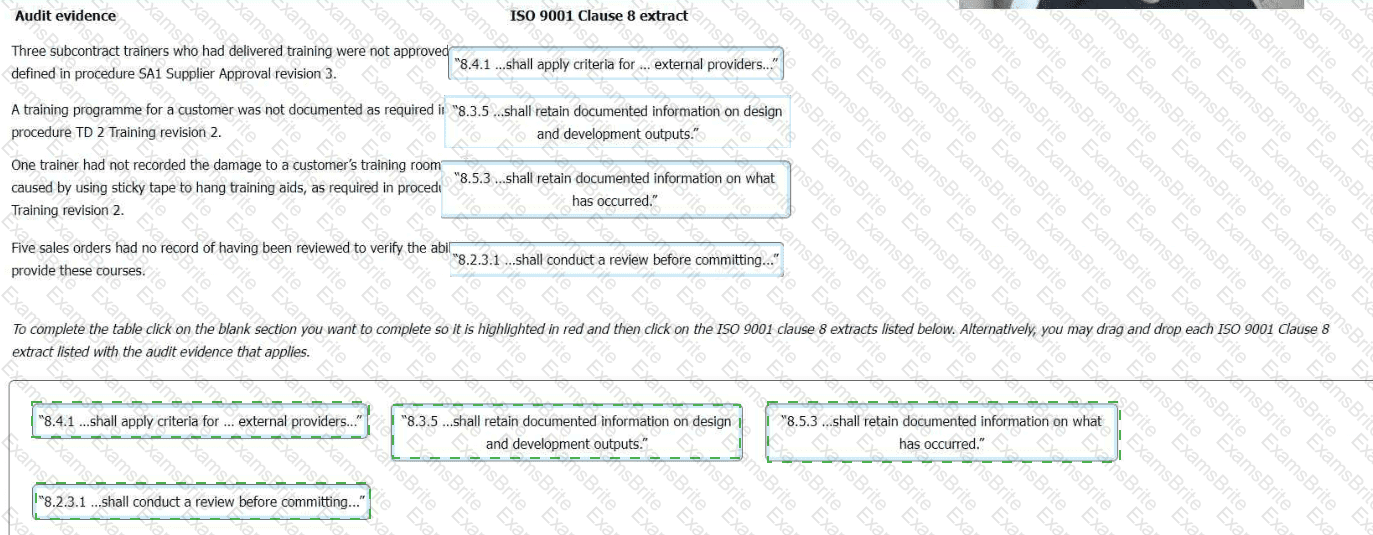
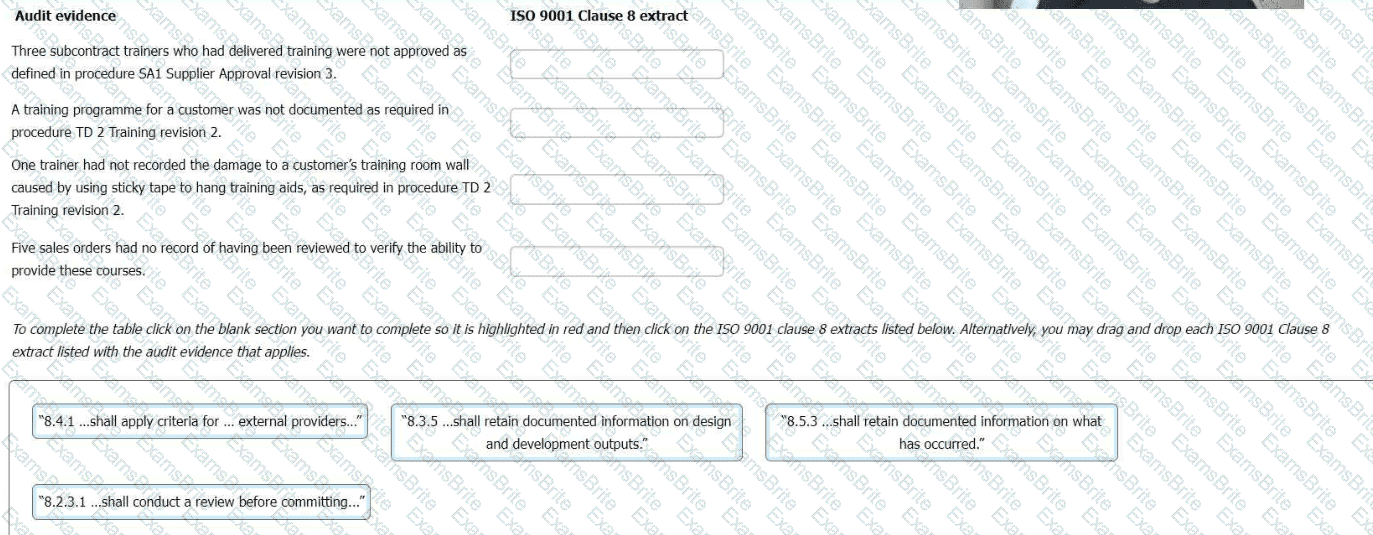
You are conducting an audit at an organisation seeking certification to ISO 9001 for the first time. The organisation offers health and safety training to customers. Training courses are offered either as open courses, delivered at a public venue, or online, or as courses that are tailored to meet specific requirements. The business operates from a single office and those who deliver the training are either full-time employees or subcontractors.
You have gathered audit evidence as outlined below. Match the ISO 9001 Clause 8 extract to the audit evidence.
During a second-party audit, the auditor examines the records that are available for the external provider, ABC Forgings, to whom manufacturing has recently been outsourced.
There are standard external provider checklists for three competitors for the contract and there are inspection records from the trial manufacturing batches produced by ABC Forgings. There is no documented evidence of the criteria used to confirm the appointment of ABC Forgings, and no contract or terms and conditions. Ongoing monitoring indicates that external provider performance is satisfactory, but no documented information has been retained.
Select two options for the evidence which demonstrates a nonconformity with clause 8.4 of ISO 9001.
An internal auditor of a manufacturer of polystyrene packaging products for the electronics industry raised a nonconformity against
section 10.3 of ISO 9001 in Report IA202. The nonconformity (NC 3) stated:
" The reject rate of ' finished ' product of 9.7% needs improvement as it doesn ' t meet the stated objective of top management of 5%. "
Just before the Closing meeting of a third-party audit, the audit team leader is invited to a meeting with the Quality Manager. He tells
the audit team leader that a member of the audit team was seen taking photographs of the factory on his phone during the day and
wants him suspended from the Closing meeting with any nonconformities raised by him rescinded. The issue of photographs was not
discussed during the opening meeting.
Select the three options for how the audit team leader might deal with this situation.
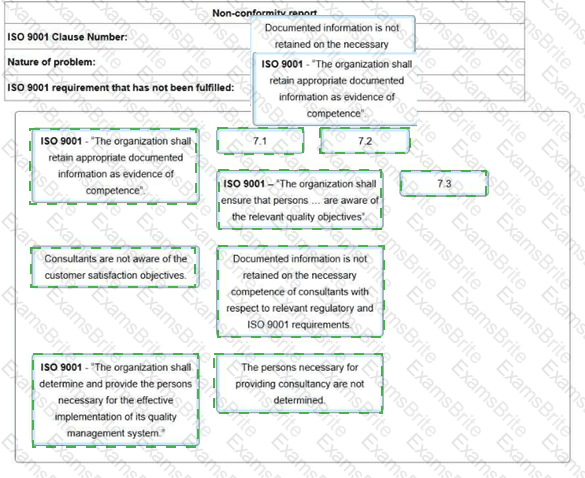
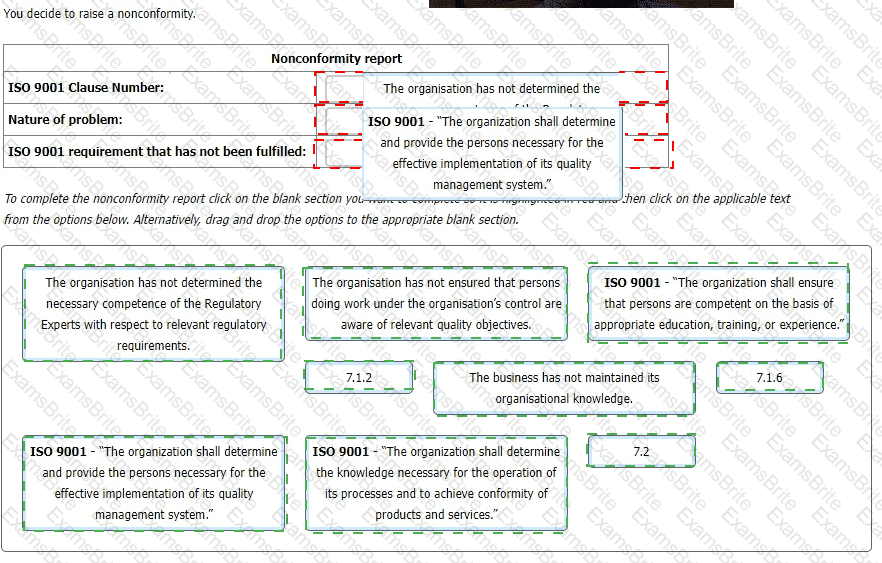
You are carrying out an audit to ISO 9001 at an organisation which offers consultancy services on the implementation of ISO 9001 quality management systems to manufacturers of cosmetics.
You are interviewing the Technical and Quality Director (TQD), who manages a team of biochemists responsible for providing ISO 9001 consultancy services to customers.
You: “How do you ensure your team’s competence concerning regulatory and ISO 9001 requirements?”
TQD: “We subcontract a part-time lead consultant who has years of experience working as a biochemist in the cosmetics industry. She is responsible for ensuring the team’s competency.”
You: “Do they retain any documented information on the individual competency of each consultant?”
TQD: “No. The lead consultant is a dedicated individual with lots of contacts in the sector. We rely on her decision on the consultants’ competency. She says that she thought that it was not necessary to keep documented information; however, after the event two weeks ago, which could not be solved due to the lack of documentation, she may consider in the future to plan which information we may need to keep.”
You: “How does the organisation enable the consultants you employ to maintain updated their competence on ISO 9001 and regulatory requirements?”
TQD: “As I said before, we leave that up to the lead consultant. She tells us when we need to employ more young consultants and when changes are introduced in the applicable regulations. Our regular survey shows that customers are quite satisfied with our consultants; last year’s objective of customer satisfaction was achieved. We gave a salary increase to consultants when they knew that the objectives had been achieved.”
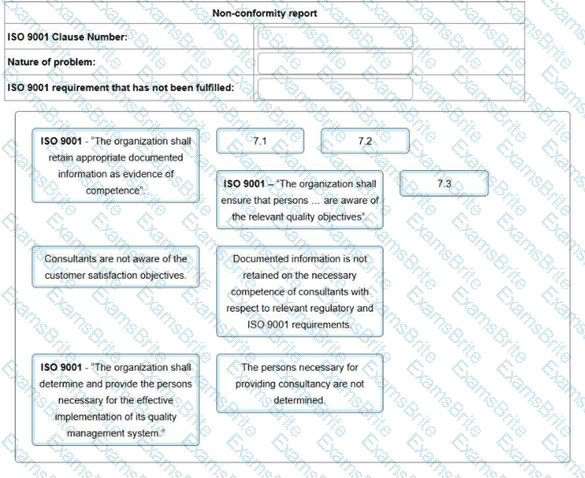
You decide to raise a non-conformity.
To complete the non-conformity report, click on the blank section you want to complete so it is highlighted in red and then click on the applicable text from the options below. Alternatively, drag and drop the options to the appropriate blank section.
You are carrying out an audit at an organisation seeking certification to ISO 9001 for the first time. The organisation offers regulatory consultancy services to manufacturers of cosmetics. The business operates from ten regional offices.
You are nearing the end of the audit and need to decide if sufficient evidence of top management leadership and commitment with respect to the quality management system has been gathered.
Which four of the following would demonstrate top management leadership and commitment with respect to the quality management system?
Takitup is a small fabrication company that manufactures steel fencing, stairs and platforms for the construction sector. It has been certified to ISO 9001 for some time and has appointed a new Quality Manager. The audit plan during a surveillance audit is to cover the company’s improvement actions and the auditor asks to see the most recent management review meeting minutes.
Which two of the options would be relevant points for the auditor’s checklist for the audit?
Whistlekleen is a national dry cleaning and laundry company with 50 shops. You are conducting a surveillance audit of the Head Office and are sampling customer complaints. 80% of complaints originate from five shops in the same region. Most of these complaints relate to customer laundry not being cleaned as customers require. The Quality Manager tells you that these are the oldest shops in the company. The cleaning equipment needs replacing but the company cannot afford it now. You learn that the shop managers were told to dismiss most of the complaints because of the poor quality of the laundered materials.
On raising the matter with senior management, you are told that there are plans to replace the equipment in these shops over the next five years.
You raised a nonconformity against clause 8.5.1 of ISO 9001.
Based on the scenario, select the three options which best describe the evidence for raising such a nonconformity.
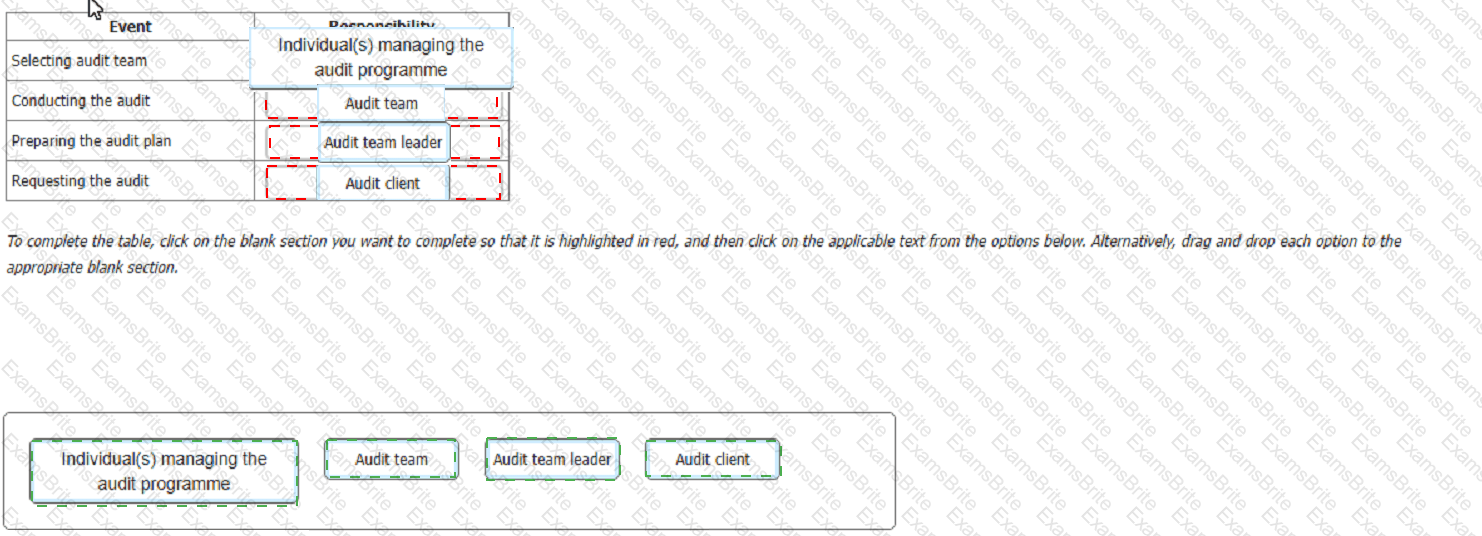
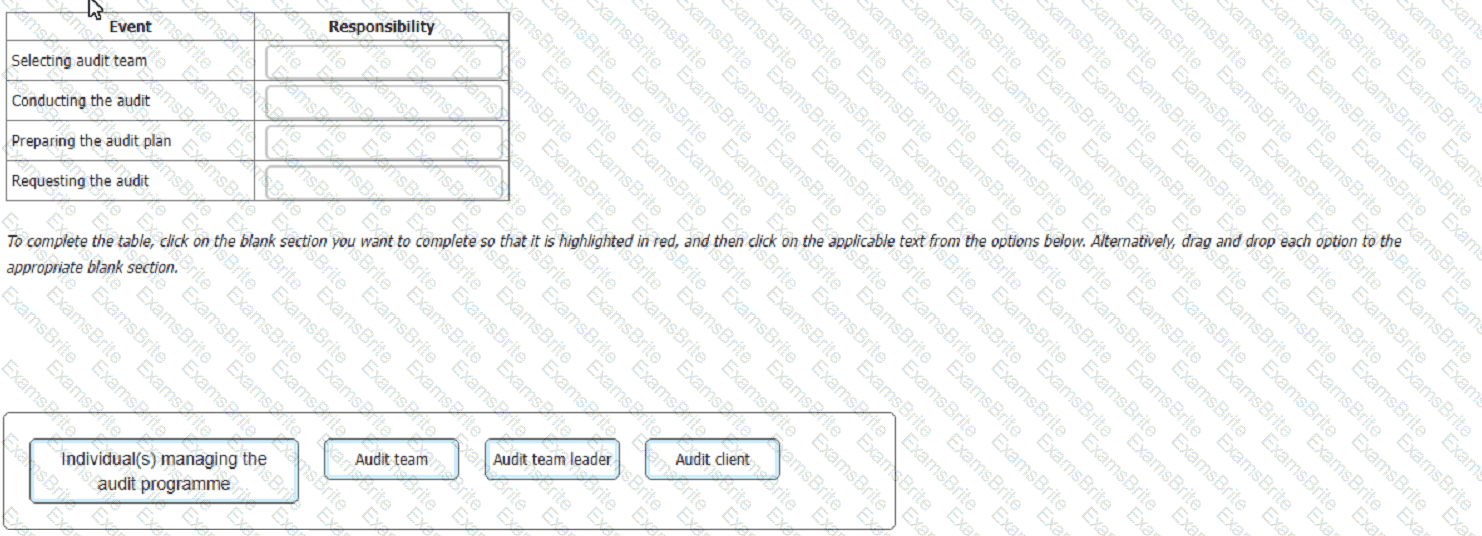
In the context of a third-party audit, match the event with the responsibility for conducting it.

TESTED 15 Oct 2026

 A screenshot of a chat Description automatically generated