HPE Network Campus Access Professional Architect Exam
Last Update Nov 24, 2026
Total Questions : 94
We are offering FREE HPE7-A11 HP exam questions. All you do is to just go and sign up. Give your details, prepare HPE7-A11 free exam questions and then go for complete pool of HPE Network Campus Access Professional Architect Exam test questions that will help you more.



XYZ Regional Hospital is an integrated healthcare system comprising hospitals, neighborhood health centers, and small doctor offices. XYZ Regional Hospital has recently merged with 4x neighborhood health centers and 125 doctor branch offices. Its wireless, wired access, and AAA solutions are outdated and must be replaced.
XYZ Regional Hospital wants to future-proof and improve efficiency at all sites by enhancing wired and wireless access and moving to centralized, unified wired/wireless and policy management that delivers uninterrupted availability of all systems.
Locations:
XYZ Regional Hospital is located in New York City
Dila Health Center is located in City A
Mount Health Center is located in City B
Rock Health Center is located in City C
Branch clinics are located at different locations across the United States
Requirements:
Provide, through management software, a single pane of glass to manage wired and wireless LANs and VPNs across campus, branch, and remote environments through a web/cloud architecture that provides near-real-time insight, troubleshooting tools, and Service Level performance reporting.
Seamless integration across wired, wireless, WAN, SD-Branch, and IoT
Provide secure wireless access for all Regional Hospital employees and partners, and wireless Internet access for medical citizens when they visit the facilities.
All access points must support these features and specifications: 802.11 ax (Wi-Fi 6E Certified)
Security options including WP2/WPA3 and 802.1X with Radius secure authentication
Identify and authenticate every wireless and wired device
End-to-end role-based security
Seamless mobility across the hospital for medical teams, patients, and visitors
Cut Wi-Fi deployment times from days to hours and enable Zero-Touch deployments across the site
Establish a resilient, future-ready network infrastructure with the intelligence, scalability, and intuitive toolsets to meet emerging needs
Fully redundant branch solution with dynamic path selection to the hospital
The hospital IT director is concerned that branch clinics will lack an onsite resource to troubleshoot issues that may arise and wants a solution that enables the hospital IT team to proactively monitor the branch offices.
Requirements:
Monitor wireless and wired connections
Provide an end-to-end experience view that identifies points of failure
Proactively troubleshoot issues that affect application performance
What is the correct solution?
Manufacturing A.B.C. is a mid-sized international company that specializes in manufacturing industrial equipment. It has operated in the market for more than two decades and has become a reputable participant in its industry. However, rapid technological advances have left its existing network infrastructure outdated and unable to keep pace with modern manufacturing-process demands.
Manufacturing A.B.C.'s network combines legacy wired and wireless components from multiple vendors, resulting in frequent downtime and reduced production efficiency. The aging equipment causes slow data-transfer rates, unreliable connectivity, and greater exposure to cyber threats. Fiber cabling must also be upgraded because OM2 is used for most of it.
Further compounding the network problems, the CTO's recent departure has left the company without a clear direction for the network-refresh project. The management team lacks consensus on the upgrade's scope, budget, and timeline.
The manufacturing customer's primary objectives are as follows:
Improve network performance and reliability to enhance production processes and minimize downtime.
Enhance network security to safeguard sensitive data and intellectual property.
Streamline communication and collaboration among the organization's different departments.
Ensure scalability to support future growth and technological advances.
Manufacturing A.B.C. requires a comprehensive network refresh with these components:
Upgrade the wired infrastructure to high-speed Ethernet switches to support increased data-transfer rates and reduce latency.
Implement a robust wireless solution with enterprise-grade access points that provides seamless connectivity throughout the manufacturing facility.
Use centralized network-management tools to simplify network administration and monitoring.
Expectations:
The customer expects the network-refresh project to be completed efficiently, with minimal disruption to ongoing operations. They seek a reliable, experienced network-solutions provider that understands their specific manufacturing requirements and can deliver a customized solution consistent with their budget constraints. Given the recent CTO change, the manufacturing customer is eager to receive clear project proposals and decision-making support.
As a network-solutions provider, your role is to address these concerns, provide expert guidance, and present a clearly defined plan to meet the objectives effectively.
Manufacturing A.B.C. must regulate various traffic types with QoS, and the architect chose DWRR instead of SP queuing. Which switches support DWRR?
Choose two.
A customer needs integration with ServiceNow.
Which CX feature automatically creates ServiceNow tickets from network events?
A large multinational financial institution has engaged you to design a new full-stack wired and wireless network for its new 6-story regional office building. The facility’s bottom two floors will be retail space for a large banking branch. The upper floors will be carpeted corporate office space, with each floor approximately 100,000 sq ft (9290 sq m). Data centers are all offsite and are outside this project’s scope. The customer is underserved by its current L2-based network infrastructure and wants to use modern best practices in the new design. The network must be fully resilient and fault-tolerant, with dynamic segmentation at the edge.
The retail space will provide public guest Wi-Fi access. Retail associates will use corporate tablets for customer service, and the retail floors will contain a mixture of wired and wireless devices. Corporate users will primarily connect wirelessly, although several wired clients, printers, and hard VoIP phones will be used.
The customer also plans to renovate the corporate office space to take advantage of ‘smart office’ technology. These upgrades will enable blue-dot wayfinding, presence analytics, and other location-based services.
After further discussions with the customer, the team determined that EVPN-VXLAN will provide dynamic segmentation. The customer wants to ensure that a particular VNI is present only when it is used on that switch.
Which solution is valid and meets this technical requirement?
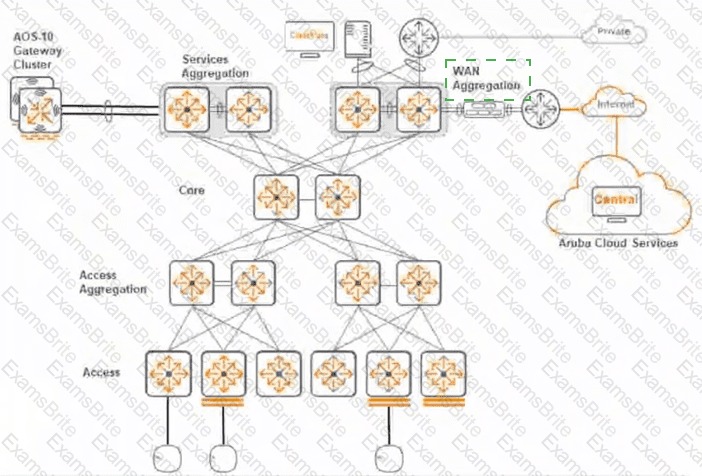
Based on this campus design, select the layer most suitable to be designed as a Border Persona when considering an EVPN VXLAN Fabric.
Original network architecture exhibit
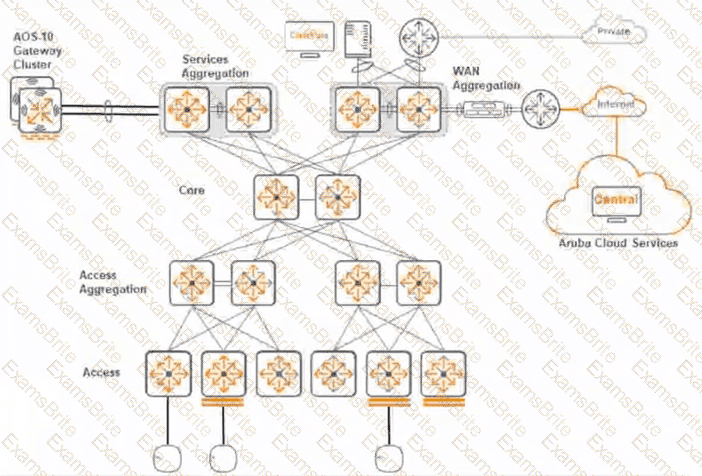
Identify the stakeholders when collecting information for the network design and the new IDF/MDF design.
Choose two.
A global cruise line company needs to modernize its existing fleet. It will refresh the ship’s “insides” to improve cost-effectiveness and sustainability, replacing all WLAN/LAN hardware. During this refresh, the company will retain its existing security requirements. The CIO also wants to minimize unused switch ports. Any future expansion will always involve a hardware refresh. The project begins with the smallest ship, which has a maximum of 800 guests.
Each ship has a LAN infrastructure comprising two core switches, up to 10 redundant distribution switches, and up to 500 access switches (400 cabins and 100 technical rooms). The core switches are in the ship’s MDF, and the distribution switches are in the IDFs. Every cabin and technical room receives one access switch.
The ship’s cabling structure will remain unchanged. Each IDF connects to the MDF through SMF, with two pairs available for the interconnect between core and distribution. The SMF distance between MDF and IDF is under 300 meters (980 ft), and it is OS1. Each cabin connects to the IDF through a single OM2 pair, with a maximum distance of 60 meters (200 ft). Each technical room connects to the IDF through a single OM2 pair, with distances from 100 to 150 meters (320 to 500 ft).
For every cabin and technical room, the customer wants to replace the existing fan-less 2530/2540 switches without changing requirements, except that the uplink to the distribution switch must be upgraded to 10GbE to accommodate increased network traffic, and technical rooms require redundant power.
The WLAN infrastructure will be refreshed 1:1, with no new cabling or AP locations. It uses 200/300 series indoor and outdoor APs running InstantOS (fewer than 300 APs), and the customer has no WLAN requirement changes.
The cruise line company will replace its existing Internet connection before the LAN/WLAN refresh. The new Internet connection will provide 99.8% uptime, needed to keep paid guest Wi-Fi operational. With this new Internet connection, the CIO wants to base the design on Aruba’s ESP architecture because the Internet connection is guaranteed.
Based on best practices, what optic type should be recommended for the connection between the IDF and the cabins?
A global cruise-line company must modernize its existing fleet. It will refresh the ship’s “insides” to reduce cost and improve sustainability, replacing all WLAN/LAN hardware. This refresh will retain the current security requirements. The CIO also wants to minimize unused switch ports. Any future expansion will require a hardware refresh. The company will begin with its smallest ship, which accommodates a maximum of 800 guests.
Each ship has a LAN infrastructure comprising two core switches, up to 10 redundant distribution switches, and up to 500 access switches (400 cabins and 100 technical rooms). The core switches are in the ship’s MDF, and the distribution switches are in the IDFs. Every cabin and technical room receives a single access switch.
The ship’s cabling infrastructure will not be replaced. Each IDF connects to the MDF through SMF, with two pairs available for the core-to-distribution interconnect. The SM fiber length between the MDF and IDF is under 300 meters (980 ft), and the fiber type is OS1. Each cabin connects to its IDF using one OM2 pair, with a maximum length of 60 meters (200 ft). Each technical room connects to its IDF through one OM2 pair, with lengths from 100 to 150 meters (320 to 500 ft).
For every cabin/technical room, the customer wants to replace its existing fan-less 2530/2540 switches without changing the requirements, except that the uplink to the distribution switch must be upgraded to 10GbE to accommodate increased network traffic, and the technical rooms require redundant power.
The WLAN infrastructure will be refreshed 1:1, with no new cabling or AP locations. It is based on 200/300-series indoor and outdoor APs running InstantOS (fewer than 300 APs), and the customer has no changes to WLAN requirements.
The cruise-line company will replace its current Internet connection before the LAN/WLAN refresh. The new Internet connection will provide 99.8% uptime, which is required to keep paid guest Wi-Fi operational. With this new Internet connection, the CIO wants to base the design on Aruba’s ESP architecture because the Internet connection is guaranteed.
Based on best practices, which switch model should be recommended as the most cost-effective option for the technical rooms?
Refer to the exhibit.
Original exhibit — Question 39
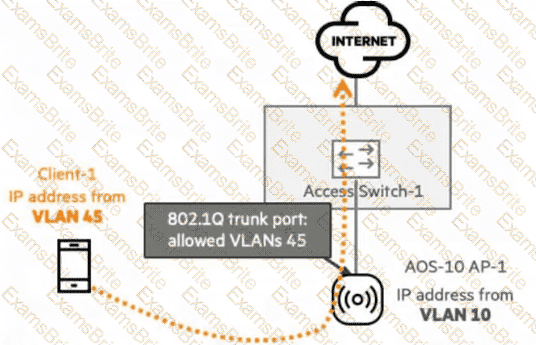
The exhibit shows an AOS-10 access point using VLAN 10 for management and a bridged wireless client receiving an IP address from VLAN 45, with the access switch carrying the client VLAN.
Your client is deploying an HPE Aruba Networking solution in which AOS-10 APs operate in bridged mode and connect directly to AOS-CX access switches in a campus environment.
A leading security priority is to block user traffic to any destination classified by BrightCloud Web Classification as “Bot Nets.” You have been asked to review and confirm the appropriate technical steps for accurate identification, classification, and blocking of this traffic through Central-managed policies and AOS-CX integration.
To block user access to the specified web destination(s) in this deployment model, which action should be taken?
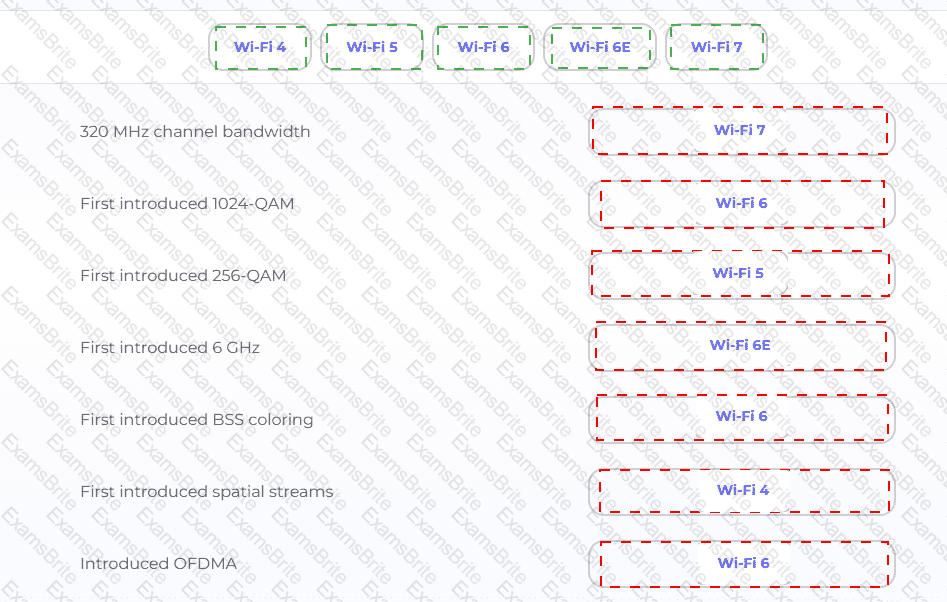
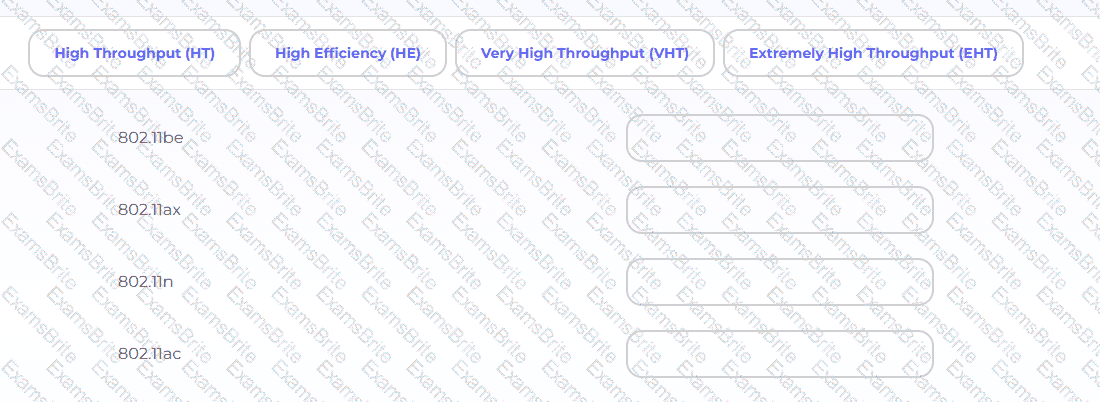
Match the Wi-Fi features to their corresponding standards. Matches may be used more than once.
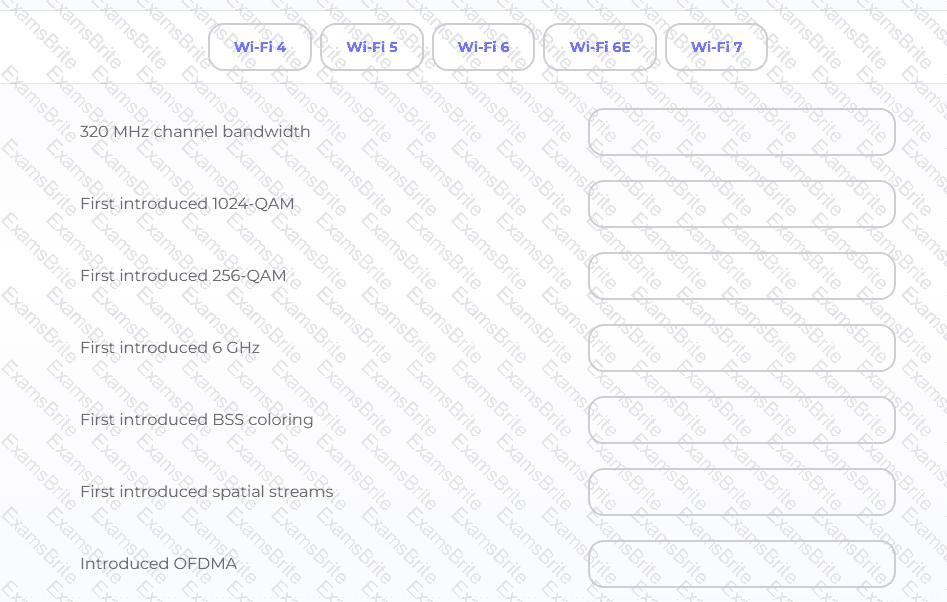
You are taking part in a multi-team design workshop for a large enterprise campus and data-center refresh project. The network engineering team has chosen an EVPN-VXLAN-based fabric to provide scalable Layer 2/3 services, enhance segmentation, and simplify future automation.
As part of the session, you have been asked to contribute to the technical design recommendations document, which will form the basis for the project implementation plan. This includes recording best practices, control-plane design, and overlay requirements for the EVPN-VXLAN fabric.
You need to identify the accurate core recommendations, required features, and key design functions to include in the proposal.
What accurately describes core recommendations, requirements, features, or functions of EVPN-VXLAN fabrics?
Choose two.
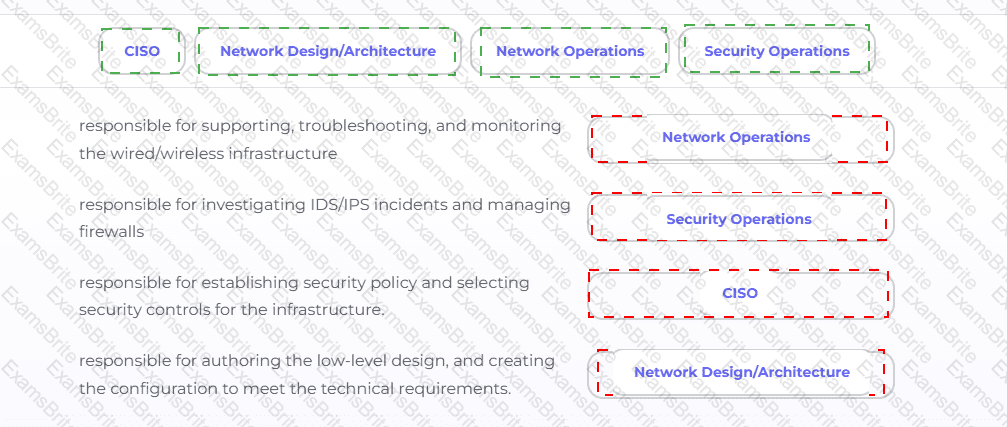
A junior engineer has been hired to help with a large-scale network infrastructure project. Because the engineer has not previously worked on a project this complex, they want to better understand the role each stakeholder will have.
Match each stakeholder title with the responsibility most likely associated with that role.
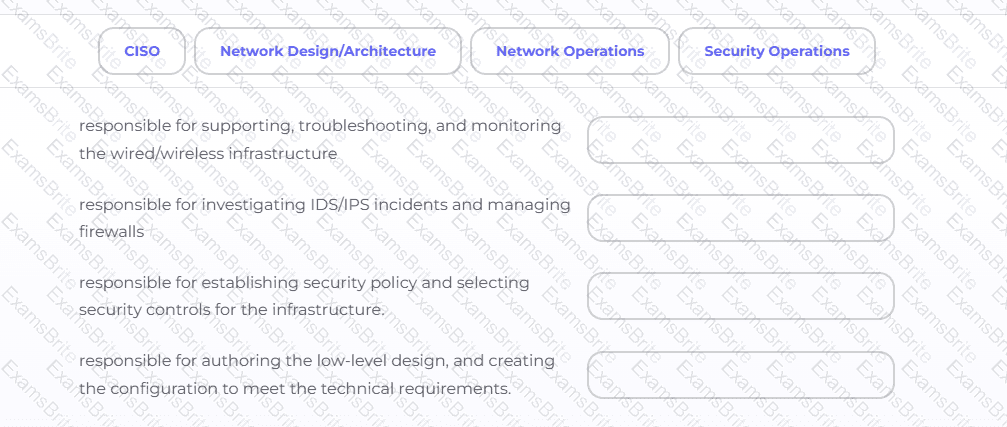
Following your initial meeting with the customer, which questions must you be able to answer?
Choose two.
You hired a junior engineer to help with a large-scale network-infrastructure project. Because the engineer has not previously worked on a project this complex, they want a clearer understanding of each stakeholder’s role.
What is the role of Network Operations in this project?
A large multinational financial institution has hired you to design a new full-stack wired and wireless network for its new six-story regional office building. The bottom two floors will provide retail space for a large banking branch. The upper floors will be carpeted corporate office space, with each floor approximately 100,000 sq ft (9290 sq m). All data centers are offsite and outside this project’s scope. The customer is underserved by its existing L2-based network infrastructure and wants to use modern best practices in the new design. The network must be fully resilient and fault-tolerant, with dynamic segmentation at the edge.
The retail space will offer public guest Wi-Fi. Retail associates will use corporate tablets for customer service, and the retail floors will contain a mix of wired and wireless devices. Corporate users will primarily connect wirelessly, although several wired clients, printers, and hard VoIP phones will also be used.
The customer also plans to renovate the corporate office space to take advantage of 'smart office' technology. These enhancements will enable blue-dot wayfinding, presence analytics, and other location-based services.
The client wants redundant RADIUS resources in each of its three geographical regions (AMER, EMEA, and APAC). A large office location in each region has sufficient VMware resources available.
Each region has 5,000 clients, all of whom must perform either 802.1x wired or wireless authentication, as well as 802.1x authentication for one personal Wi-Fi device.
All non-personal devices must also validate health with a local agent.
An average of 500 guests are expected to be connected, with a maximum of 700 simultaneous connections using Guest Portal for Internet access.
TACACS authentication will also be configured for a total of 1,200 evenly distributed NADs.
To support virtual IPs and server redundancy in every region, how many Virtual Policy Manager Licenses are required?
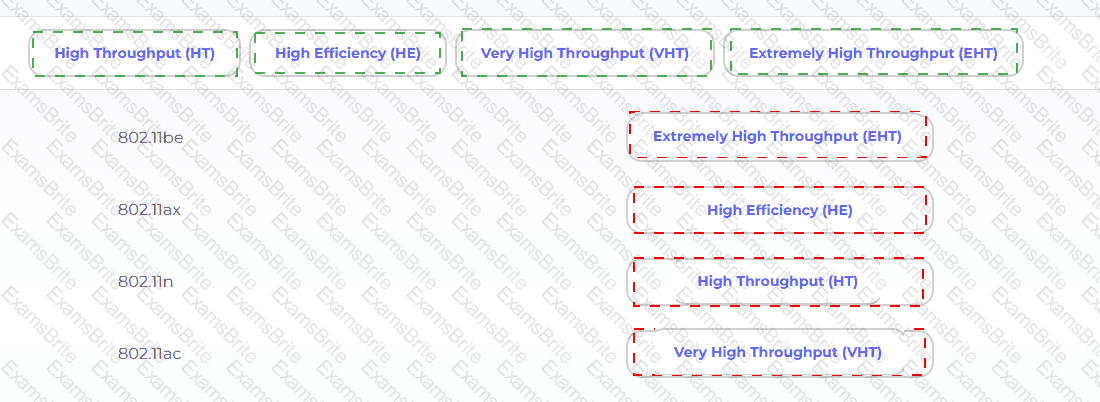
Match each IEEE designation with its official technical Physical Layer (PHY) protocol acronym.
What alternative source is most suitable for site surveys or simu-lations when no floor plans are available?
Before starting the design for HPE Aruba Networking Cloud Authentication at a distributed enterprise, you must collect information about the customer’s current identity infrastructure and endpoint capabilities. The customer has indicated interest in a cloud-native authentication solution, but details about its identity infrastructure or endpoint capabilities still need to be gathered.
As the network architect, you must proceed with initial planning by recording reasonable assumptions about the existing environment and its readiness to support cloud-native authentication.
Which assumptions are appropriate to include at this point to guide the design process?
Choose two.
What is the recommended practice for using VSX at the core of a three-tier design?
You are designing a solution with OS10-based access points and redundant gateways, with these requirements:
Wi-Fi6E-based access points
Support for tunneled traffic
Application visibility
Rogue APs
Live upgrades
Air Slice
Cloud Guest Authentication
AI Insights
Which licenses are required?
Choose two.
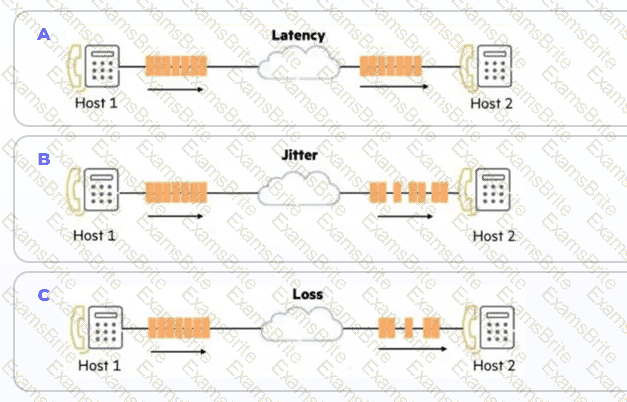
Because of the transport type used between regional data centers, the client is experiencing consistently delayed data transmissions. Response time between the locations remains around 200 ms.
How would this phenomenon be classified?
Original exhibit — Question 8
A large multinational financial institution has engaged you to design a new full-stack wired and wireless network for its new 6-story regional office building. The facility’s bottom two floors will be retail space for a large banking branch. The upper floors will be carpeted corporate office space, with each floor approximately 100,000 sq ft (9290 sq m). Data centers are all offsite and are out of scope for this project. The customer is underserved by its current L2-based network infrastructure and wants to use modern best practices in the new design. The network must be fully resilient and fault-tolerant, with dynamic segmentation at the edge.
The retail space will provide public guest Wi-Fi access. Retail associates will use corporate tablets for customer service, with a mix of wired and wireless devices throughout the retail floors. Corporate users will mainly use wireless connectivity, although several wired clients, printers, and hard VoIP phones will also be used.
The customer also plans to renovate the corporate office space to take advantage of 'smart office' technology. These enhancements will enable blue-dot wayfinding, presence analytics, and other location-based services.
The client wants to provide Blue Dot wayfinding for its carpeted office space. The retail floors are not currently in scope.
What is required to ensure the solution is properly licensed?
Which uplink oversubscription ratios satisfy A.B.C.'s requirements, assuming they can be adjusted later based on actual performance and capacity requirements?
Choose two.
Refer to the exhibit.
Original exhibit — primary and secondary gateway clusters
Planning a gateway cluster | TechDocs - WLAN, SD-Branch, & Location Services
The uploaded exhibit depicts an AP with connections toward a three-gateway primary cluster and a three-gateway secondary cluster. The original diagram is preserved in the source document.
Maintaining uninterrupted client connectivity during gateway failover is the top priority for your customer’s AOS-10 deployment.
Which option describes the AP redundancy strategy for the customer’s HPE Aruba Networking environment with minimal disruption when moving between primary and secondary gateway clusters?
Which platforms can be used to demonstrate your solution to a customer?
Choose two.
You are creating a wireless intrusion detection and prevention strategy (WIDS/WIPS) for a client’s enterprise network with HPE Aruba Networking and AOS-10. As part of the design, you intend to deploy dedicated Air Monitors (AMs).
Which two statements are consistent with HPE Aruba Networking best practices for deploying AMs in an AOS-10 environment?
Choose two.
A global cruise-line company must refresh its current fleet. It will refresh the ship’s “insides” to remain cost-effective and improve sustainability, replacing all WLAN/LAN hardware. During this refresh, the company will retain its current security requirements. The CIO also wants to minimize the number of unused switch ports. Any future expansion will always involve a hardware refresh. The company begins with its smallest ship, supporting a maximum of 800 guests.
Each ship has a LAN infrastructure comprising two core switches, up to 10 redundant distribution switches, and up to 500 access switches (400 cabins and 100 technical rooms). The core switches are in the ship’s MDF, and the distribution switches are in the IDFs. Each cabin and technical room has one access switch.
The ship’s cabling structure will not be refreshed. Each IDF connects to the MDF through SMF, with two pairs available for the core-to-distribution interconnect. The MDF-to-IDF SMF run is under 300 meters (980 ft) and uses OS1 fiber. Each cabin connects to its IDF through a single OM2 pair, with a maximum length of 60 meters (200 ft). Each technical room connects to its IDF through a single OM2 pair, with lengths from 100 to 150 meters (320 to 500 ft).
For every cabin and technical room, the customer wants to replace its current fanless 2530/2540 without changing requirements, except that the uplink to the distribution switch must be upgraded to 10GbE to accommodate increased network traffic, and technical rooms require redundant power.
The WLAN infrastructure will be refreshed 1:1, with no new cabling or AP locations. It uses 200/300-series indoor and outdoor APs running InstantOS (fewer than 300 APs), and the customer has no changes to WLAN requirements.
The cruise-line company will replace its current Internet connection before the LAN/WLAN refresh. The new Internet connection will provide 99.8% uptime, required to keep paid guest Wi-Fi operational. With this new Internet connection, the CIO wants to base the design on Aruba’s ESP architecture because the Internet connection is guaranteed.
Based on HPE Aruba Networking best practices and the customer’s stated requirements, which segmentation design approach is suitable for this environment?

TESTED 24 Nov 2026