HPE Network Security Expert Written Exam
Last Update Nov 24, 2026
Total Questions : 75
We are offering FREE HPE7-A10 HP exam questions. All you do is to just go and sign up. Give your details, prepare HPE7-A10 free exam questions and then go for complete pool of HPE Network Security Expert Written Exam test questions that will help you more.



You want to use HPE Aruba Networking ClearPass Device Insight tags as conditions in CPPM role-mapping or enforcement-policy rules.
Which guidelines should you follow?
Refer to the exhibit.
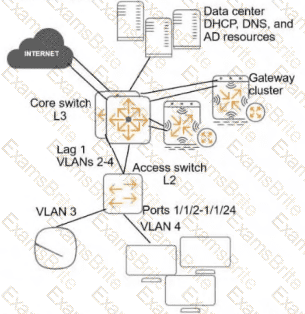
A customer needs protection from ARP poisoning in VLAN 4. The following lists all settings for VLAN 4 and the physical interfaces associated with VLAN 4 on the AOS-CX access-layer switch:
interface 1/1/2-1/1/24
no shutdown
no routing
vlan access 4
exit
interface lag 1
no shutdown
no routing
vlan trunk native 1
vlan trunk allowed 2-4
arp inspection trust
exit
vlan 4
arp inspection
exit
What is one problem with this configuration?
A company wants its AOS-CX switches to obtain certificates from ClearPass Onboard and use those certificates to implement RadSec with ClearPass Policy Manager (CPPM).
ClearPass Onboard has a CA with EST enabled and this EST URL: `[https://cp1.acnsxtest.com/.well-known/est/ca:2](https://cp1.acnsxtest.com/.well-known/est/ca:2)`
ClearPass Guest has an account whose username is `switchcorp123`. (Assume CPPM also has a valid service to authenticate users who access the EST application.)
CPPM has a network-device account for the switches with RadSec enabled. The RadSec settings validate by CN or SAN using this regex: `switchcorp123`
ClearPass has these certificates:
* HTTPS certificate signed by DigiCert
* RadSec certificate signed by DigiCert
* RADIUS/EAP certificate signed by MyDomainCA
This configuration is on the AOS-CX switches:
```text
crypto pki est-profile est1
url https://clearpass1.acnsxtest.com/.well-known/est/ca:2
username switchcorp123
password plaintext %FY212h & zaTk
vrf default
exit
crypto pki certificate cert1
subject switchcorp123
enroll est-profile onboard
crypto pki application radsec-client certificate cert1
```
The switches’ TA-profile list includes DigiCert.
Assume you have obtained the correct password associated with the indicated username. What error or errors are present?
You must install a certificate on a standalone HPE Aruba Networking Mobility Controller (MC). The MC must use the certificate for the Web UI and to implement RadSec with HPE Aruba Networking ClearPass Policy Manager. You have received a certificate with these settings:
Subject: CN=mc49.site30.example.com
No SANs
Issuer: CN=ca89.example.com
EKUs: Server Authentication, Client Authentication
What problem does this certificate have for its intended uses?
An organization wants an AOS-CX switch to generate an alert when its RADIUS server (cp.acnsxtest.local) rejects an abnormal number of client authentication requests each hour. After discussing this with other HPE Aruba Networking administrators, you still do not know how many rejections should be considered normal or abnormal. You expect this value may vary for every switch.
You are assisting the developer with developing an NAE script for this use case.
Refer to the scenario.
You are helping a customer define an NAE script for AOS-CX switches. The script will monitor statistics from a RADIUS server configured on the switch. To future-proof the script, you want administrators to be able to choose a different hostname or IP address for the monitored RADIUS server when they create an agent from the script.
What should you recommend?
A customer has an AOS-10 architecture that includes HPE Aruba Networking APs. The customer recently enabled WIDS at the high level on the APs. Administrators see several "ad hoc using valid SSID" events.
What should you explain?
The customer's security team has added a requirement: TEAP settings delivered to domain clients must use anonymous for the outer method. AOS mobility administrators now report that every wireless client appears under the same anonymous name, which makes troubleshooting difficult.
What should you recommend to best balance the security and mobility-administration needs?
A financial institution must authenticate managers of HPE Aruba Networking Mobility Controllers (MCs) and HPE Aruba Networking Mobility Conductors through ClearPass Policy Manager (CPPM). The institution’s security policies require strong encryption for manager-authentication communications between the HPE Aruba Networking devices and CPPM.
What is a valid solution?
What benefit does an organization obtain by upgrading wireless security from WPA2-Personal to WPA3-Personal?
You are helping a developer create a custom NAE script for an AOS-CX switch. What information might you need to provide so the developer can define the parameters correctly?
A client connected to an AOS-CX switch has been assigned Role1. Role1 has the following port-access classes and policy associated with it:
```text
class ip class1
10 match tcp any any eq 22
20 ignore tcp any 10.10.4.0/23 eq 443
30 match ip any 10.10.4.0/23
class ip class2
10 match any any eq 67
20 match ip any 10.10.4.0/22
port-access policy policy1
10 class ip class1 action drop
20 class ip class2
```
The client sends two packets:
1: HTTPS to 10.10.5.5
2: DNS to 10.10.6.6
What occurs?
A customer is migrating from on-premises AD to Microsoft Entra ID (Azure AD) as its only domain solution. The customer also manages wired and wireless devices with Microsoft Endpoint Manager (Intune).
The customer wants to strengthen security at the network edge. You are assisting with the design of an HPE Aruba Networking ClearPass deployment for this purpose. HPE Aruba Networking devices will authenticate wired and wireless clients to a ClearPass Policy Manager (CPPM) cluster that uses version 6.10.
The customer has several authentication requirements. Clients must pass EAP-TLS authentication only when a Microsoft Entra ID (Azure AD) query confirms that they have Microsoft Entra ID (Azure AD) accounts. To further refine client privileges, ClearPass must also use information gathered by Intune to make access-control decisions.
Refer to the scenario.
Assume that the Microsoft Entra ID (Azure AD) deployment has the required prerequisites in place.
You are planning the CPPM authentication source that you will use as the authentication source in 802.1X services. How should you configure this authentication source?
Refer to the exhibit.
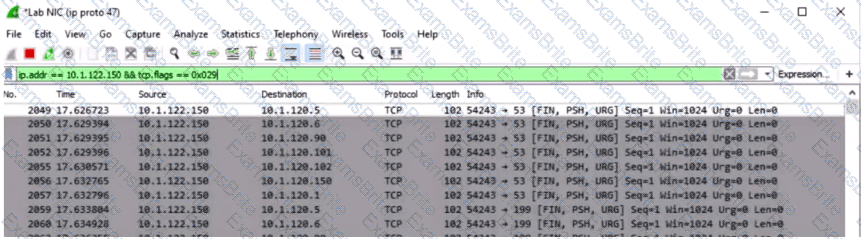
Packet trace display:
Source: 10.1.122.150 - > Destination: 10.1.120.5 TCP 54243 - > 53 [FIN, PSH, URG] Seq=1 Win=1024 Urg=0 Len=0
Source: 10.1.122.150 - > Destination: 10.1.120.6 TCP 54243 - > 53 [FIN, PSH, URG] Seq=1 Win=1024 Urg=0 Len=0
Source: 10.1.122.150 - > Destination: 10.1.120.90 TCP 54243 - > 53 [FIN, PSH, URG] Seq=1 Win=1024 Urg=0 Len=0
Source: 10.1.122.150 - > Destination: 10.1.120.101 TCP 54243 - > 53 [FIN, PSH, URG] Seq=1 Win= 1024 Urg=0 Len=0
Source: 10.1.122.150 - > Destination: 10.1.120.5 TCP 54243 - > 199 [FIN, PSH, URG] Seq=1 Win=1024 Urg=0 Len=0
What does this indicate?
Refer to the exhibit.
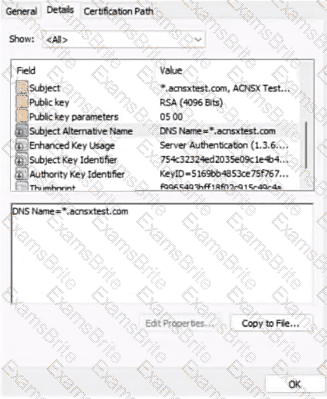
Field: Subject
Value: .acnsxtest.com, ACNSX Test...
Field: Subject Alternative Name
Value: DNS Name=.acnsxtest.com
Field: Enhanced Key Usage
Value: Server Authentication (1.3.6.1.5.5.7.3.1)
You have received this certificate to install on an HPE Aruba Networking ClearPass server for RADIUS/EAP and RadSec use. What is one issue?
A customer has an HPE Aruba Networking ClearPass cluster that uses the Intune extension. ClearPass Policy Manager (CPPM) has a service called myservice; as part of authorization, this service queries the ClearPass Intune extension.
What is recommended for high availability?
A hospital uses an AOS-10 architecture managed through HPE Aruba Networking Central. The customer has deployed a pair of HPE Aruba Networking 9000 Series gateways with Security licenses at every clinic. The gateways run IDS/IPS in IDS mode.
The Security Dashboard displays several recent events with the same signature, as shown below:
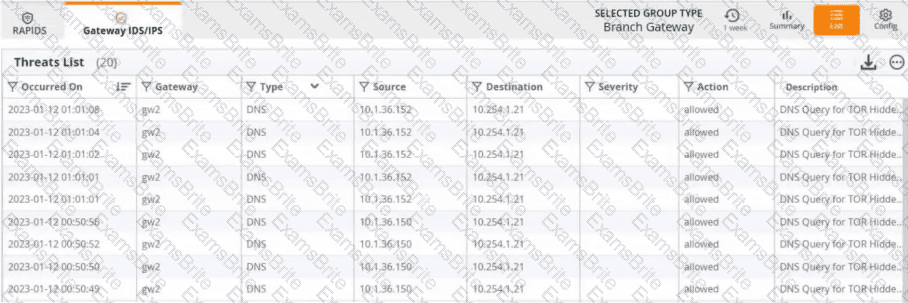
Occurred On: 2023-01-12 | Gateway: gw2 | Type: DNS | Source: 10.1.36.152 | Destination: 10.254.1.21 | Action: allowed | Description: DNS Query for TOR Hidden...
Which action could provide valuable context about the incident?
A customer uses an AOS-10 architecture that includes HPE Aruba Networking APs. Administrators recently enabled WIDS at the High level and also enabled alerts and email notifications for several events.

Administrators report receiving so many emails that they must ignore them and are considering disabling all notifications. What is one step you could recommend trying first?
A customer uses an AOS-10 architecture managed by HPE Aruba Networking Central. HPE Aruba Networking infrastructure devices authenticate clients against an HPE Aruba Networking ClearPass cluster.
In HPE Aruba Networking Central, you are reviewing network traffic flows for a wireless IoT device categorized as a “Raspberry Pi” client. You observe SSH traffic. You then inspect several additional wireless IoT clients and find that they are also sending SSH.
Refer to the scenario.
What potential issue does this indicate?
You are assisting a company with designing role-based access control policies on HPE Aruba Networking AOS-10 gateways. The security policy dictates that traffic originating from authenticated corporate user roles must be inspected statefully, allowing client-initiated outbound flows to the data center while strictly dropping any unsolicited inbound connection attempts initiated from data center servers back toward the clients.
What design principle ensures this traffic flow behavior?
When should BPDU protection be implemented on an AOS-CX switch port rather than BPDU filtering?
A customer has HPE Aruba Networking mobility devices and AOS-CX switches that use RADIUS authentication and accounting with HPE Aruba Networking ClearPass Policy Manager (CPPM). The customer relies on accounting data for auditing and has found that accounting records for clients connected to access switches lack IP address information.
Which action could you take to populate this information?
A customer operates two AOS-10 HPE Aruba Networking gateways at a site. The gateways are part of an SD-Branch solution managed by HPE Aruba Networking Central, and their cluster setting uses WLAN mode (the non-default gateway mode).
You are configuring a manual HPE Aruba Networking gateway cluster for dynamic authorization. The gateways have these IP addresses on a subnet that CPPM can access:
Gateway 1 = 10.56.20.2
Gateway 2 = 10.56.20.3
Which VRRP IP address assignments are valid for the gateways? Assume that all IP address options are available.

TESTED 24 Nov 2026