HashiCorp Certified: Vault Associate (003) Exam
Last Update Oct 12, 2026
Total Questions : 324
We are offering FREE HCVA0-003 HashiCorp exam questions. All you do is to just go and sign up. Give your details, prepare HCVA0-003 free exam questions and then go for complete pool of HashiCorp Certified: Vault Associate (003) Exam test questions that will help you more.

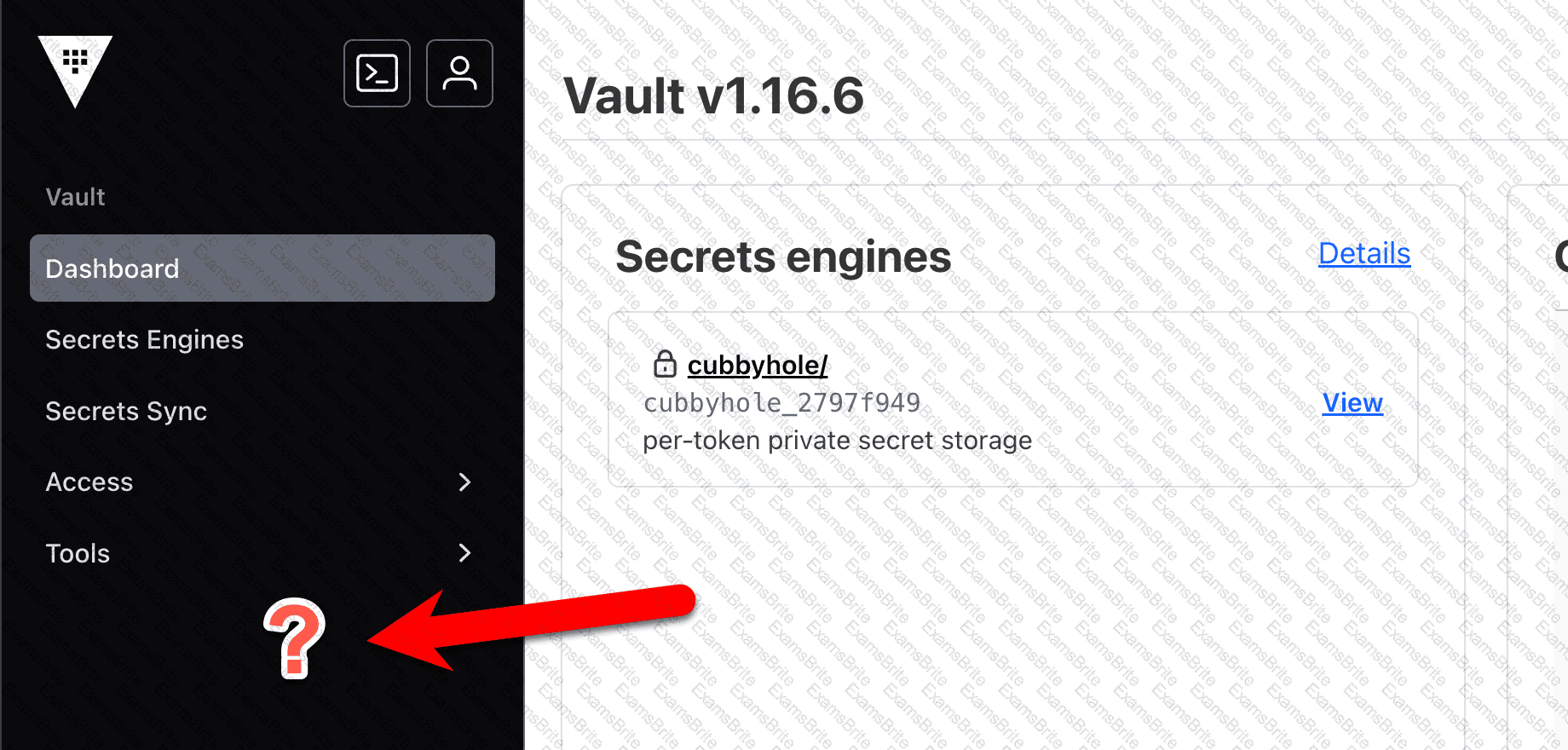
Your supervisor has requested that you log into Vault and update a policy for one of the development teams. You successfully authenticated to Vault via OIDC but do not see a way to manage the Vault policies. Why are you unable to manage policies in the Vault UI?
You have a requirement that an application needs to implement AES encryption.
What parameter must you use to meet this requirement when defining a new key in a Transit secrets engine for this app?
Which of the following are true about Vault policies?
Pick the 2 correct responses below.
You need to manage access to Vault secrets engines for users that will have multiple accounts with various identity providers with which they will authenticate to Vault, such as GitHub, LDAP, Active Directory, etc.
What would allow them to have a single set of policies across all of these identity providers for each user?
You are using Vault to generate dynamic credentials for a Microsoft SQL server to perform queries for a month-end report. The report seems to be taking much longer than expected due to degradation on the underlying server, and you are afraid that Vault might automatically revoke the credentials. How can you extend the time the credentials are valid to ensure your month-end query is successful?
A large organization uses Vault for various use cases with multiple auth methods enabled. A user can authenticate via LDAP, OIDC, or a local userpass account, but they receive different policies for each method and often need to log out and back in for different actions. What can be configured in Vault to ensure users have consistent policies regardless of their authentication method?
The Key/Value (KV) secrets engine is an example of a dynamic secrets engine.
Which of the following policies would permit a user to generate dynamic credentials on a database?
Select the policies below that permit you to create a new entry of environment=prod at the path /secrets/apps/my_secret (select three).
After issuing the command to delete a secret, you run a vault kv list command, but the path to the secret still seems to exist. What command would permanently delete the path from Vault?

True or False? When using the Transit secrets engine, setting the min_decryption_version will determine the minimum key length of the data key (i.e., 2048, 4096, etc.).
You are using an orchestrator to deploy a new application. Even though the orchestrator creates a new AppRole secret ID, security requires that only the new application has the combination of the role ID and secret ID. What feature can you use to meet these requirements?
Which scenario most strongly indicates a need to run a self-hosted Vault cluster instead of using HCP Vault Dedicated?
Jason has enabled the userpass auth method at the path users/. What path would Jason and other Vault operators use to interact with this new auth method?
Which of the following statements best describes the difference in cluster strategies between self-managed Vault and HashiCorp-managed Vault?
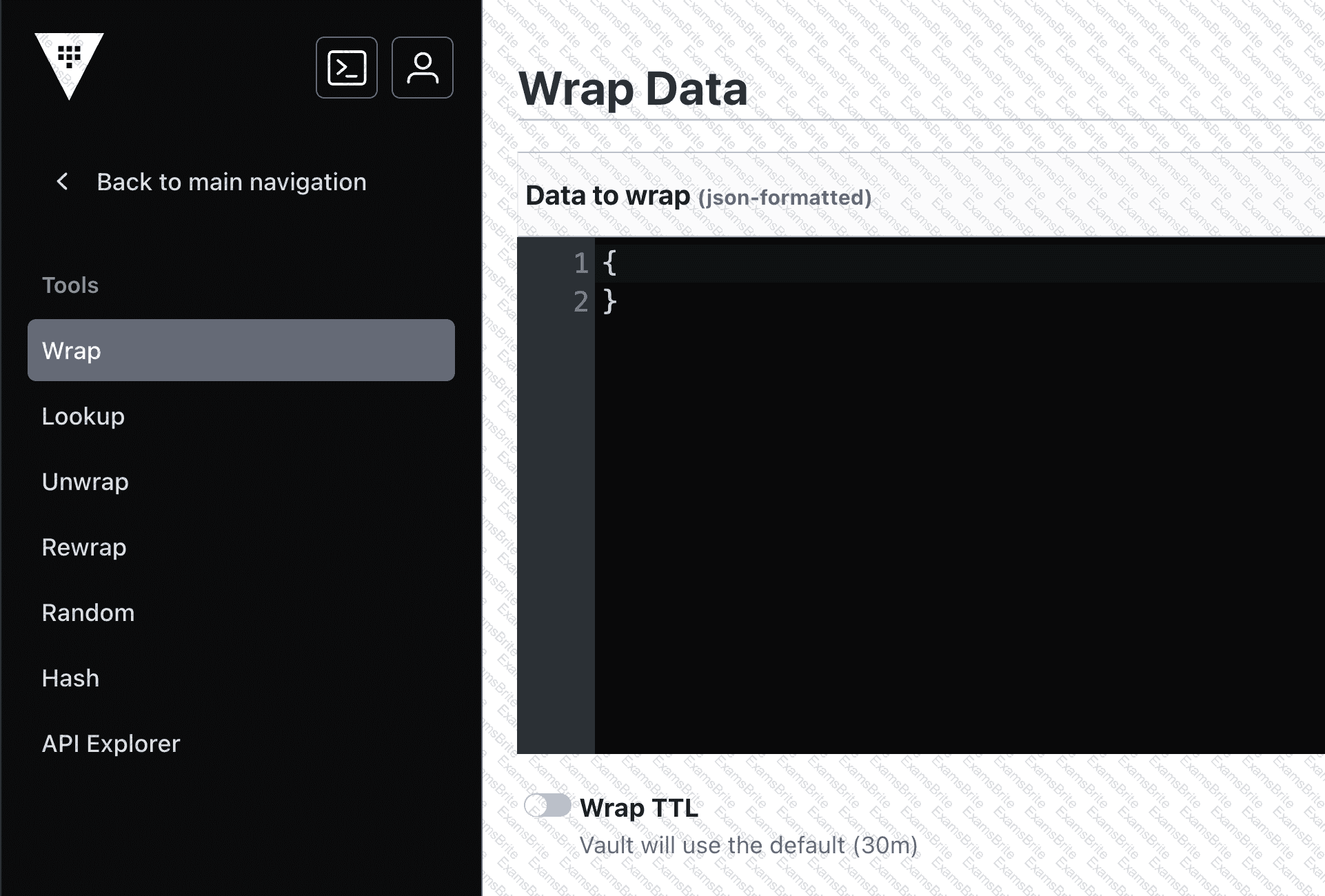
What could you do with the feature found in the screenshot below (select two)?
True or False? When encrypting data with the Transit secrets engine, Vault always stores the ciphertext in a dedicated KV store along with the associated encryption key.
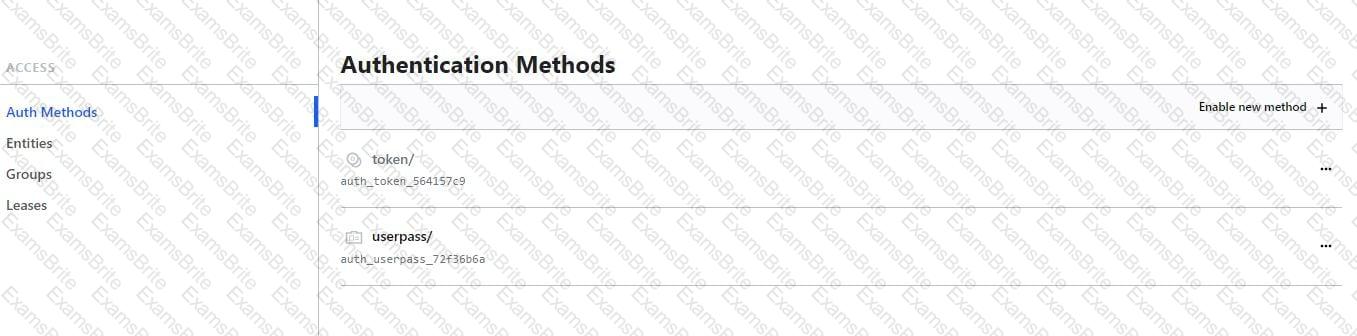
Based on the screenshot below, how many auth methods have been enabled on this Vault instance?
From the options below, select the benefits of using a batch token over a service token (select four).
Which of the following secrets engines does NOT issue a lease upon a read request?
What is the primary role of the Vault Security Operator (VSO) in a Kubernetes environment?
You are the primary Vault operator. During a routine audit, an auditor requested the ability to display all secrets under a specific path in Vault without seeing the actual stored data. Which policy permits the auditor to display the stored secrets without revealing their contents?
You have multiple Vault clusters in your environment, one for test and one for production. You have the CLI installed on your local machine and need to target the production cluster to make configuration changes. What environment variable can you set to target the production cluster?
True or False? Your organization currently runs all of its workloads on Google Cloud Platform (GCP). Recently, Vault has been deployed, and you need to select an auth method to authenticate your workloads with Vault. Based on this information, GCP is the only auth method that can be used in your environment.
Your organization recently suffered a security breach on a specific application, and the security response team believes that MySQL database credentials were likely obtained during the event. The application generated the credentials using the database secrets engine in Vault mounted at the path database/. How can you quickly revoke all of the secrets generated by this secrets engine?
Over a few years, you have a lot of data that has been encrypted by older versions of a Transit encryption key. Due to compliance regulations, you have to re-encrypt the data using the newest version of the encryption key. What is the easiest way to complete this task without putting the data at risk?
Which of the following capabilities can be used when writing a Vault policy? (Select four)
Which core component of Vault can store, generate, or encrypt data for organizations?
You have enabled the Transit secrets engine and want to start encrypting data to store in Azure Blob storage. What is the next step that needs to be completed before you can encrypt data? (Select two)
Which of the following are considered benefits of using policies in Vault? (Select three)
You are planning the deployment of your first Vault cluster and have decided to use Integrated Storage as the storage backend. Where do you configure the storage backend to be used by Vault?
How does the instance updates feature work when using the Vault Secrets Operator?
Your co-worker has asked you to perform certain operations in Vault and has provided you with a token accessor (not the token itself). What Vault operations would you be allowed to perform using only the provided accessor? (Select three)
You have a new team member on the Vault operations team. Their first task is to rotate the encryption key in Vault as part of the organization’s security policy. However, when they log in, they get an access denied error when attempting to rotate the key. The policy being used is below. Why can’t the user rotate the encryption key?
path " auth/* " {
capabilities = [ " create " , " read " , " update " , " delete " , " list " ]
}
path " sys/rotate " {
capabilities = [ " read " , " update " ]
}
Vault is configured with the oidc auth method and you need to log in using the CLI. What command would you use to authenticate so you can make configuration changes to Vault?
True or False? After rotating a transit encryption key, all data encrypted with the previous version must be rewrapped or re-encrypted with the new key.
An Active Directory admin created a service account for an internal application. You want to store these credentials in Vault, allowing a CI/CD pipeline to read and configure the application with them during provisioning. Vault should maintain the last 3 versions of this secret. Which Vault secrets engine should you use?
Which two interfaces automatically assume the token for subsequent requests after successfully authenticating? (Select two)
Christy has created a token and needs to use that token to access Vault. What command can she use to authenticate and access secrets stored in Vault?
$ vault token create -policy=christy
Key Value
--- -----
token hvs.hxDIPd8RPVtxu4AzSGS1lArP
token_accessor AxwxpDs6LbdFQbWGmBDnwIK3
token_duration 24h
token_renewable true
token_policies [ " christy " " default " ]
identity_policies []
policies [ " christy " " default " ]
Which of the following auth methods is the best choice for human interaction with Vault (as opposed to machine/system authentication)?
What is the result of the following Vault command?
$ vault auth enable kubernetes
You have a long-running app that cannot handle a regeneration of a token or secret. What type of token should be created for this application in order to authenticate and interact with Vault?
Using the Vault CLI, there are several ways to create a new policy. Select the valid commands (Select three)
When Vault is sealed, which are the only two operations available to a Vault administrator? (Select two)
Which two characters can be used when writing a policy to reflect a wildcard or path segment? (Select two)
Beyond encryption and decryption of data, which of the following is not a function of the Transit secrets engine?
An application is trying to use a dynamic secret in which the lease has expired. What can be done in order for the application to successfully request data from Vault?
Mike’s Cereal Shack uses Vault to encrypt customer data to ensure it is always stored securely. They are developing a new application integration to send new customer data to be encrypted using the following API request:
text
CollapseWrapCopy
$ curl \
--header " X-Vault-Token: hvs.sf4vj1rFV5PvQSV3M9dcv832brxQFsfbXA " \
--request POST \
--data @data.json \
https://vault.mcshack.com:8200/v1/transit/encrypt/customer-data
What would be contained within the data.json file?
True or False? To prepare for day-to-day operations, the root token should be safely saved outside of Vault in order to administer Vault.
You have a legacy application that requires secrets from Vault that must be written to a local configuration file. However, you cannot refactor the application to communicate directly with Vault. What solution should you implement to satisfy the requirements?
You have deployed an application that needs to encrypt data before writing to a database. What secrets engine should you use?
Before the following command can be run to encrypt data, what (three) commands must be run to enable and configure the transit secrets engine in Vault? (Select three)
text
CollapseWrapCopy
$ vault write transit/encrypt/vendor \
plaintext= " aGFzaGljb3JwIGNlcnRpZmllZA== "
True or False? Once the minimum decryption version is set on an encryption key, older versions of the key are removed from Vault and are no longer available for decryption operations.
Your organization has many applications needing heavy read access to Vault. As these applications integrate with Vault, the primary Vault cluster’s performance is negatively impacted. What feature can you use to scale the cluster and improve performance?
Tom is authenticating to Vault using the CLI. Which of the following commands allows Tom to authenticate using the userpass method WITHOUT logging his password to the shell history?
Although batch and service tokens share many characteristics, which of the following are true only about batch tokens? (Select three)
You need to decrypt customer data to provide it to an application. When you run the decryption command, you get the output below. Why does the response not directly reveal the cleartext data?
$ vault write transit/decrypt/phone_number ciphertext= " vault:v1:tgx2vsxtlQRfyLSKvem... "
Key Value
--- -----
plaintext aGFzaGljb3JwIGNlcnRpZmllZDogdmF1bHQgYXNzb2NpYXRl
True or False? The following policy permits a user to read secrets contained in the path secrets/cloud/apps/jenkins?
text
CollapseWrapCopy
path " secrets/cloud/apps/jenkins/* " {
capabilities = [ " create " , " read " , " update " , " delete " , " list " ]
}
Based on the output below, how many policies have been added to Vault?
$ vault policy list
base
default
root
web-app-1
automation-team
Vault operators can create two types of groups in Vault. What are the two types?
True or False? Once the lease for a dynamic secret has expired, Vault revokes the credentials on the backend platform for which they were created (i.e., database, AWS, Kubernetes).
Kyle enabled the database secrets engine for dynamic credentials. Amy, the senior DBA, accidentally deleted the database users created by Vault, disrupting client applications. How can Kyle manually remove the leases in Vault?
Suzy is a Vault user that needs to create and replace values at the path secrets/automation/apps/chef. Does the following policy permit her the permissions to do so?
text
CollapseWrapCopy
path " secrets/automation/apps/chef " {
capabilities = [ " create " , " read " , " list " ]
}
What command can be used to update a Vault policy named web-app-1 using the command line?
You have TBs of data encrypted by Vault stored in a database and are worried about Vault becoming unavailable and not being able to decrypt the data. Is it possible to export the encryption key to store it somewhere else in the event Vault becomes unavailable?
You are considering using HCP Vault Dedicated but are concerned about differences between a hosted version and a self-hosted deployment. Which of the following statements is true about HCP Vault Dedicated?
Assuming default configurations, which of the following operations require a threshold of key shares to perform? (Select three)
When a lease is created, what actions can be performed by using only the lease ID? (Choose two)
True or False? Once you authenticate to Vault using the API, subsequent requests will automatically be permitted without further interaction.
Short-lived, dynamically generated secrets provide organizations with many benefits. Select the benefits from the options below. (Select four)
You have a 2GB Base64 binary large object (blob) that needs to be encrypted.
How will the Transit secrets engine manage the encryption lifecycle for a large blob?
The following three policies exist in Vault. What do these policies allow an organization to do?

You have ciphertext stored in an Amazon S3 bucket encrypted by the key named prod-customer. Will Vault decrypt this data with the command vault write transit/decrypt/prod-customer ciphertext= " vault:v4:Xa1f9FIJtn13em/Wb7QCsXsU/kCOn7... " given this output?
$ vault read transit/keys/prod-customer
Key Value
--- -----
...
keys map[4:1549347108 5:1549347109 6:1549347110]
latest_version 6
min_available_version 0
min_decryption_version 4
min_encryption_version 0
Will Vault decrypt this data for you by running the following command?
$ vault write transit/decrypt/prod-customer ciphertext= " vault:v4:Xa1f9FIJtn13em/Wb7QCsXsU/kCOn7... "
You are building a new CI/CD pipeline which integrates with Vault. You will be building multiple targets: on premises in vSphere, and in AWS. You have already selected the AWS authentication method for the AWS targets.
Which auth method can the CI/CD tool use to authenticate with the on-premises targets?
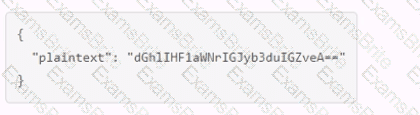
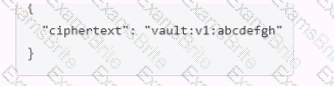
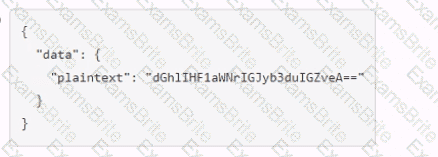
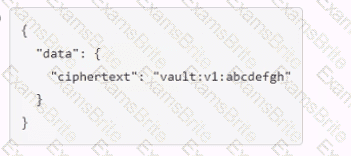
A user issues the following cURL command to encrypt data using the transit engine and the Vault AP:

Which payload.json file has the correct contents?
A.
B.
C.
D.
Which of the following are replication methods available in Vault Enterprise? Choose two correct answers.
Use this screenshot to answer the question below:
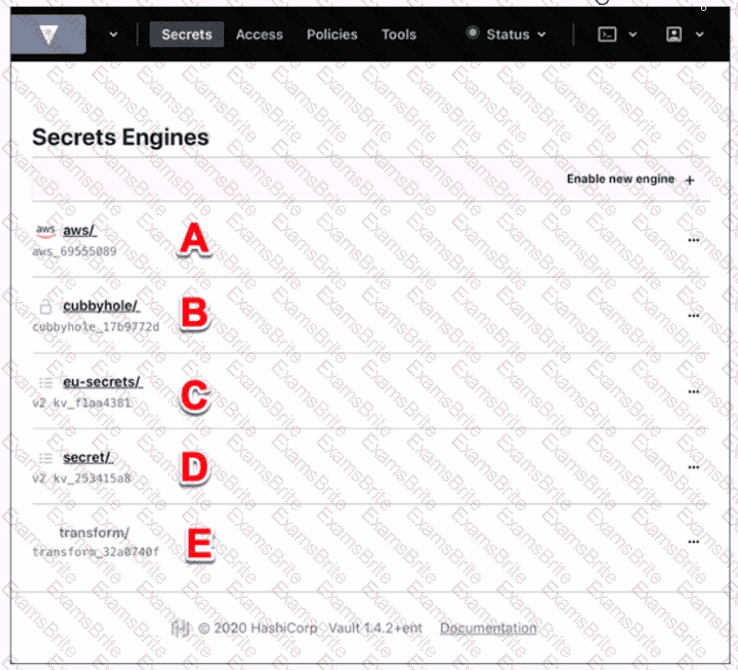
Where on this page would you click to view a secret located at secret/my-secret?
Security requirements demand that no secrets appear in the shell history. Which command does not meet this requirement?
What is the Vault CLI command to query information about the token the client is currently using?
A developer mistakenly committed code that contained AWS S3 credentials into a public repository. You have been tasked with revoking the AWS S3 credential that was in the code. This credential was created using Vault ' s AWS secrets engine and the developer received the following output when requesting a credential from Vault.
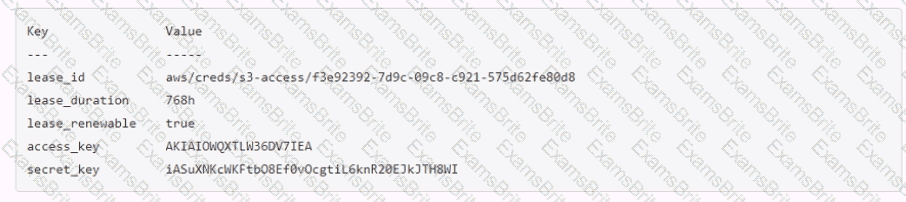
Which Vault command will revoke the lease and remove the credential from AWS?

TESTED 12 Oct 2026