Month End Special 75% Discount offer - Ends in 0d 00h 00m 00s - Coupon code: 75brite

ExamsBrite Dumps

HCIA-Cloud Service V3.5 Question and Answers

HCIA-Cloud Service V3.5

Last Update Aug 29, 2026
Total Questions : 60

We are offering FREE H13-811_V3.5 Huawei exam questions. All you do is to just go and sign up. Give your details, prepare H13-811_V3.5 free exam questions and then go for complete pool of HCIA-Cloud Service V3.5 test questions that will help you more.


H13-811_V3.5 pdf

H13-811_V3.5 PDF

$26.25  $104.99
H13-811_V3.5 Engine

H13-811_V3.5 Testing Engine

$31.25  $124.99
H13-811_V3.5 PDF + Engine

H13-811_V3.5 PDF + Testing Engine

$41.25  $164.99
Questions 1

In HUAWEI CLOUD Object Storage Service (OBS), an object policy is only applied to a single object in a bucket. A bucket policy applies to some or all of the objects in a bucket.

Options:

A.  

TRUE

B.  

FALSE

Discussion 0
Questions 2

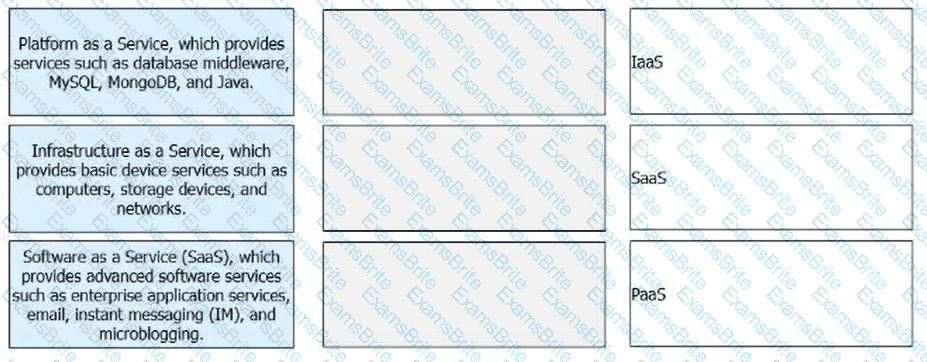
The three cloud computing service models are continuously being improved. Match the acronyms of the three models with their respective functions:
Options:

Discussion 0
Questions 3

The underlying physical resources of an Elastic Cloud Server (ECS) can be shared between users, but those of a Bare Metal Server (BMS) are exclusive to a single user.

Options:

A.  

TRUE

B.  

FALSE

Discussion 0
Questions 4

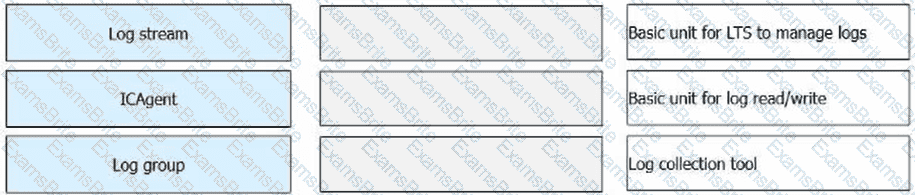
Match the concepts involved in Log Tank Service (LTS) with their description:
Options:

Discussion 0
Questions 5

Which of the following statements about Cloud Eye are correct?

Options:

A.  

The server monitoring of Cloud Eye can only monitor the operating system (OS), and not processes.

B.  

If you select 50 monitored objects and a monitoring template with 20 metrics in Cloud Eye, you can create a maximum of 1,000 alarms at once.

C.  

An alarm rule can be set on the Cloud Eye to trigger auto scaling when the ECS usage reaches the defined threshold.

D.  

The alarm rules of Cloud Eye must be created individually.

Discussion 0
Questions 6

Which of the following are included in the HUAWEI CLOUD security service system?

Options:

A.  

Application security

B.  

Network security

C.  

Computing security and security management

D.  

Data security

Discussion 0
Questions 7

An image is a template used to create servers or disks. It contains an OS, service data, and necessary application software. Image Management Service (IMS) allows you to manage the full lifecycle of images. Which of the following statements about images is false?

Options:

A.  

A Marketplace image is a third-party image published in the Marketplace. It has an OS, application environment, and software pre-installed.

B.  

A public image is a system image provided by the cloud platform.

C.  

A private image is shared by other users.

D.  

A shared image cannot be encrypted.

Discussion 0
Questions 8

To use Cloud Trace Service (CTS) on HUAWEI CLOUD, you need to enable CTS and manually create a tracker that will identify and track all cloud services that you use.

Options:

A.  

TRUE

B.  

FALSE

Discussion 0
Questions 9

Which of the following statements is correct about dynamic resource scaling of Auto Scaling (AS)?

Options:

A.  

Alarm-based AS policies can be used to adjust resources to keep up with dynamically changing demands.

B.  

When the conditions specified in an AS policy are met, the system automatically changes the maximum number of instances to trigger a scaling action.

C.  

Scheduled and periodic AS policies can be used to adjust resources to meet demands that change on a regular schedule.

D.  

Resources can be adjusted on demand at any time without being restricted by the cooldown period.

Discussion 0
Questions 10

How does Cloud Trace Service (CTS) notify subscribed users when key operations occur?

Options:

A.  

SMS

B.  

WeChat

C.  

Phone call

D.  

Email

Discussion 0
Questions 11

Which of the following statements is incorrect about Scalable File Service (SFS) Capacity-Oriented and SFS Turbo file systems?

Options:

A.  

SFS Capacity-Oriented file systems provide more bandwidth than SFS Turbo Standard file systems.

B.  

SFS Capacity-Oriented file systems have higher latency than SFS Turbo file systems.

C.  

For the same unit price, an SFS Capacity-Oriented file system has greater capacity than an SFS Turbo file system.

D.  

For the same amount of capacity, an SFS Capacity-Oriented file system is more expensive than an SFS Turbo file system.

Discussion 0
Questions 12

On HUAWEI CLOUD, if a user wants to enable an Elastic Cloud Server (ECS) to access the Internet, the only way is to bind an Elastic IP (EIP) to the ECS.

Options:

A.  

TRUE

B.  

FALSE

Discussion 0
Questions 13

Which of the following statements about security group configurations are correct?

Options:

A.  

When creating an Elastic Cloud Server (ECS), users must select a security group.

B.  

When selecting a security group, users can select the default security group or create one manually.

C.  

Security groups protect ECSs and only support allow rules.

D.  

The inbound and outbound rules of the default security group cannot be modified, but those of custom security groups can.

Discussion 0
Questions 14

Cloud Backup and Recovery (CBR) allows users to easily back up cloud resources, including Elastic Cloud Servers (ECSs), Elastic Volume Service (EVS disks), and Scalable File Service (SFS) file systems. Which of the following statements about CBR are true?

Options:

A.  

Backups are usually performed manually by users to protect user data or service backups.

B.  

Policies that CBR supports include backup policies and replication policies.

C.  

CBR ensures that user data is never lost.

D.  

CBR uses vaults to store backups.

Discussion 0
Questions 15

IAM users created by an administrator do not have default permissions. Which of the following statements about permissions is incorrect?

Options:

A.  

FullAccess permissions provide read-only access to all services except IAM.

B.  

Permissions are classified into roles and policies based on granularity.

C.  

To assign permissions to new users, add them to one or more groups, then attach permissions policies or roles to these groups. The users inherit permissions from their groups.

D.  

IAM users can perform operations on cloud services as specified by the assigned permissions.

Discussion 0
Questions 16

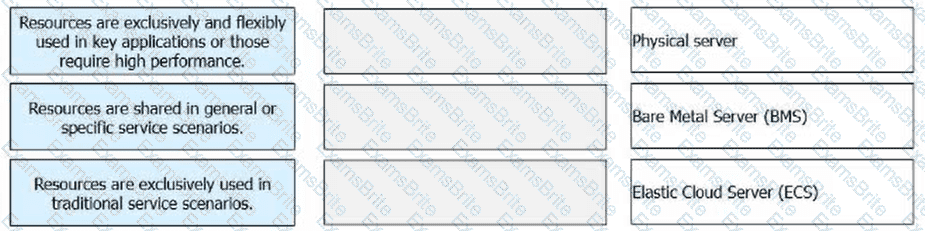
Match the following application scenarios with the corresponding server types:
Options:

Discussion 0
Questions 17

On Huawei Cloud, snapshots can be used to save Elastic Volume Service (EVS) disk data at specific points in time. If you delete an EVS disk, its snapshots will not be deleted.

Options:

A.  

TRUE

B.  

FALSE

Discussion 0
Questions 18

Which of the following statements are false about Auto Scaling (AS)?

Options:

A.  

Public images provided by Huawei Cloud can be used in AS configurations.

B.  

An alarm policy can be used to increase the number of instances in an AS group every three hours.

C.  

The expected number of instances of an AS group is the minimum number of instances in the AS group during peak hours.

D.  

An Elastic Cloud Server (ECS) instance cannot be a member of two AS groups.

Discussion 0