HCIP-WLAN V2.0
Last Update Nov 23, 2026
Total Questions : 55
We are offering FREE H12-323_V2.0 Huawei exam questions. All you do is to just go and sign up. Give your details, prepare H12-323_V2.0 free exam questions and then go for complete pool of HCIP-WLAN V2.0 test questions that will help you more.



In a network with Huawei's CloudCampus Solution deployed, an AP cannot come online on iMaster NCE-Campus. Which of the following could cause this issue?
CHOOSE THREE
In healthcare environments, spaces such as wards and consultation rooms commonly contain multiple separate small rooms. Therefore, wall-plate APs or agile distributed RUs can be installed in each small room to deliver wireless coverage.
An AP steers a STA when that STA satisfies the steering conditions. STAs running voice or video services are not steered.
Among the SISO, SIMO, MISO, and MIMO transmission systems on a WLAN, only MIMO can simultaneously transmit two copies of a signal.
In an N+1 backup scenario, APs determine an active/standby WAC switchover. By default, how long after an AP stops receiving CAPWAP heartbeat detection packets from the active WAC is an active/standby switchover triggered?
When using the CloudCampus APP to run a speed test, the Internet speed test cannot be performed if the radio signal associated with the current STA cannot access the Internet.
For the parking-lot scenario shown, it is recommended to deploy APs above lanes and at intersections as well, to provide continuous signal coverage.
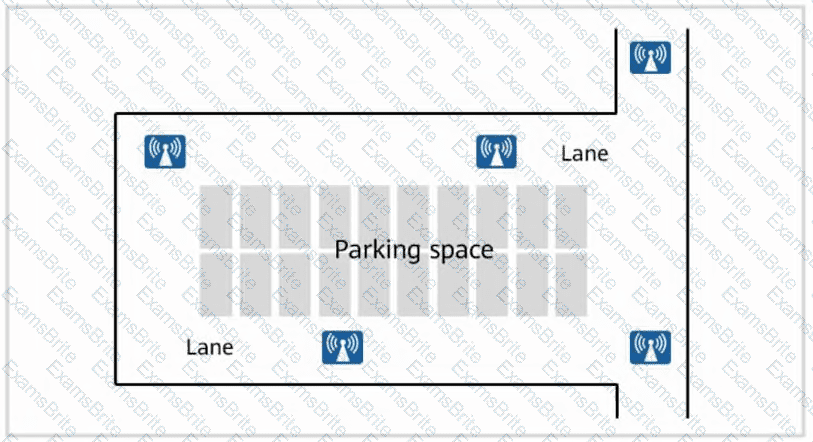
Original exhibit: Q25 Parking Exhibit
On a network using Huawei’s traditional WLAN solution, all APs are managed by a WAC. If users experience STA roaming failures and degraded WLAN service, which of the following is not a possible cause?
On an agile distributed WLAN, RUs and central APs must be located on the same Layer 2 network, and each RU can associate with only one central AP.
Which of the following statements are correct regarding network optimization in the WLAN optimization solution?
CHOOSE THREE
A Huawei Wi-Fi 6 AP supports up to 8x8 MIMO on the 5 GHz band when operating in dual-radio mode. When its 5 GHz radio uses 160 MHz channel bandwidth, a Wi-Fi 6 STA operating in 2x2 MIMO + 160 MHz mode connects to that radio. What is this STA’s maximum theoretical rate?
Which of the following statements are accurate about the wireless health evaluation feature in CampusInsight?
CHOOSE THREE
Actual packet transmission rates of STAs differ greatly depending on the radio modes that STAs support and the radio environment. The airtime scheduling function allocates channel resources according to the channel-occupation time of users connected to the same radio. Each user receives equal time to occupy the channel, ensuring fairness in channel occupation. If multiple users send different packet types, airtime scheduling still takes effect.
In inter-WAC roaming scenarios, WACs can be placed into different groups. STAs can roam among WACs within the same group, which is called a mobility group. A WAC can serve as the mobility server for multiple mobility groups, but it can be added to only one mobility group.
In roaming scenarios, because of individual differences, some STAs do not roam to APs with stronger signals and instead remain connected to the initially associated APs, even if they are disconnected. These STAs might not initiate association requests again after disconnection. To resolve this problem, the WAC directly takes these sticky STAs offline.

TESTED 23 Nov 2026