BIG-IP Administration Data Plane Configuration (F5CAB3) exam
Last Update Sep 21, 2026
Total Questions : 82
We are offering FREE F5CAB3 F5 exam questions. All you do is to just go and sign up. Give your details, prepare F5CAB3 free exam questions and then go for complete pool of BIG-IP Administration Data Plane Configuration (F5CAB3) exam test questions that will help you more.



Application administrators are reporting that nodes different from those configured in the pool are selected. The use of an iRule is suspected. How can the BIG-IP Administrator check if an iRule is used for this traffic? (Pick the 2 correct responses below)
How will the BIG-IP system distribute the traffic based on the configuration below?
pool my_pool {
lb_mode fastest
min_active_members 2
member 10.12.10.7:80 priority 3
member 10.12.10.8:80 priority 3
member 10.12.10.9:80 priority 3
member 10.12.10.4:80 priority 2
member 10.12.10.5:80 priority 2
member 10.12.10.6:80 priority 2
member 10.12.10.1:80 priority 1
member 10.12.10.2:80 priority 1
member 10.12.10.3:80 priority 1
}
(Pick the 2 correct responses below)
A Standard Virtual Server for a web application is configured with SNAT Automap. The original client IP must be known by backend servers.
What should the BIG-IP Administrator configure?
Refer to the exhibit.
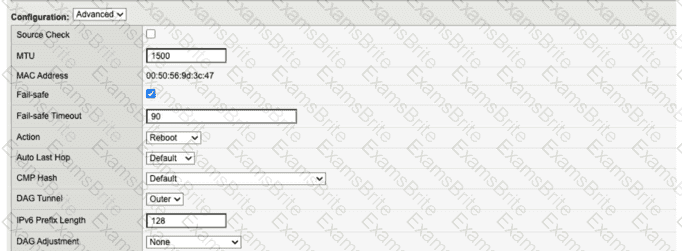
A BIG-IP Administrator configures a new VLAN on an HA pair of devices that does NOT yet have any traffic. This action causes the assigned traffic group to fail over to the standby device. Which VLAN setting should be changed to prevent this issue?
A Standard Virtual Server reports poor network performance for Internet-based clients.
What configuration should be applied?
A BIG-IP Administrator finds the following log entry after a report of user issues connecting to a virtual server:
01010201: Intercept exhaustion on 10.70.110.112 to 192.28.123.250:80 (proto 6)
How should the BIG-IP Administrator modify the SNAT pool that is associated with the virtual server? (Choose one answer)
A BIG-IP Administrator adds new pool members to a highly utilized pool. The application begins failing.
What pool-level setting should be checked?
Which two load balancing methods consider all the connections the BIG-IP has between it and each backend application server (Pool Member) when making a load balancing decision for a new connection?
The BIG-IP Administrator has to provide encrypted communication between the users and the virtual server they access. Multiple hostnames are configured in DNS with the same IP address. Which profile type and setting in the profile should be used? (Choose one answer)
Local Traffic Network Map: VS_HTTP → POOL_WEB → 192.168.212.30:80 Pool Member | Parent Node 192.168.212.30 Port 80
Why is the virtual server unresponsive to incoming connections?
An organization is reporting slow performance accessing their Intranet website. All employees use a single Proxy Server with a public IP.
What should the BIG-IP Administrator do to fix this issue?
A BIG-IP Administrator adds new pool members into a highly utilized pool. Users report application failures.
Which pool-level setting should be checked?
A BIG-IP Administrator needs to modify a virtual server that will offload web traffic compression tasks from the target server. Which two profiles must the BIG-IP Administrator apply to a virtual server to enable compression? (Pick the 2 correct responses below)
In the BIG-IP Configuration Utility, a user requests a single screen view to determine the status of all Virtual Servers and associated pool members, as well as any iRules in use. Where should the BIG-IP Administrator instruct the user to find this view?
A BIG-IP Administrator configures an SSH pool with five members.
Which health monitor should be applied?
Users report that traffic is negatively affected every time a BIG-IP device fails over. The traffic becomes stabilized after a few minutes. What should the BIG-IP Administrator do to reduce the impact of future failovers?
The BIG-IP Administrator is investigating if better TCP performance is possible for a virtual server. Which built-in profile should be tried first?
A virtual server is configured to offload SSL from a pool of backend servers. When users connect to the virtual server, they successfully establish an SSL connection but no content is displayed. A packet trace performed on the server shows that the server receives and responds to the request. What should a BIG-IP Administrator do to resolve the problem? (Choose one answer)
A BIG-IP Administrator needs to configure health monitors for a pool containing HTTP, HTTPS, FTP, and SSH services.
Which configuration ensures accurate member status?
A BIG-IP Administrator finds the following log entry: tmm tmm[714]: 011e0002:4: sweeper_update: aggressive mode activated. Which action should the BIG-IP administrator take to mitigate this memory issue?
The BIG-IP Administrator has to provide encrypted communication between users and the virtual server they access. Multiple hostnames are configured in DNS with the same IP address.
Which profile type and setting in the profile should be used? (Choose one answer)
A BIG-IP Administrator needs to apply persistence to a virtual server that is configured as a Performance (Layer 4) virtual server that allows access to a secure (TLS) e-commerce website.
What type of persistence profile can be used? (Choose one answer)
Refer to the exhibit.
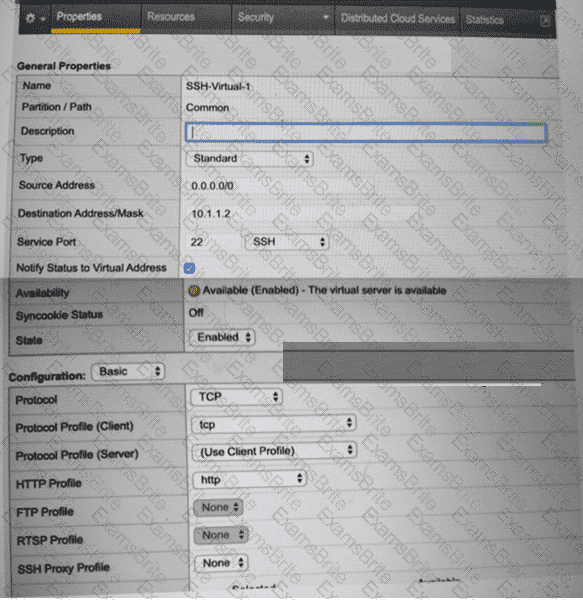
A BIG-IP Administrator creates a new Virtual Server to load balance SSH traffic. Users are unable to log on to the servers.
What should the BIG-IP Administrator do to resolve the issue? (Choose one answer)

TESTED 21 Sep 2026