BIG-IP Administration Data Plane Concepts (F5CAB2) exam
Last Update Sep 21, 2026
Total Questions : 66
We are offering FREE F5CAB2 F5 exam questions. All you do is to just go and sign up. Give your details, prepare F5CAB2 free exam questions and then go for complete pool of BIG-IP Administration Data Plane Concepts (F5CAB2) exam test questions that will help you more.



A BIG-IP Administrator needs to have a BIG-IP linked to two upstream switches for resilience of the external network. The network engineer who is going to configure the switch instructs the BIG-IP Administrator to configure interface binding with LACP. Which configuration should the administrator use?
A BIG-IP Administrator needs to apply a health monitor for a pool of database servers named DB_Pool that uses TCP port 1521. Where should the BIG-IP Administrator apply this monitor?
A standard virtual server has been associated with a pool with multiple members. Assuming all other settings are left at their defaults, which statement is always true concerning traffic processed by the virtual server?
Refer to the exhibit.
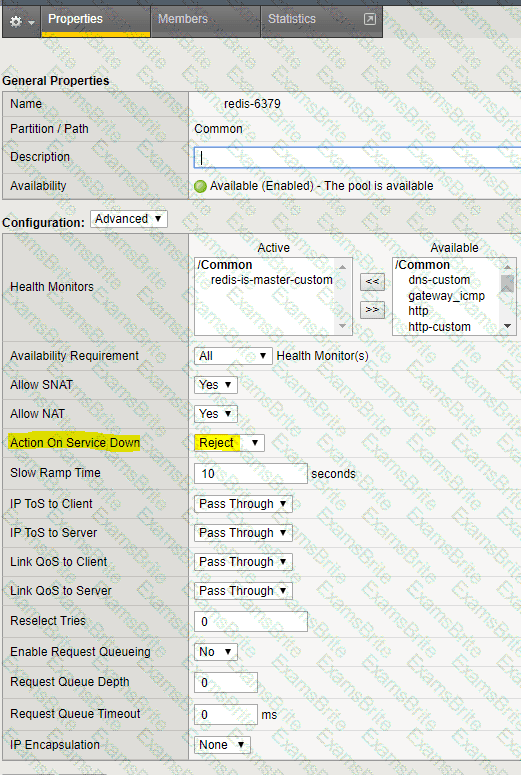
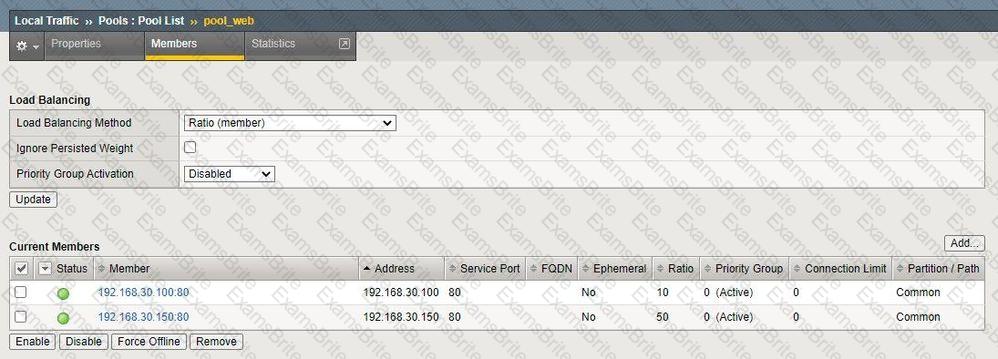
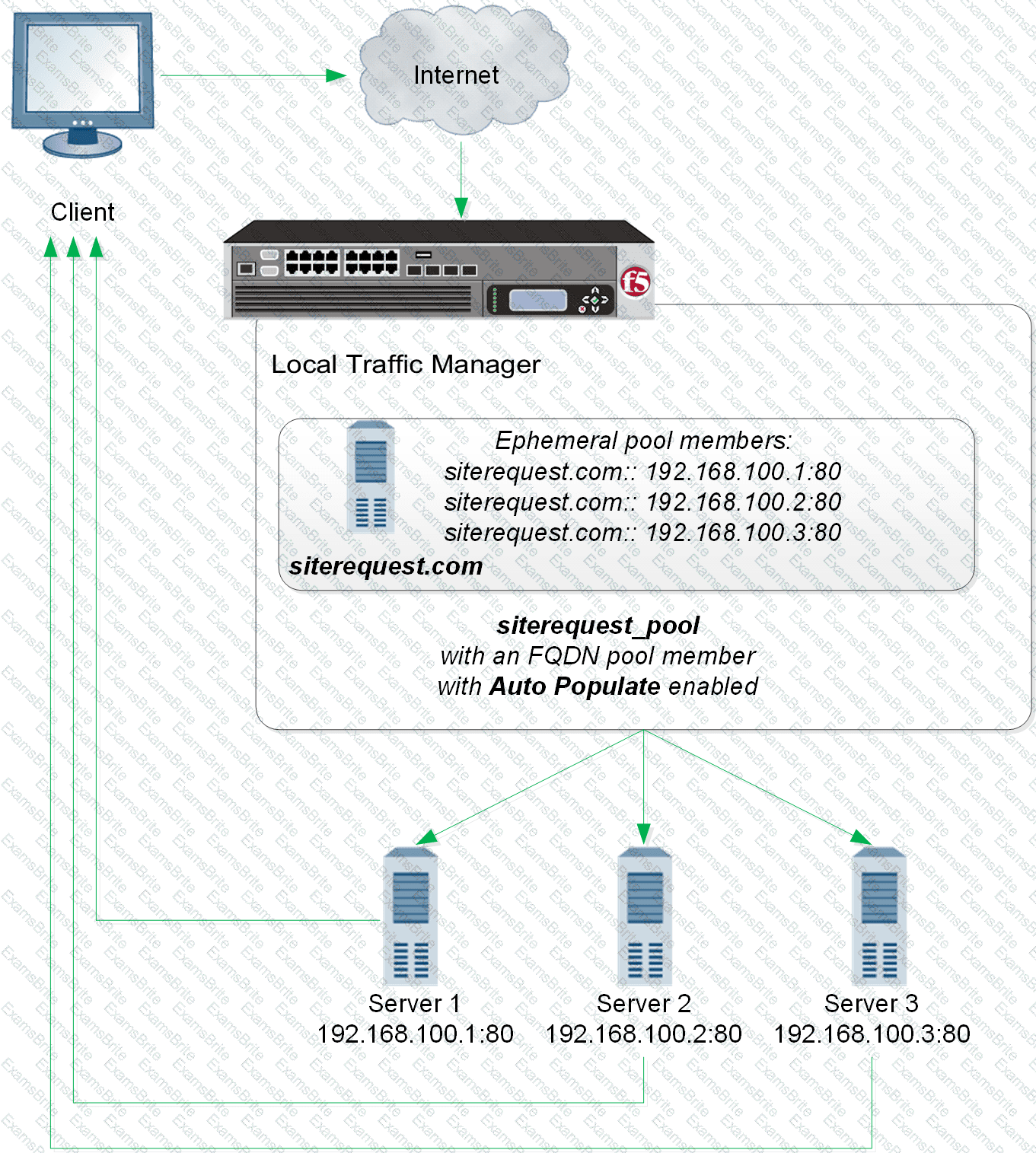
The BIG-IP Administrator needs toavoid overloading any of the pool members with connections when they become active. What should the BIG-IP Administrator configure to meet this requirement? (Choose one answer)
A BIG-IP Administrator needs to connect a BIG-IP system totwo upstream switchesto provideexternal network resilience. The network engineer instructs the administrator to configureinterface binding with LACP. Which configuration should the administrator use? (Choose one answer)
Refer to the exhibit.
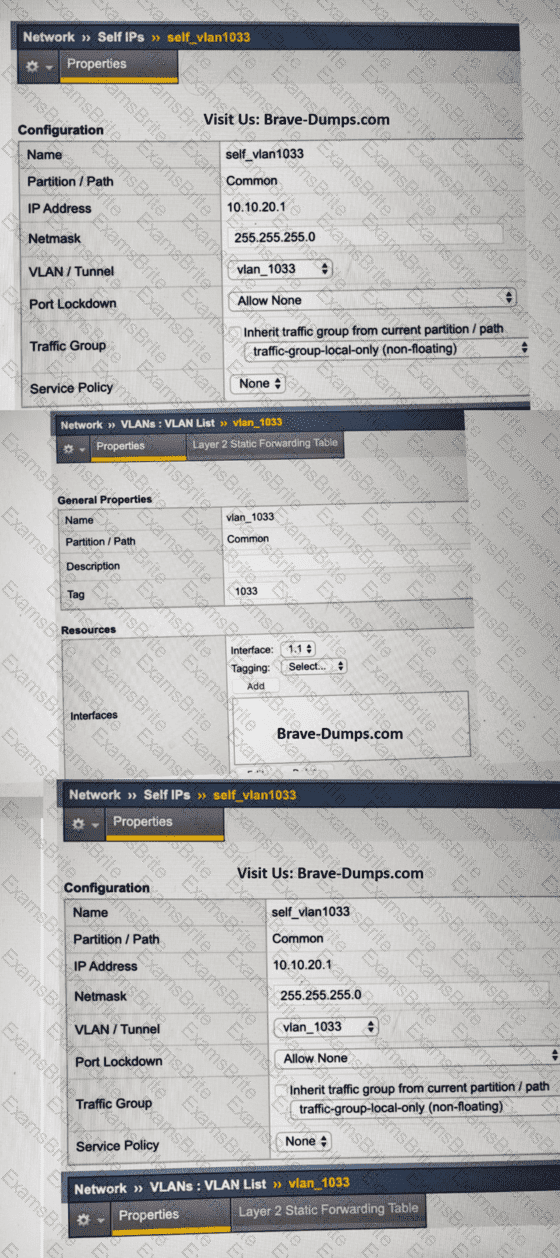
The network team creates a new VLAN on the switches. The BIG-IP Administrator creates a new VLAN and a Self IP on the BIG-IP device, but theservers on the new VLAN are NOT reachablefrom the BIG-IP device.
Which action should the BIG-IP Administrator take to resolve this issue? (Choose one answer)
A network administrator is planning to add a trunk to a single BIG-IP system. What does a trunk provide? (Pick the 2 correct responses below)
When using the setup utility to configure a redundant pair, you are asked to provide a "Failover Peer IP". Which address is this?
Which event is always triggered when a client initially connects to a virtual server configured with an HTTP profile?
The BIG-IP Administrator wants to provide quick failover between the F5 LTM devices that are configured as an HA pair with a single-selfip using the MAC Masquerade feature for this quick failover and runs this command: tmsh modify /cm traffic-group traffic-group-1 mac 02:12:34:56:00:00 However, the Network Operations team has identified an issue with the use of the same MAC address being used within different VLANs. As a result, the administrator decides to implement the Per-VLAN Mac Masquerade in order to have a unique MAC address on each VLAN: tmsh modify /sys db tm.macmasqaddr_per_vlan value true. What would be the resulting MAC address on a tagged VLAN of 1501? (Choose one answer)
An ecommerce company is experiencing latency issues with online shops during Black Friday’s peak season. The BIG-IP Administrator detects an overall high CPU load on the BIG-IP device and wants to move thetop utilized Virtual Serversto a dedicated BIG-IP device. Where should the BIG-IP Administrator determine the problematic Virtual Servers? (Choose one answer)
A BIG-IP Administrator is making adjustments to an iRule and needs to identify which of the 235 virtual server configured on the BIG-IP device will be affected. How should the administrator obtain this information in an effective way? (Choose one answer)
The BIG-IP appliance fails to boot. The BIG-IP Administrator needs to run the End User Diagnostics (EUD) utility to collect data to send to F5 Support. Where can the BIG-IP Administrator access this utility?
A BIG-IP Administrator has acluster of devices.
What should the administrator doafter creating a new Virtual Server on device 1? (Choose one answer)
A BIG-IP Administrator has a cluster of devices. What should the administrator do after creating a new Virtual Server on device 1?
What command will assist the BIG-IP Administrator in finding the tmm routes when in the TMSH CLI?
A BIG-IP Administrator makes a configuration change to a Virtual Server on theStandbydevice of an HA pair. The HA pair is currently configured withAuto-Syncenabled. What effect will the change have on the HA pair configuration? (Choose one answer)
Which two statements describe differences between the active and standby systems? (Choose two.)

TESTED 21 Sep 2026