Spring Sale 65% Discount Offer - Ends in 0d 00h 00m 00s - Coupon code: exams65

ExamsBrite Dumps

SnowPro Advanced: Data Analyst Exam Question and Answers

SnowPro Advanced: Data Analyst Exam

Last Update Feb 28, 2026
Total Questions : 65

We are offering FREE DAA-C01 Snowflake exam questions. All you do is to just go and sign up. Give your details, prepare DAA-C01 free exam questions and then go for complete pool of SnowPro Advanced: Data Analyst Exam test questions that will help you more.


DAA-C01 pdf

DAA-C01 PDF

$36.75  $104.99
DAA-C01 Engine

DAA-C01 Testing Engine

$43.75  $124.99
DAA-C01 PDF + Engine

DAA-C01 PDF + Testing Engine

$57.75  $164.99
Questions 1

A Data Analyst is working with three tables:
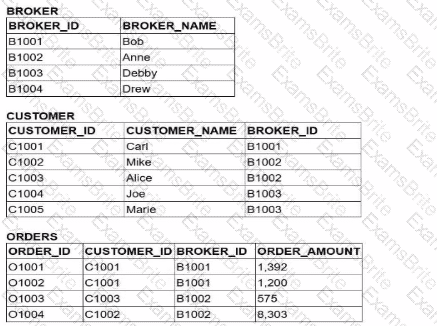
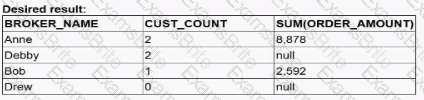
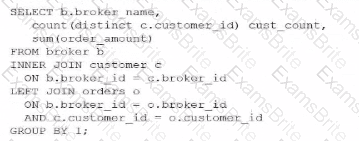
Which query would return a list of all brokers, a count of the customers each broker has. and the total order amount of their customers (as shown below)?
A)
B)
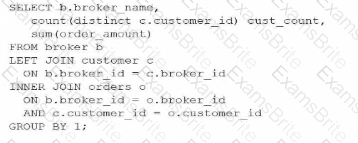
C)
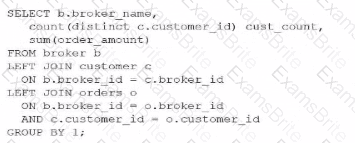
D)
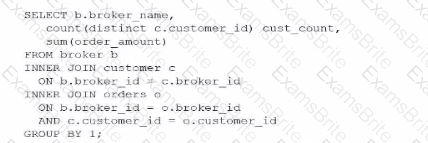
Options:

A.  

Option A

B.  

Option B

C.  

Option C

D.  

Option D

Discussion 0
Questions 2

A Data Analyst created two functions and one procedures:

The Analyst then runs this query:
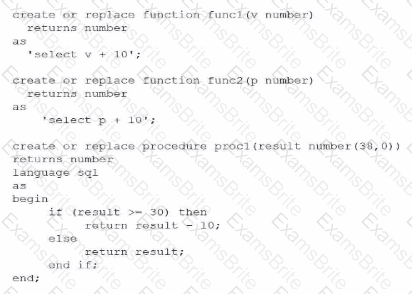
The Analyst then runs this query:

What will be the output?

Options:

A.  

Null

B.  

10

C.  

20

D.  

30

Discussion 0
Questions 3

A Data Analyst creates and populates the following table:

create or replace table aggr(v int) as select * from values (1), (2), (3), (4);

The Analyst then executes this query:

select percentile_disc(0.60) within group (order by v desc) from aggr;

What will be the result?

Options:

A.  

1

B.  

2

C.  

3

D.  

4

Discussion 0
Questions 4

A Data Analyst created two tables that are related by a foreign key, using the following commands:

Then the Analyst renamed the referenced table using the following command: ALTER TABLE mother RENAME TO father; What happens to the foreign key after the referenced table is renamed?

Options:

A.  

The foreign key becomes invalid because the referenced table no longer exists.

B.  

The foreign key is dropped because the reference is no longer valid.

C.  

The foreign key will not be used during the query rewrite.

D.  

The foreign key is updated to reference the renamed table.

Discussion 0
Questions 5

Why would an INFER_SCHEMA table function be used?

Options:

A.  

To detect the file metadata schema from staged data files that contain unstructured data

B.  

To detect the file metadata schema from staged data files that contain semi-structured data

C.  

To detect the metadata schema from a table cell that contains JSON data

D.  

To retrieve the column definitions from a previously-loaded database table

Discussion 0
Questions 6

A large, complicated query is used to generate a data set for a report on the most recent month. It is taking longer than expected. A review of the Query Profile shows excessive spilling. How can the performance of the query be improved WITHOUT increasing costs?

Options:

A.  

Run the query against zero-copy clones of the source tables to avoid contention with other queries.

B.  

Create a materialized view clustered on a date column, on the table that is causing the spilling.

C.  

Change the source tables into external tables to establish and take advantage of custom partitioning.

D.  

Split the query into multiple steps, replacing Common Table Expressions (CTEs) with temporary tables to process the data in smaller batches.

Discussion 0
Questions 7

What is a benefit of using SQL queries that contain secure views?

Options:

A.  

Users will not be able to make observations about the quantity of underlying data.

B.  

The amount of data scanned, and the total data volume are obfuscated.

C.  

Only the number of scanned micro-partitions is exposed, not the number of bytes scanned.

D.  

Snowflake secure views are more performant than regular views.

Discussion 0
Questions 8

A Data Analyst runs this query:

The Analyst men runs this query:

What will be the output?

A)
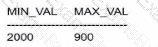
B)
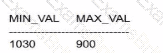
C)
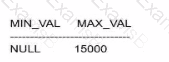
D)
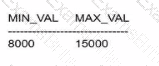
Options:

A.  

Option A

B.  

Option B

C.  

Option C

D.  

Option D

Discussion 0
Questions 9

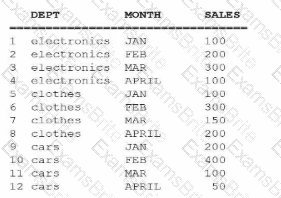
A Data Analyst needs to rotate a table by transforming a wide table’s columns into rows.

Which operator will be MOST beneficial for producing this output?
Options:

A.  

PIVOT

B.  

UNPIVOT

C.  

INTERSECT

D.  

EXCEPT

Discussion 0
Questions 10

A Data Analyst created a cost overview dashboard in Snowsight. Management has asked for a system date filter to easily change the time period and refresh the data in all dashboard tiles with a single filter selection.

The system date filter is shown below:
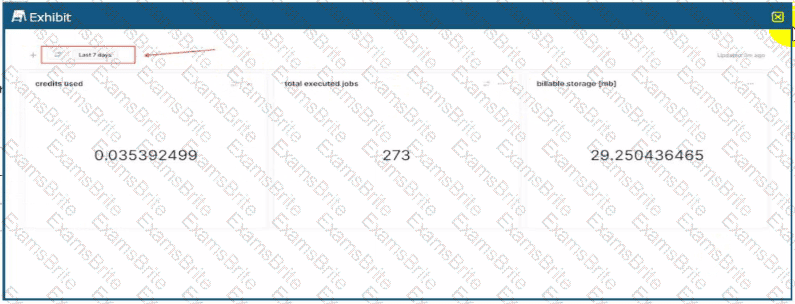
The Analyst wants to apply the filter onto individual dashboard components.

Adding which where clause to the queries will apply the filter as required?

Options:

A.  

Where start_time >= dateadd('days', -7, SYSDATE())

B.  

Where start_time >= dateadd('days', -7, CURRENT_TIMESTAMP())

C.  

Where start_time = :date_filter

D.  

Where start_time = :daterange

Discussion 0
Questions 11

Table TB_A with column COL_B contains an ARRAY. Which statement will select the last element of the ARRAY?

Options:

A.  

SELECT GET(COL_B, ARRAY_SIZE(COL_B)-1) FROM TB_A;

B.  

SELECT COL_B[ARRAY_SIZE(COL_B)] FROM TB_A;

C.  

SELECT COL_B[-1] FROM TB_A;

D.  

SELECT LAST_VALUE(COL_B) FROM TB_A;

Discussion 0
Questions 12

What functions should a Data Analyst use to run descriptive analytics on a data set? (Select TWO).

Options:

A.  

REGR_INTERCEPT

B.  

REGR_SLOPE

C.  

ROW_NUMBER

D.  

APPROX_COUNT_DISTINCT

E.  

AVG

Discussion 0
Questions 13

This query is run:

SQL

SELECT

customer.id,

ANY_VALUE(customer.name),

SUM(orders.value)

FROM customer

JOIN orders ON customer.id = orders.customer_id

GROUP BY customer.id;

What is the effect of ANY_VALUE in this syntax?

Options:

A.  

It will return an equivalent NULL value when the expression is evaluated.

B.  

It will return some value of the expression from the group, with a non-deterministic result.

C.  

It will return the minimum value of those generated by the expression, with a deterministic result.

D.  

It will return a value equivalent to the median of those generated by the expression, which may be a non-deterministic result.

Discussion 0
Questions 14

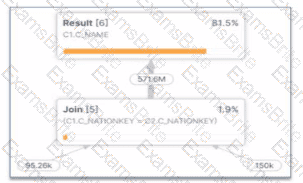
What potential problem can be identified in the Query profile below?

Options:

A.  

There is query spilling.

B.  

There is an exploding join

C.  

There Is inefficient pruning.

D.  

The query is not using a foreign Key.

Discussion 0
Questions 15

Which Snowflake feature allows users to encapsulate a series of SQL statements into a reusable database object, facilitating modular code development?

Options:

A.  

Stored procedure

B.  

Materialized view

C.  

User-Defined Function (UDF)

D.  

Common Table Expressions (CTE)

Discussion 0
Questions 16

A Data Analyst is creating a Snowsight dashboard from a shared worksheet. What happens to the access and permissions of the users who initially had sharing privileges on the worksheet?

Options:

A.  

The original users retain access and permissions on the worksheet.

B.  

The original users gain additional access to the worksheet.

C.  

The original users temporarily lose access but regain it once the dashboard is created.

D.  

The original users lose access to the worksheet, their permissions on the worksheet are revoked.

Discussion 0
Questions 17

Which query will provide this data without incurring additional storage costs?

Options:

A.  

CREATE TABLE DEV.PUBLIC.TRANS_HIST LIKE PROD.PUBLIC.TRANS_HIST;

B.  

CREATE TABLE DEV.PUBLIC.TRANS_HIST AS (SELECT * FROM PROD.PUBLIC.TRANS_HIST);

C.  

CREATE TABLE DEV.PUBLI

C.  

TRANS_HIST CLONE PROD.PUBLI

C.  

TRANS_HIST;

D.  

CREATE TABLE DEV.PUBLIC.TRANS_HIST AS (SELECT * FROM PRO

D.  

PUBLIC.TRANS_HIST WHERE extract(year from (TRANS_DATE)) = 2019);

Discussion 0
Questions 18

Given the following data:

This SELECT statement is executed:

What will be the result?

Options:

A.  

200

B.  

2.0

C.  

1.84

D.  

1.8

Discussion 0
Questions 19

The image shows a table with a variant column that is storing a JSON record:
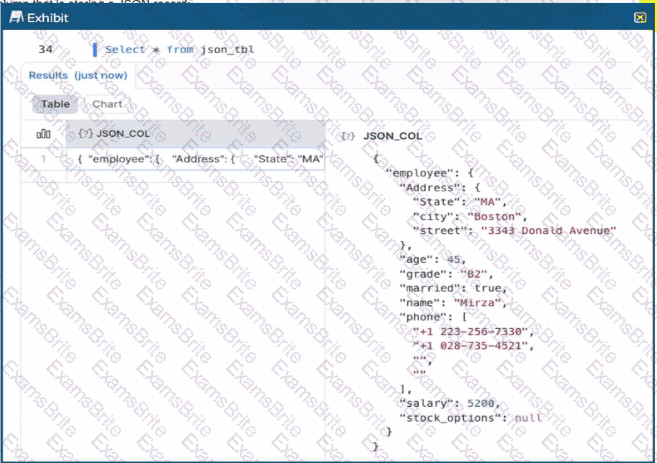
This SQL query is run:

What will be the result?

A)

B)

C)

D)

Options:

A.  

Option A

B.  

Option B

C.  

Option C

D.  

Option D

Discussion 0