Summer Sale 65% Discount Offer - Ends in 0d 00h 00m 00s - Coupon code: exams65

ExamsBrite Dumps

Claude Certified Architect - Professional Question and Answers

Claude Certified Architect - Professional

Last Update Aug 28, 2026
Total Questions : 114

We are offering FREE CCAR-P Anthropic exam questions. All you do is to just go and sign up. Give your details, prepare CCAR-P free exam questions and then go for complete pool of Claude Certified Architect - Professional test questions that will help you more.


CCAR-P pdf

CCAR-P PDF

$36.75  $104.99
CCAR-P Engine

CCAR-P Testing Engine

$43.75  $124.99
CCAR-P PDF + Engine

CCAR-P PDF + Testing Engine

$57.75  $164.99
Questions 1

A Claude-based research assistant begins producing responses that confidently contradict its retrieved source documents despite no change to the retrieval pipeline.

Which two diagnostic actions most directly identify the root cause of this behavior? (Select two.)

Options:

A.  

Increase the context-window size to allow more retrieved chunks per query.

B.  

Switch the retrieval index to a denser embedding model to improve chunk-relevance scores.

C.  

Determine whether the failure reproduces on the previous model version to test for a model mismatch.

D.  

Reduce the temperature setting to lower response variance across all query types.

E.  

Inspect the system-prompt grounding instructions to determine whether citation constraints remain intact.

Discussion 0
Questions 2

You are designing a test strategy for a Claude-based pipeline that handles sensitive financial data.

Which two test types should be prioritized to cover both safety under attack and cross-component correctness? (Select two.)

Options:

A.  

Adversarial tests using prompt-injection and malformed-input cases.

B.  

Regression tests against a stable reference set of previously known-good outputs.

C.  

Smoke tests that verify core paths after each deployment.

D.  

Integration tests that verify end-to-end pipeline behavior across all components.

E.  

Unit tests targeting only individual prompt-template rendering logic.

Discussion 0
Questions 3

You are identifying signals that a deployment should re-enter design rather than continue iterating in place.

Which signal most directly indicates the need for a new design cycle?

Options:

A.  

A runbook step requires a clarification edit to improve on-call guidance accuracy, which can be handled as a documentation update without changes to component responsibilities or core contracts.

B.  

A dashboard alert threshold needs a small numerical adjustment to reduce false-positive noise, which can be handled as an operational configuration change without a new design cycle.

C.  

A minor copy edit is requested in a customer-facing string within the existing UI, which can be handled as a localized content change without altering component responsibilities or contracts.

D.  

The system’s current architecture cannot meet the new requirements without changes to component responsibilities or core contracts.

Discussion 0
Questions 4

You are preparing an operational runbook for a Claude-based service.

Which content is essential to include in the runbook?

Options:

A.  

Dashboard and log references only, without alert definitions, triage steps, escalation paths, or rollback procedures for the on-call engineer to act on.

B.  

Common alerts and their triage steps, escalation paths, rollback procedures, and references to the relevant dashboards and logs.

C.  

Alert definitions and triage steps only, without escalation paths, rollback procedures, or references to dashboards and logs for on-call use.

D.  

Escalation paths and rollback procedures only, without alert definitions, triage steps, or dashboard references to guide initial incident response.

Discussion 0
Questions 5

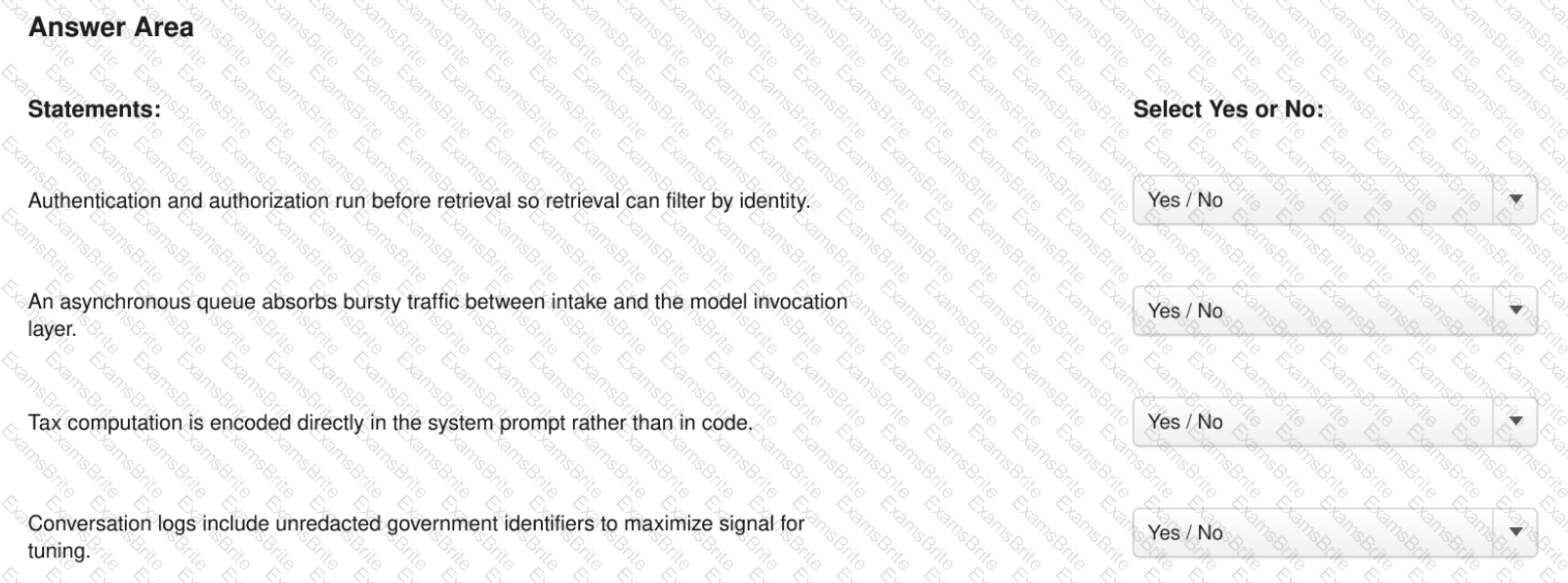
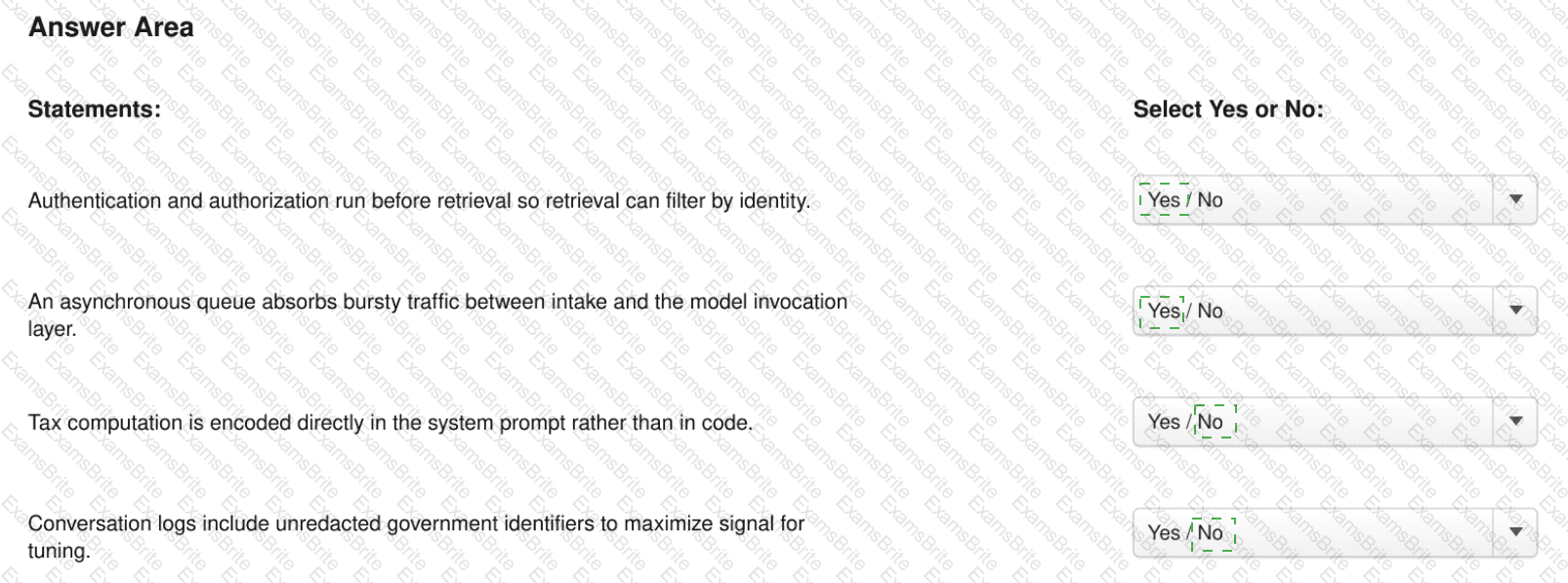
You are sequencing decomposed components in an invoice-processing pipeline.

For each of the decomposed components, select the execution layer it belongs to: “Pre-Processing,” “Model Stage,” or “Post-Processing.”

Options:

Discussion 0
Questions 6

You are supporting a team whose Claude Code sessions consistently load 60 or more MCP tools from many servers, exhausting context budget before the session begins.

Which adjustment most directly addresses this issue without removing capability?

Options:

A.  

Enable Tool Search so tool definitions are deferred and discovered on demand rather than loaded into context upfront.

B.  

Disable every MCP server in the configuration to free up context budget, accepting that the team loses all tool access and cannot perform any MCP-dependent task in the session.

C.  

Increase the prompt’s verbosity with additional instructions and context, which consumes more of the context budget rather than reducing the tool-definition overhead causing the issue.

D.  

Add additional MCP servers to give the team more capability, which increases rather than reduces the number of tool definitions loaded into the session’s context budget.

Discussion 0
Questions 7

You are presenting an architectural decision to a mixed audience that includes an executive sponsor and the engineering leads who will implement the decision.

Which presentation strategy best serves both audiences?

Options:

A.  

Open with a deep dive into low-level implementation details targeted at engineering leads, and stop there without addressing the business outcomes or trade-offs the executive sponsor needs.

B.  

Lead with the decision, the business outcomes it serves, and the trade-offs accepted; follow with the technical rationale, alternatives, and implementation implications for the engineering audience.

C.  

Skip the rationale, alternatives, and trade-off discussion entirely and simply announce the chosen decision, leaving both audiences without the context needed to implement or validate it.

D.  

Present a single undifferentiated narrative that addresses technical and business concerns with equal weight throughout, treating both audiences as requiring the same depth on every section.

Discussion 0
Questions 8

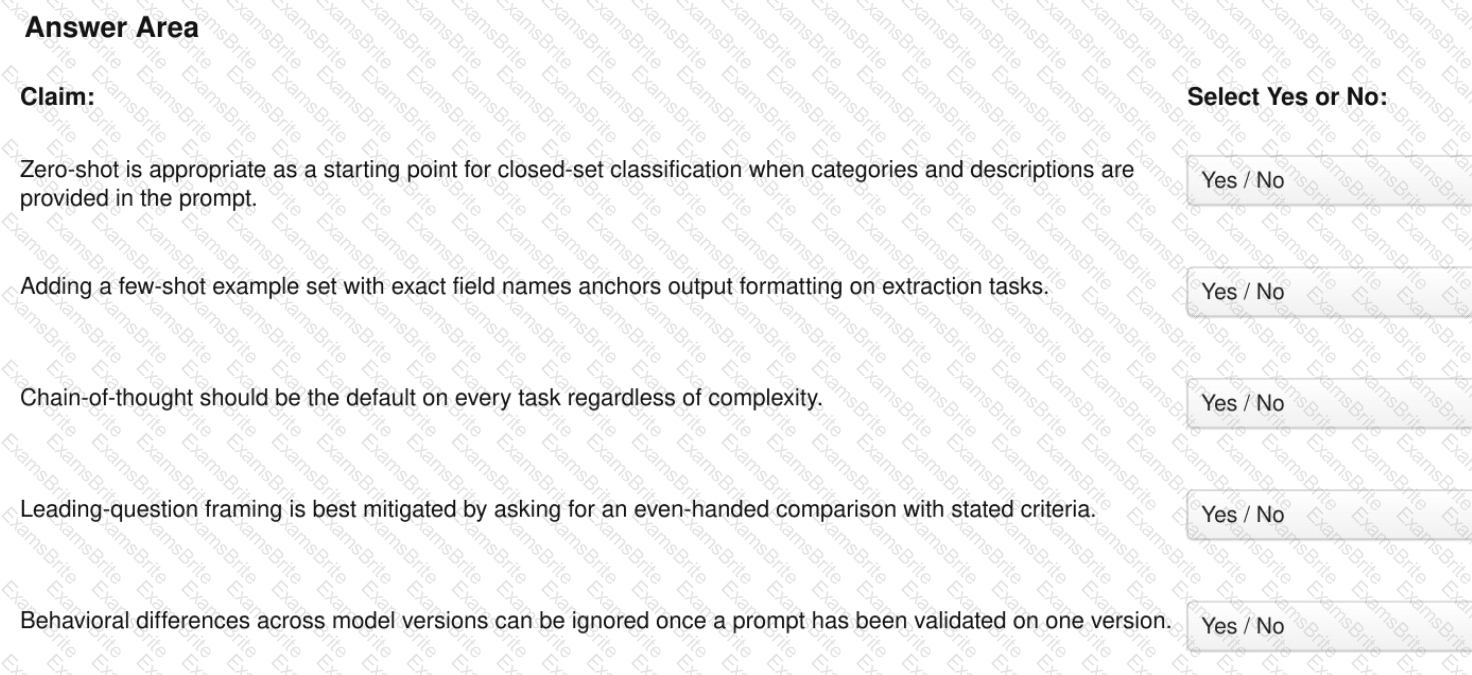
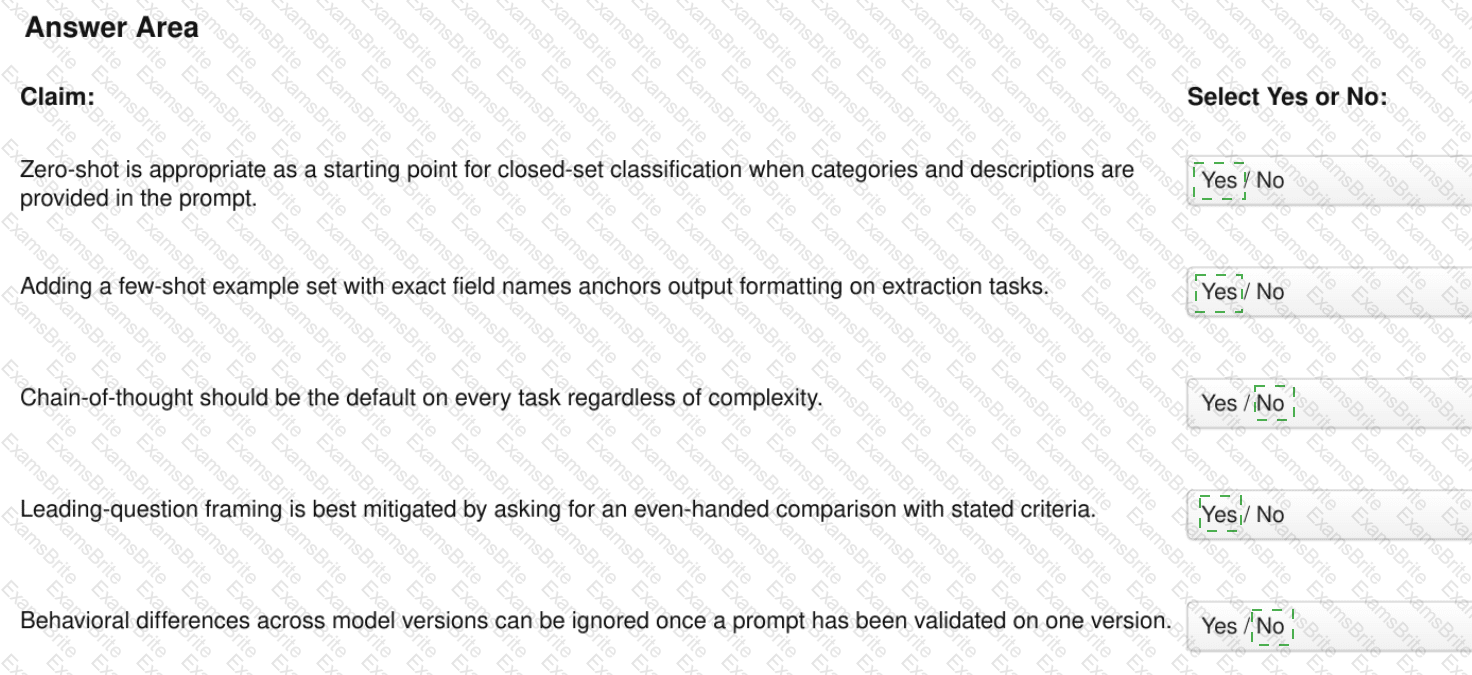
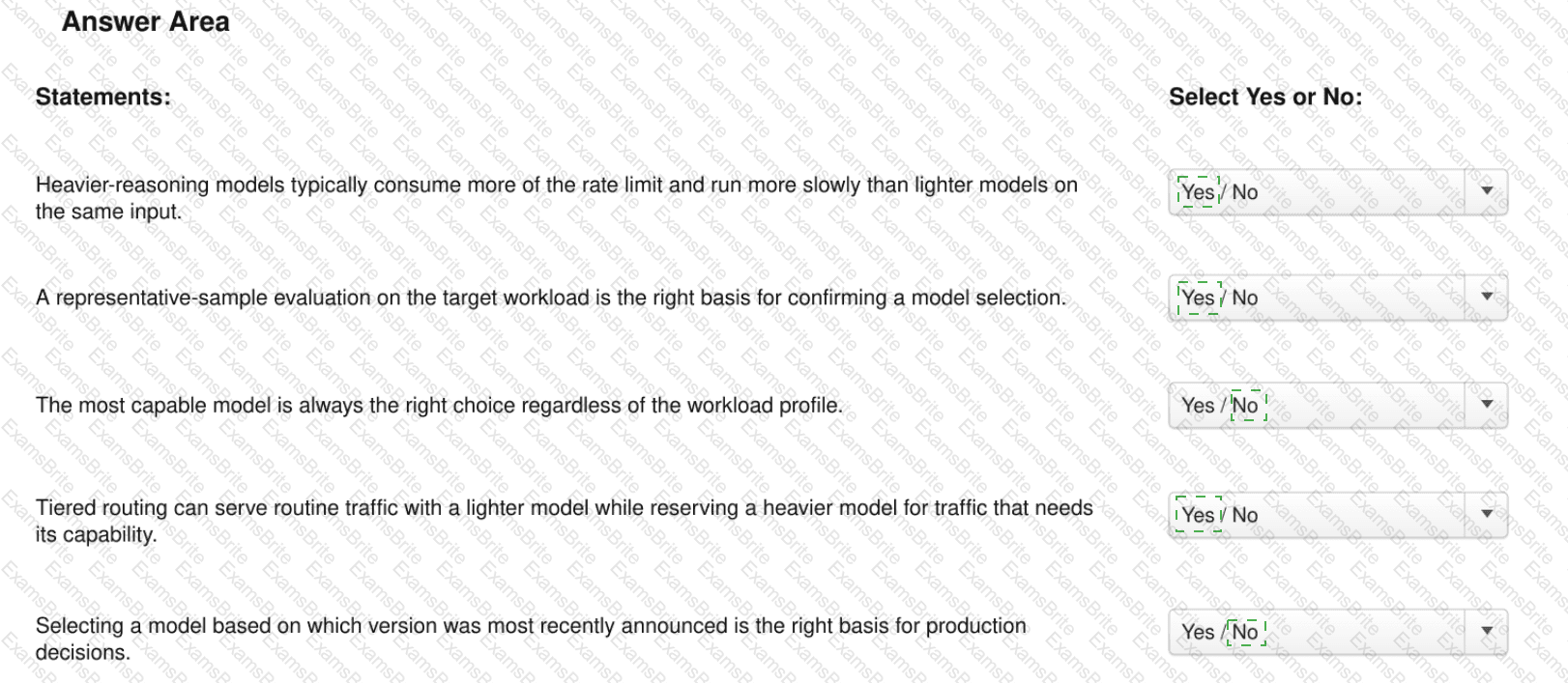
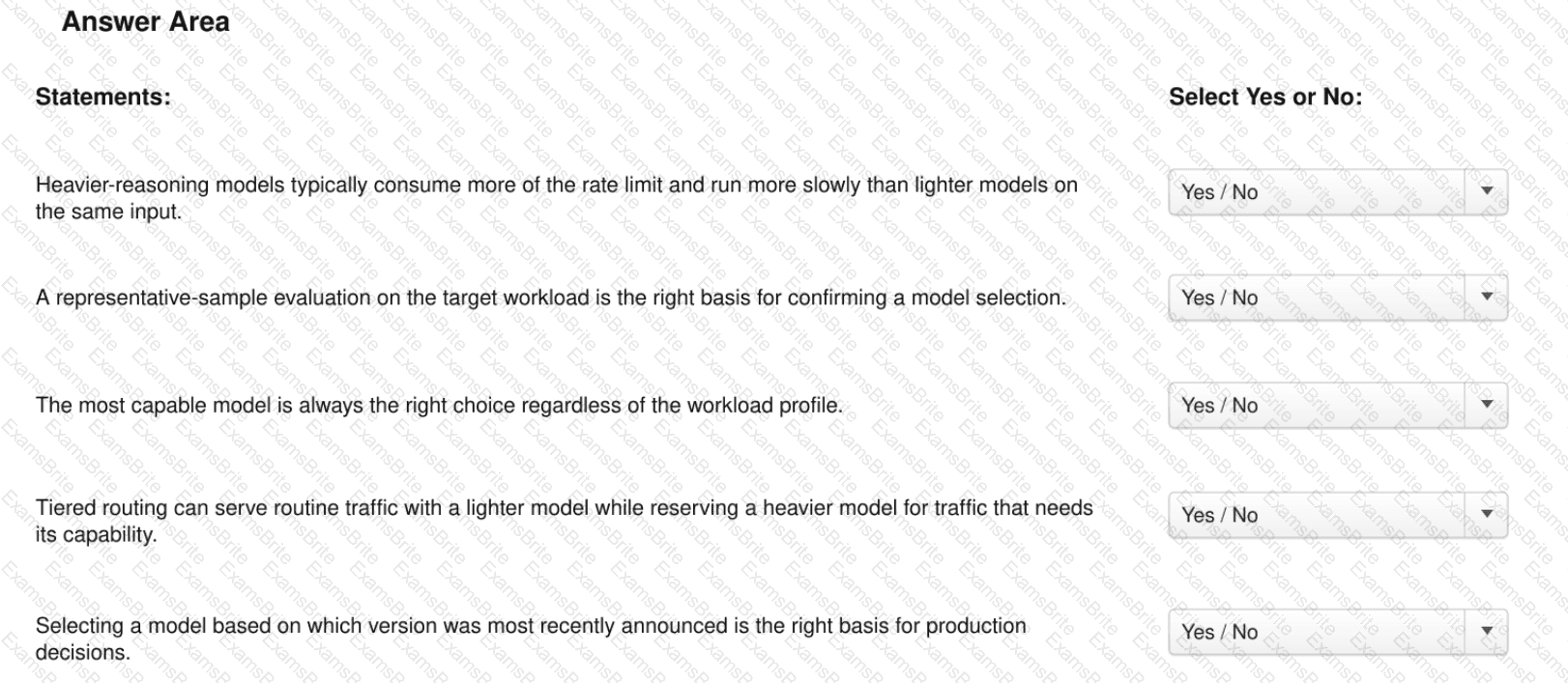
You are evaluating model-selection claims used by a peer team.

For each statement, select yes if the statement is generally true. Otherwise, select no.
Options:

Discussion 0
Questions 9

You are operating an interactive assistant whose dominant performance constraint is per-turn latency. Quality on routine turns is already acceptable.

Which configuration adjustment most directly improves latency without disproportionately damaging quality?

Options:

A.  

Disable prompt caching entirely to ensure fresh context processing on every request, preventing stale prefix content from affecting latency-sensitive interactions.

B.  

Reduce retrieval depth to the top-k passages that historically cover the answer, and cache stable system-prompt content.

C.  

Increase retrieval depth to the corpus maximum to improve recall regardless of latency.

D.  

Switch every turn to the heaviest available model to maximize output quality, accepting that the increased model latency will worsen the per-turn SLO rather than improve it.

Discussion 0
Questions 10

A senior architect is managing stakeholder expectations for a Claude-based reporting assistant midway through development. Stakeholders have escalating concerns about response latency.

Which two actions most directly address stakeholder expectation alignment in this situation? (Select two.)

Options:

A.  

Present measured p50 and p95 latency baselines against the agreed SLA thresholds so stakeholders have accurate data.

B.  

Pause all development and reallocate engineering resources entirely to latency optimization.

C.  

Communicate that latency concerns are a known LLM limitation and outside the architecture team’s control.

D.  

Replace the current Claude model with a third-party model that may offer lower latency without evaluation.

E.  

Revise the SLA definition collaboratively with stakeholders if current targets are not achievable given production constraints.

Discussion 0
Questions 11

You are defining an SLA for a Claude-based assistant.

Which SLA definition is most operationally meaningful?

Options:

A.  

A target tied to a stakeholder sentiment measure such as “the team feels satisfied,” which cannot be measured objectively or used to trigger a documented breach response.

B.  

A measurable target with a defined metric, threshold, evaluation window, and consequence for breach—for example, “p95 per-request latency under 800 ms over a 28-day window.”

C.  

A qualitative commitment such as “the system will be fast and reliable,” which names no metric, threshold, or evaluation window.

D.  

A target that names the metric and threshold but omits the evaluation window and breach consequence, leaving compliance periods and remediation triggers undefined.

Discussion 0
Questions 12

You are compiling continuity practices that span the deployment lifecycle.

Which two practices belong on the list? (Select two.)

Each correct answer presents a complete solution.

Options:

A.  

Maintain a stakeholder register and notify the listed parties at every phase transition event.

B.  

Carry the evaluation framework and reference set forward across iterations rather than rebuilding each time.

C.  

Archive every phase deliverable in long-term storage to preserve a record of what was produced.

D.  

Capture lessons learned at the end of each phase and surface them as inputs to the next phase.

E.  

Lock decisions made in early phases to prevent revisiting them as later phases begin.

Discussion 0
Questions 13

The compliance team at a firm has approved a Claude Skill that generates client-facing investment summaries. The Skill includes the firm’s required disclaimers and prohibited-language list. A product manager has asked whether additional guardrails are needed at the application layer or whether the Skill alone is sufficient.

Which two guardrail responsibilities should remain at the application layer rather than the Skill? (Select two.)

Each correct answer presents part of the solution.

Options:

A.  

Log every generated summary to the firm’s compliance audit trail for retention.

B.  

Verify the requesting user is authorized to generate investment summaries at all.

C.  

Format output sections according to the firm’s standardized house style guidelines.

D.  

Apply the disclaimer template that the compliance team has standardized firm-wide.

E.  

Apply the prohibited-language list that the compliance team maintains and updates.

Discussion 0
Questions 14

You are supporting an engineer whose newly added MCP server does not appear in their Claude Code session.

Which diagnostic step should be tried first?

Options:

A.  

Disable every MCP server in the configuration to isolate the issue, removing all tool access rather than confirming whether the new server is registered.

B.  

Switch the team to a different Claude product family unrelated to the existing workflow, abandoning the current configuration rather than diagnosing the registration issue.

C.  

Verify the MCP server is registered using the listing command, then reconnect the session if needed, since configuration changes typically require a restart to take effect.

D.  

Reinstall the developer’s operating system from scratch, discarding all local configuration and tool state before attempting any targeted diagnostic steps.

Discussion 0
Questions 15

You are designing a content moderation classifier that processes high volumes of user-generated comments under a tight per-message latency budget using well-defined classification labels.

Which model selection best aligns with the workload?

Options:

A.  

Opus, because every moderation decision requires maximum reasoning depth regardless of classification complexity.

B.  

Haiku, because its latency and cost profile align with high-volume classification workloads that require limited reasoning depth.

C.  

Sonnet, because larger general-purpose models are preferred even when workload latency requirements are strict.

D.  

Sonnet with extended thinking enabled, because deeper reasoning should be applied to every moderation request to improve edge-case handling.

Discussion 0
Questions 16

A Claude architect is auditing configuration scope assignments.

Which two statements correctly identify an appropriate use of user-scope configuration versus other scopes? (Select two.)

Options:

A.  

Persisting personal editor theme preferences that follow an engineer across projects.

B.  

Saving a preferred Claude response language that applies to all repositories the engineer uses.

C.  

Enforcing a company-wide policy that disables a feature for all engineers.

D.  

Defining MCP server endpoints shared by all contributors to a specific repository.

E.  

Storing API authentication keys so they are not committed to version control.

Discussion 0
Questions 17

You are identifying inefficiency in a Claude Code workflow where each engineer manually re-explains the project's conventions and architecture in every session.

Which adjustment most directly removes this inefficiency?

Options:

A.  

Forbid the use of Claude Code on the project entirely to avoid the session-initialization overhead, accepting that the team loses all AI-assisted development productivity for this codebase.

B.  

Capture the project's conventions and architecture in a project-scoped CLAUDE.md (or equivalent persistent project-context file) committed to the repository, so each session loads it automatically.

C.  

Tell each engineer to retype the project conventions and architecture context more quickly at the start of each session, reducing time lost without eliminating the repeated manual effort.

D.  

Remove all documented project conventions and architectural standards so engineers have nothing to re-explain at session start, accepting the loss of consistency and shared coding standards.

Discussion 0
Questions 18

You are defining transparency practices for a customer-facing assistant whose responses are materially shaped by AI.

Which transparency practice most directly supports responsible deployment?

Options:

A.  

Misrepresent the AI’s role in producing responses in order to make the assistant feel more trustworthy or more human, undermining informed user consent and organizational transparency.

B.  

Refuse to answer any user question about how the responses were produced or whether AI was involved, treating the AI’s role as confidential operational information.

C.  

Disclose AI involvement to end users in line with the organization’s transparency policy and provide a documented path to reach a human when needed.

D.  

Disclose AI involvement only to internal staff and operators while withholding that information from the end users whose interactions are materially shaped by the AI system.

Discussion 0
Questions 19

You are integrating Claude Code into the team’s pull-request workflow. The team wants AI-assisted review without removing human approval.

Which integration design best fits this requirement?

Options:

A.  

Claude Code reviews the pull request and posts a structured analysis as a comment, while a human reviewer retains the approval decision under the existing branch-protection rules.

B.  

Claude Code merges every pull request automatically after completing its analysis, bypassing human approval and the existing branch-protection rules.

C.  

Claude Code disables all existing branch-protection rules to streamline the merge process, removing human approval as a required gate.

D.  

Claude Code silently deletes pull requests it assesses as low quality without posting a comment or notifying the author.

Discussion 0
Questions 20

A Claude architect is implementing safety controls for a customer-facing advice assistant that must never provide regulated investment recommendations.

Which two guardrail implementations most directly enforce this constraint? (Select two.)

Options:

A.  

Increase response temperature to introduce variability that reduces the likelihood of specific recommendations.

B.  

Add an output classifier that detects and blocks responses containing regulated investment-recommendation language.

C.  

Limit session length to reduce the volume of queries processed per user per day.

D.  

Log all user queries to a SIEM for post-hoc compliance review.

E.  

Define explicit out-of-scope categories in the system prompt with fixed refusal phrasing for investment advice requests.

Discussion 0
Questions 21

You are building a feedback-and-alignment routine for a multi-stakeholder deployment.

Which two practices belong in the routine? (Select two.)

Each correct answer presents a complete solution.

Options:

A.  

Record each session and distribute the recording to stakeholders who could not attend live.

B.  

Escalate any disagreement among stakeholders to the executive sponsor for binding resolution.

C.  

Rotate facilitation among the participating stakeholder groups to share ownership of the routine.

D.  

Set a regular cadence for revisiting expectations and assumptions as conditions evolve over time.

E.  

Reconcile divergent stakeholder positions explicitly rather than papering over them in the moment.

Discussion 0
Questions 22

You are comparing patterns for a batch document-classification job that follows fixed steps: extract metadata, classify, summarize, and persist.

Which pattern is the best fit and why?

Options:

A.  

A workflow pattern, because agentic patterns do not support tool invocations and therefore cannot execute the persist step that writes results to the downstream store.

B.  

An agentic pattern, because the open-ended planning capability of agents produces more consistent structured outputs than a fixed workflow graph on classification tasks.

C.  

An agentic pattern, because agents are categorically more accurate than workflows and therefore always preferable regardless of step predictability.

D.  

A workflow pattern, because the steps are well-defined and predictable per-request token cost is preferred over flexibility.

Discussion 0
Questions 23

You are choosing the level of detail for an implementation guide. The audience is a delivery team that will build the deployment.

Which guidance composition best serves them?

Options:

A.  

Component responsibilities, contracts between components, sequence diagrams of the dominant flows, configuration parameters with defaults, and operational runbooks.

B.  

Component responsibilities and interface contracts only, without sequence diagrams of the dominant flows, configuration parameters with defaults, or runbooks to guide operational tasks.

C.  

An architecture overview and sequence diagrams for the dominant flows, without interface contracts, configuration-parameter tables, or operational runbooks for the delivery team to follow.

D.  

An architecture overview and a list of known limitations, without component-level diagrams, interface contracts, configuration parameters, or operational runbooks to support implementation.

Discussion 0
Questions 24

You are responding to an adversarial input pattern in which users include text claiming admin authority and instructing the model to bypass safety restrictions.

Which combination of controls most effectively mitigates this attack pattern?

Options:

A.  

Trusting that the model will intrinsically recognize and reject all bypass attempts without prompt-level instructions, runtime classifiers, scoped permissions, or audit logging.

B.  

Prompt-level instructions that treat user content as untrusted data, runtime classifiers that detect override attempts, scoped tool permissions that cannot be elevated by user content, and audit logging of attempts.

C.  

Removing all safety restrictions and guardrails to eliminate the attack surface that bypass attempts target, accepting that this makes the assistant unrestricted for all inputs.

D.  

Granting users any privilege level they assert in their message content, on the assumption that cooperative behavior requires honoring self-declared authority without independent verification.

Discussion 0
Questions 25

A Claude architect observes that after a recent model-version upgrade, grounded responses began including claims not supported by the retrieved source documents.

Which mitigation is most directly targeted at this failure mode?

Options:

A.  

Constrain responses to source-supported content, require citations, and add a verification step.

B.  

Score each new model version against a stable adversarial evaluation set.

C.  

Replace the shared API key with per-user OAuth tokens to restrict data access.

D.  

Treat retrieved data as untrusted and apply input classifiers at ingestion time.

Discussion 0
Questions 26

A platform team operates a self-hosted multi-agent system on Kubernetes that orchestrates seven specialized agents for invoice processing. The team spends approximately 40 percent of engineering capacity on infrastructure maintenance, message bus reliability, and agent state recovery. The CFO has asked you to evaluate moving to managed agent infrastructure to reclaim engineering capacity. The security officer requires that all customer financial data remain within an approved network boundary.

Which factor should most heavily influence your recommendation?

Options:

A.  

Whether the current seven agents map cleanly to the patterns supported by managed agents.

B.  

Whether managed agents reduce per-invoice token costs across the existing processing volume.

C.  

Whether managed agents support the current bus topology used by the platform team.

D.  

Whether managed agent data handling satisfies the network boundary required by security.

Discussion 0
Questions 27

You are a platform architect designing an internal Claude-based assistant that serves both finance analysts and external auditors. Each population must access only documents permitted by its role.

Where should role-based access control be enforced in the pipeline?

Options:

A.  

Inside the system prompt as a natural-language instruction for Claude to ignore unauthorized documents.

B.  

At the retrieval layer, before any role-restricted content reaches the prompt-construction step or the model.

C.  

Nowhere in the pipeline; rely on the model’s general refusal behavior to reject unauthorized document access without any enforced access control.

D.  

After the response is generated, by post-filtering content that should not have been retrieved.

Discussion 0
Questions 28

You are reviewing a peer’s draft system prompt that contains contradictory instructions: one section says never to speculate beyond the supplied source, while another says to confidently fill in any gaps.

Which response is most appropriate?

Options:

A.  

Add a priority instruction directing the model to evaluate all instructions and apply whichever appears most contextually appropriate on each request.

B.  

Remove or rewrite the gap-filling instruction so the prompt consistently constrains the model to source-supported content.

C.  

Increase temperature so output randomness masks the contradiction.

D.  

Keep both instructions and rely on the model to decide which one to follow on each request.

Discussion 0
Questions 29

A Claude architect is leading the discovery phase for a new AI-powered customer service solution.

Which two activities are characteristic of structured discovery and requirement gathering for a Claude-based deployment? (Select two.)

Options:

A.  

Facilitating stakeholder workshops to surface latency, accuracy, and compliance constraints before scoping begins.

B.  

Selecting the Claude model tier based on the architect’s prior project experience before stakeholder input is collected.

C.  

Generating an initial prototype and iterating based on user reaction rather than written requirements.

D.  

Documenting explicit success criteria and failure thresholds that will gate production deployment.

E.  

Deferring constraint documentation until the integration design phase to avoid scope creep.

Discussion 0
Questions 30

You are diagnosing a Claude Code session whose subagent uses 50,000 tokens of context before the engineer types a single message.

Which root cause is most likely?

Options:

A.  

The developer's keyboard layout or input-method configuration is the cause of the elevated context consumption, introducing extra tokens before the engineer types any message.

B.  

Many MCP servers are configured, each contributing tool definitions to the context budget; Tool Search is not enabled, so all definitions load upfront.

C.  

The model has internal personal preferences or default behaviors that silently consume large portions of context budget before any user message is processed, independent of tool configuration.

D.  

The font rendering or display-scaling settings of the IDE are converting visual output into additional context tokens, causing the high pre-session context consumption.

Discussion 0
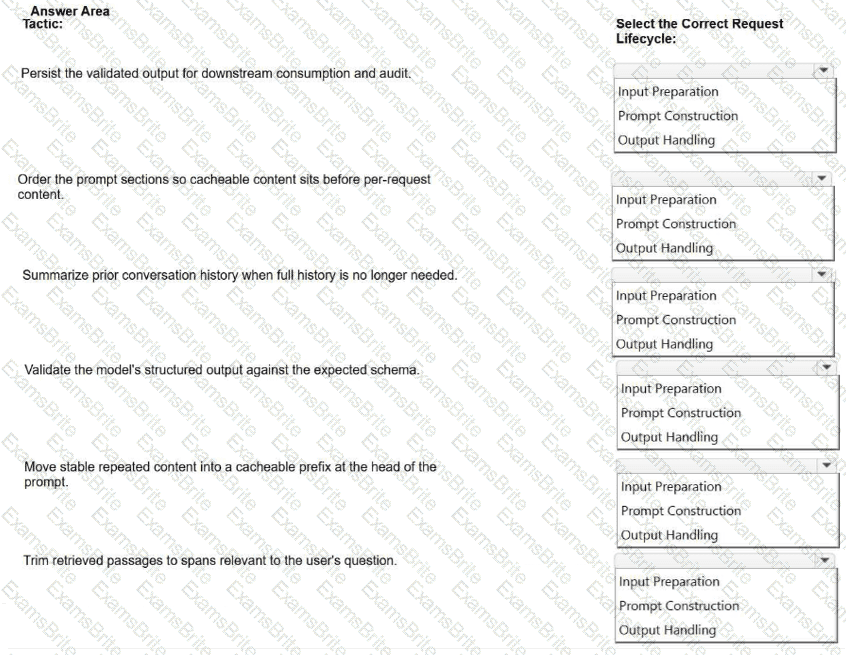
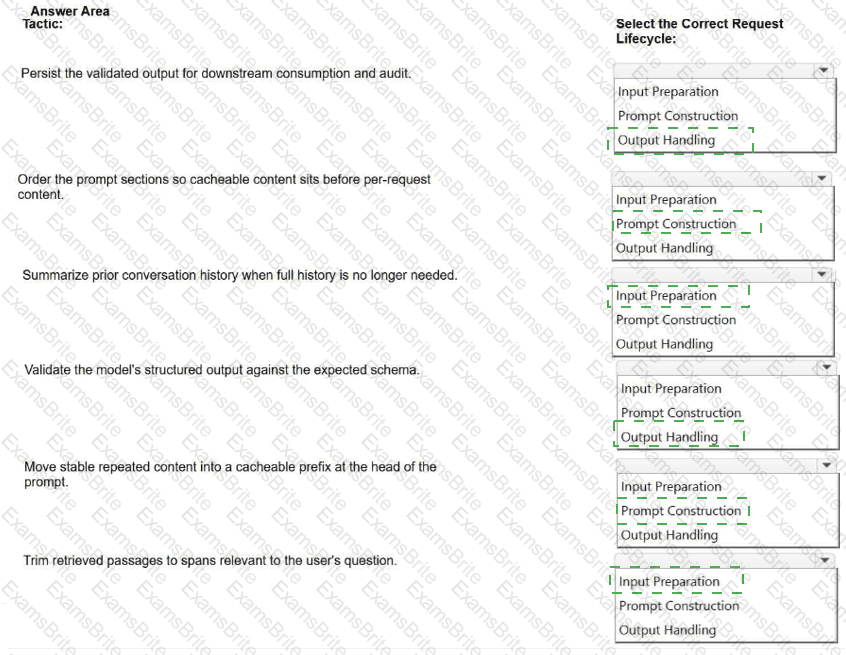
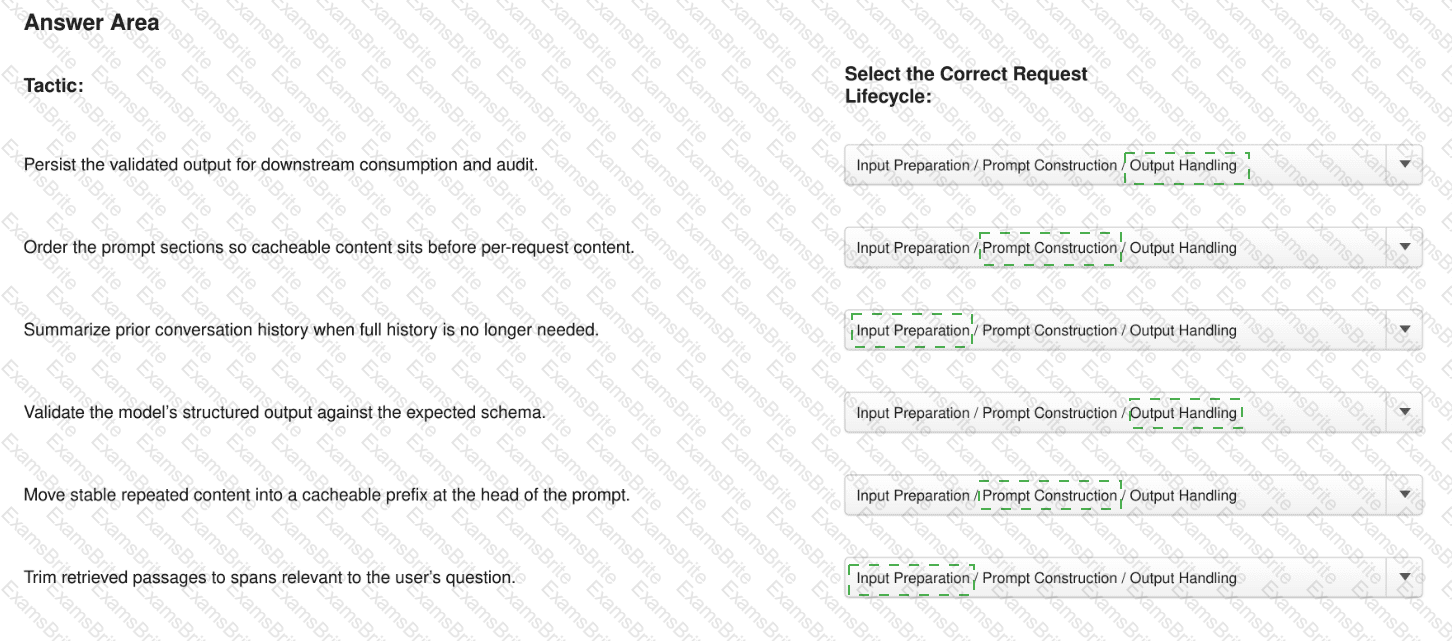
Questions 31

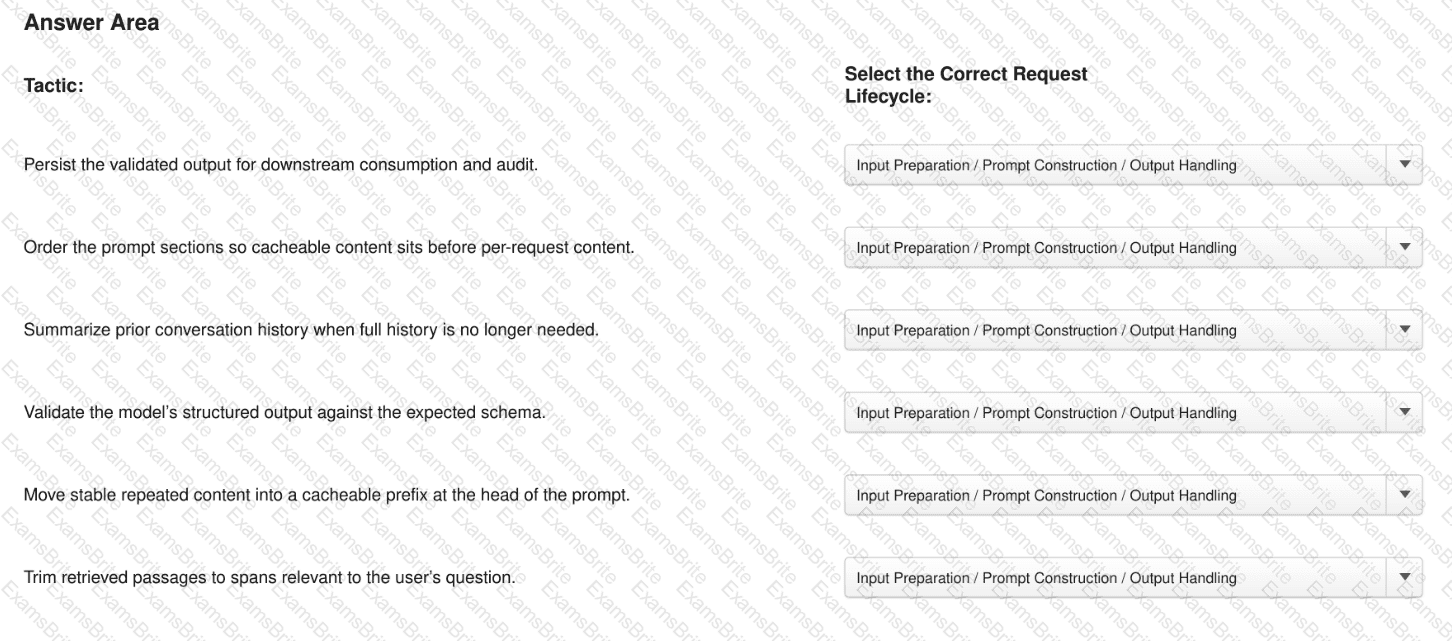
You are classifying token-management tactics by where each tactic applies in the request lifecycle: “Input Preparation,” “Prompt Construction,” or “Output Handling.”
Options:

Discussion 0
Questions 32

You are rolling out monitoring for a Claude-based deployment and must complete the specification steps before instrumenting the deployment.

Which two steps must be completed BEFORE instrumenting the deployment to emit metrics and traces? (Select two.)

Each correct answer presents part of the solution.

Options:

A.  

Define the metrics and the slices the deployment will monitor across normal and adversarial traffic.

B.  

Tune the alert thresholds based on observed normal-state distributions to reduce false positives.

C.  

Define the service-level objectives (SLOs) and the error budgets the deployment will be held to.

D.  

Build the dashboards that surface metrics across slices at the cadence the team operates on.

E.  

Document the dashboards, alerts, and runbooks for the on-call rotation that will respond.

Discussion 0
Questions 33

A Claude architect is designing a HIPAA-compliant pipeline that processes patient records.

Which two design decisions directly support HIPAA compliance requirements? (Select two.)

Options:

A.  

Setting max_tokens to a low value to minimize the volume of text generated per request.

B.  

Selecting the highest-capability Claude model to maximize diagnostic accuracy.

C.  

Enforcing role-based access controls so that PHI is retrievable only by authorized personnel.

D.  

Ensuring patient data is never included in training feedback loops sent to the model provider without a BAA in place.

E.  

Using streaming responses to reduce perceived latency for clinical users.

Discussion 0
Questions 34

You are producing an architecture guide for a new deployment and must complete the planning steps before drafting each section.

Which two steps must be completed BEFORE drafting each section of the guide? (Select two.)

Each correct answer presents part of the solution.

Options:

A.  

Identify the audience and the questions the guide must answer for that audience.

B.  

Translate the guide into the supported regional languages for the candidate population.

C.  

Validate the guide with the implementation team and incorporate corrections.

D.  

Establish the document under version control with a defined review cadence and approver list.

E.  

Outline the guide sections covering the overview, components, contracts, flows, runbooks, and limitations.

Discussion 0