MongoDB Associate Database Administrator(Based on MongoDB 6.0 and 7.0+)
Last Update Nov 23, 2026
Total Questions : 172
We are offering FREE C100DBA MongoDB exam questions. All you do is to just go and sign up. Give your details, prepare C100DBA free exam questions and then go for complete pool of MongoDB Associate Database Administrator(Based on MongoDB 6.0 and 7.0+) test questions that will help you more.


What does the totalCreated field mean in the output of the db.serverStatus().connections command?
> db.serverStatus().connections
{
" current " : 4,
" available " : 51196,
" totalCreated " : 5,
" active " : 2,
" threaded " : 4,
" exhaustIsMaster " : 1,
" exhaustHello " : 0,
" awaitingTopologyChanges " : 1
}
Which of the following is incorrect statement about find and findOne operations in MongoDB?
Consider the following posts document:
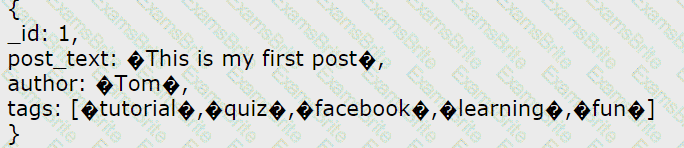
Which of the following queries will return the documents but with only the first two tags in the tags array?
Which TWO indicators should an administrator keep an eye on to determine if the storage capacity is nearing its limit?
Given a replica set with five data-bearing members, suppose the primary goes down with operations in its oplog that have been copied from the primary to only one secondary. Assuming no other problems occur, which of the following describes what is most likely to happen?
What is the replication factor for a replicated cluster with 1 primary, 3 secondaries with one of them hidden. The set also has an arbiter?
What is the equivalent command in MongoDB for the following SQL query?
SELECT * FROM posts WHERE author like " %john% "
Which of the documents below will be retrieved by the following query? Assume the documents are stored in a collection called " sample " . Check all that apply.
db.sample.find( { " $or " : [ { " a " : { " $in " : [ 3, 10] > }, { " b " : { " $lt " : 2 > > ] > )
Which of the following aggregation commands in MongoDB does not support sharded collections?
In which of the following scenarios is sharding not the correct option. Select all that apply.
Consider an orders collection that contains these documents:
{ _id: 1, product: " X-pad " , quantity: 950 }
{ _id: 2, product: " X-pad-pro " , quantity: 1000 }
{ _id: 3, product: " X-phone " , quantity: 850 }
{ _id: 4, product: " X-phone-pro " , quantity: 1350 }
Commands A and B are run at the same time. Assume that no other operations are running.
You have designed a web application with mongoDB. You have configured replication. The replica set is in place and function properly. What happens in case of failure?
Consider a contacts collection that contains these documents:
{ " _id " : 1, " name " : " Poppy " , " birthday " : " 03-09-1984 " }
{ " _id " : 2, " name " : " Ashley " , " birthday " : " 08-12-1990 " }
{ " _id " : 3, " name " : " Cleo " , " birthday " : " 11-02-1976 " }
What query returns the document where the field name is " Poppy " ?
What is the output of following two commands in MongoDB: db. posts. insert({n_id " :l}) db.posts.insert({ " _id " :l})
The MongoDB explain() method does not support which of the following verbosity mode:
Suposse tou have the following collection with only 2 documents:

If you run an aggregation query and use { $unwind: " $traits " } as the first stage, how many documents will be passed to the next stage of the aggregation pipeline?
What command returns all documents in an orders collection where quantity is less than or equal to 1000 and salesRep is not equal to " Anne " ?
Which of the following collections stores authentication credentials in MongoDB?
Which of the tags in a replica set configuration specify the operations to be read from the node with the least network latency?
A collection and a document in MongoDB is equivalent to which of the SQL concepts respectively?
Consider the following document from the products collection:
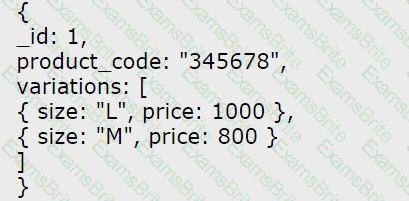
What does the following query using $elemMatch return? db.products.find( { product_code: " 345678 " }, { variations: { $elemMatch: { size: ^L^ } } } )
What is the maximum size of Index Key Limit and Number of Indexes per collection?
You perform the following operation in the shell: db.foo.insert( { } ); What gets inserted?
Consider an inventory collection that contains these documents:
{ " _id " : 1, " product " : " x-small box " , " colors " : [ " brown " , " black " , " white " ], " qty " : 50 }
{ " _id " : 2, " product " : " small box " , " colors " : [ " brown " , " white " ], " qty " : 60 }
{ " _id " : 3, " product " : " medium box " , " colors " : [ " black " , " grey " , " white " ], " qty " : 45 }
{ " _id " : 4, " product " : " large box " , " colors " : [ " grey " ], " qty " : 50 }
{ " _id " : 5, " product " : " x-large box " , " colors " : [ " grey " , " white " ], " qty " : 10 }
What result set does the following query return?
db.inventory.find({
$or: [
{ " product " : " x-small box " },
{
$and: [
{ " qty " : { $ne: 50 } },
{ " colors " : { $nin: [ " brown " ] } }
]
}
]
})
In a replica set, a_________number of members ensures that the replica set is always able to select a primary.
What command is used to grant a role " customRole1 " to an existing user called " user1 " ?
What operation updates the value of the unitsInStock field to 25 for a document with a " laptop " product, and inserts a new document if it does not exist?
A collection named scores includes:
[
{ _id: 1, home_score: 6, away_score: [ 5, 7 ] },
{ _id: 2, home_score: [ 8, 6 ], away_score: 9 },
{ _id: 3, home_score: [ 5, 8 ], away_score: [ 9, 6 ] },
{ _id: 4, home_score: 5, away_score: 10 }
]
Given the following index:
db.scores.createIndex( { home_score: 1, away_score: 1 } )
What document will cause the index to fail?
Write the command(s) are correct to enable sharding on a database " testdb " and shard a collection " testCollection " with _id as shard key.

We can insert multiple documents in bulk using which of the following operations:
What method should be used to configure dynamically runtime parameters for the mongod process in MongoDB?
In a sharded replica set environment, the w Option provides ability for write concern and j Option provides ability for the data to be written on disk journal. Consider that we have a seven member replica set and we want to assure that the writes are committed to journal. What should be the value of j?
What command set removes node-1.cluster1.mycompany.local:27017 and node-2.cluster1.mycompany.local:27017 from the replica set, then adds node-1.cluster1.mycompany.local:27017 back to the replica set?
Which TWO commands can be used to check for all active operations on the current node?
Which of the following operator can be used to control the number of items of an array that a query returns?
What does the output x of the following MongoDB aggregation query result into; db.posts.aggregate( [ { $group: { _id; " $author " , x: { $sum: $likes } } } ] )
Consider the following example document from the sample collection. All documents in this collection have the same schema.
Which of the following queries will replace this with the document.
Which of the following command inside aggregate command is used in MongoDB aggregation to filter the documents to pass only the documents that match the specified condition(s) to the next pipeline stage.
In a collection that contains 100 post documents, what does the following command do? db. posts. find().skip(5).limit(5)
Consider the following example document:
{
" _id " : Objectld( " 5360c0a0a655a60674680bbe " ),
" user "
" login " : " irOn "
" description " : " Made of steel "
" date " : ISODate( " 2014-04-30T09:16:45.836Z " ),
}
>
and index creation command:
db.users.createlndex( { " user.login " : 1, " user.date " : -1 }, " mylndex " )
When performing the following query:
db.users.find( { " user.login " : /Air.*/ },
{ " user " :1, " _id " :0 > ).sort( { " user.date " :1 > )
which of the following statements correctly describe how MongoDB will handle the query? Check all that apply.

TESTED 23 Nov 2026