VMware Certified Advanced Professional - VMware Cloud Foundation 9.0 Networking
Last Update Oct 12, 2026
Total Questions : 60
We are offering FREE 3V0-25.25 VMware exam questions. All you do is to just go and sign up. Give your details, prepare 3V0-25.25 free exam questions and then go for complete pool of VMware Certified Advanced Professional - VMware Cloud Foundation 9.0 Networking test questions that will help you more.



A sovereign cloud provider has a VMware Cloud Foundation (VCF) stretched Workload Domain across two data centers (AZ1 and AZ2), where site connectivity via Layer 3 is provided by the underlay. The following NSX details are included in the design:
• Each site must host its own local NSX Edge Cluster for availability zones.
• Tier-0 gateways must be configured in active/active mode with BGP ECMP to local top-of-rack switches.
• Inter-site Edge TEP traffic must not cross the inter-DC link.
• SDDC Manager is used to automate NSX deployment.
During deployment of the Edge Cluster for AZ2, the SDDC Manager workflow fails because the Edge transport nodes' TEP IPs are not reachable from the ESXi transport nodes. Which step ensures correct Edge Cluster deployment in multi-site stretched domains?
An administrator has deployed a new VMware Cloud Foundation (VCF) management domain. To be compliant with company policy, backups must be configured to occur anytime a change is made to the NSX configuration. How can the administrator ensure that complete configuration backups are captured every time a change occurs?
An administrator is troubleshooting intermittent connectivity failures between two workloads connected to NSX VLAN segments using Traceflow. In-band Network Telemetry (INT) has been enabled in the NSX Global Configuration. How does Traceflow identify issues in a VLAN network?
An administrator is troubleshooting an issue where workloads connected to a Tier-1 Gateway named T1-App can no longer reach external North/South destinations.
• The Tier-1 is connected to an Active/Standby Tier-0 Gateway named T0-Prod.
Symptoms observed:
• VMs on segments attached to T1-App can ping each other.
• VMs on T1-App cannot reach any external IP outside T0-Prod.
• From a VM on the segment, ping to the T1-App Distributed Router (DR) IP succeeds.
• Ping from the VM to the T1-App Service Router (SR) fails.
• The Edge cluster hosting the T1-App SR shows both Edge nodes Up and Healthy.
• No failover has occurred — the same Edge node is still shown as Active for T1-App.
What is the most likely cause of this issue?
In an NSX environment, an administrator is observing low throughput and intermittent congestion between the Tier-0 Gateway and the upstream physical routers. The environment was designed for high availability and load balancing, using two Edge Nodes deployed in Active/Active mode. The administrator enables ECMP on the Tier-0 gateway, but the issues persist. Which action would address low throughput and congestion?
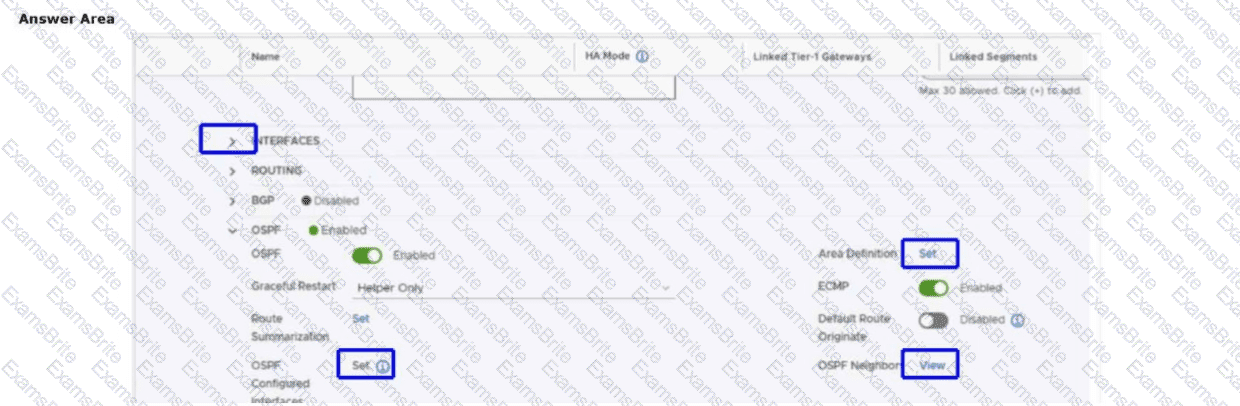
An administrator has been tasked with enabling OSPF as the routing protocol for a Tier-0 Gateway. Which two items must be configured to enable OSPF for a Tier-0 Gateway?
Mark two answers by clicking the two correct locations on the image. (Choose two.)
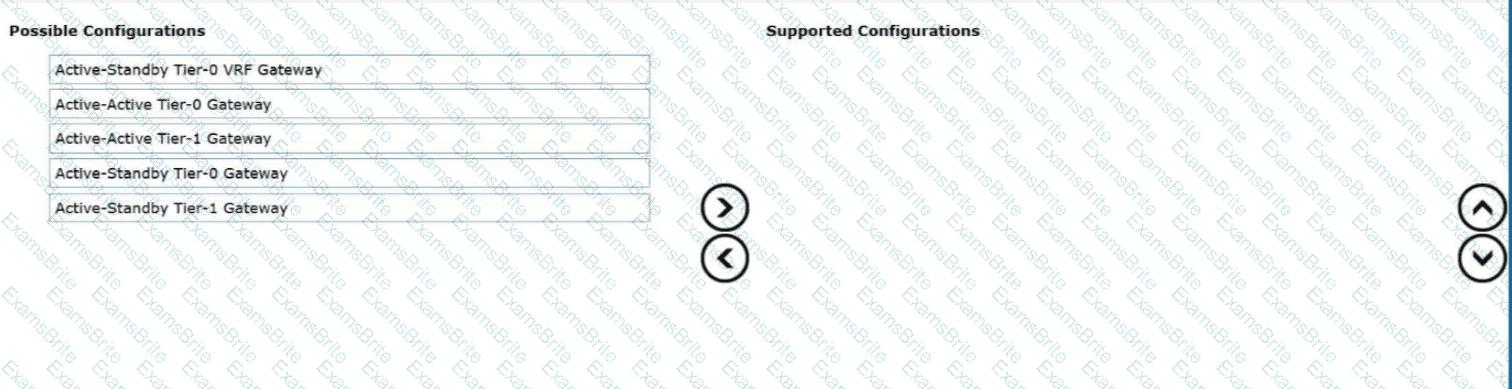
An administrator is responsible for the management of a VMware Cloud Foundation (VCF) Fleet that consists of two VCF instances that are located in different physical locations. The administrator has been tasked with configuring a VPN between the two locations and has been tasked with identifying the two supported NSX Gateway configurations for an IPSec VPN. Drag and drop two items from the list of Possible Configurations into the list of Supported Configurations in any order.(Choose two.)
An administrator has been tasked with providing a networking solution including a Source and Destination NAT for a single Tenant. The tenant is using Centralized Connectivity with a Tier-0 Gateway named Ten-A-Tier-0 supported by an Edge cluster in Active-Active mode. The NAT solution must be available for multiple subnets within the Tenant space. The administrator chooses to deploy a Tier-1 Gateway to implement the NAT solution. How would the administrator complete the task?
An administrator is preparing to deploy a new workload domain that will host vSphere Kubernetes Service (VKS) clusters. Before configuring the network for the Kubernetes clusters, the administrator needs to create a Tier-0 Gateway to handle North/South connectivity. What is the requirement for creating a Tier-0 Gateway for use with a workload domain that is running the vSphere Kubernetes service (VKS) with VPC?
An administrator has a VMware Cloud Foundation (VCF) instance. A critical NSX security update has been released by Broadcom. How can the administrator install the NSX update?
The administrator is implementing a multi-location VMware Cloud Foundation (VCF) environment. The design requires centralized security and networking policies across multiple VCF instances. What action must the administrator take to satisfy the requirements?
An administrator is configuring NSX resource sharing to allow shared access to multiple resources in the default space.
By default, which user role owns the shared resources for the default space?
An administrator is configuring an NSX segment used by a nested hypervisor deployment where an ESXi VM runs on an ESXi host and multiple VMs run inside the ESXi VM. Which segment profile must be created to satisfy the request?
An administrator is tasked to configure NSX Federation between separate VMware Cloud Foundation (VCF) Fleets. Which requirement must all sites meet before being added to a Global Manager (GM) for NSX Federation?
A large multinational corporation is seeking proposals for the modernization of a Private Cloud environment. The proposed solution must meet the following requirements:
• Support multiple data centers located in different geographic regions.
• Provide a secure and scalable solution that ensures seamless connectivity between data centers and different departments.
Which three NSX features or capabilities must be included in the proposed solution? (Choose three.)
An administrator is troubleshooting east—west network performance between several virtual machines connected to the same logical segment. The administrator inspects the internal forwarding tables used by ESXi and notices that different tables exist for MAC and IP mapping. Which table on an ESXi host is used to determine the location of a particular workload for frame forwarding?
Which two statements describe the recommended strategy for configuring and synchronizing security policies across Federated NSX sites? (Choose two.)
An administrator has a standalone vSphere 8.0 Update 1a deployment that is running with VMware NSX 4.1.0.2 and has to converge the deployment into a new VMware Cloud Foundation (VCF) instance. How can the administrator accomplish this task?

TESTED 12 Oct 2026