Advanced VMware Cloud Foundation 9.0 Storage
Last Update Oct 12, 2026
Total Questions : 77
We are offering FREE 3V0-23.25 VMware exam questions. All you do is to just go and sign up. Give your details, prepare 3V0-23.25 free exam questions and then go for complete pool of Advanced VMware Cloud Foundation 9.0 Storage test questions that will help you more.



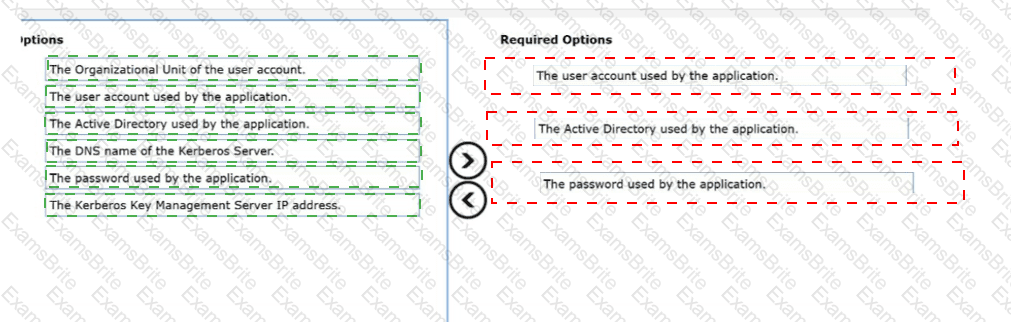
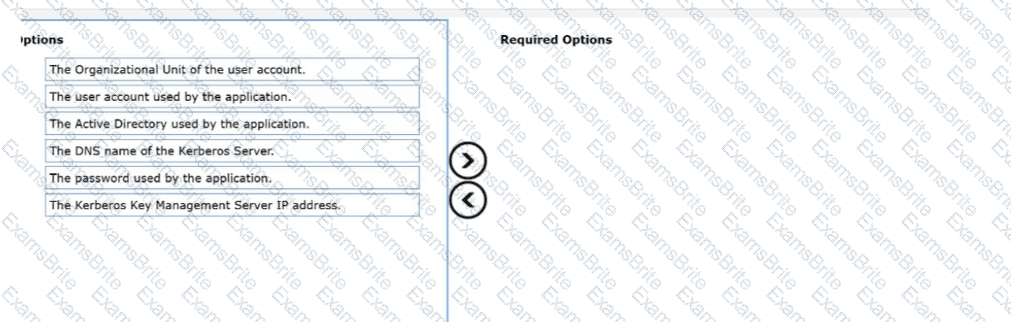
An administrator has been presented with the following requirements from an application owner:
• The application is distributed across multiple data centers.
• The application currently uses NFSv4.1 for mounting data volumes.
• The application requires Kerberos encryption.
Drag and drop the three correct options from the Options list on the left and place them into the Required Options on the right to properly configure the storage solution to meet the requirements in any order. (Choose three.)
While creating a recovery plan that matches the business continuity plan, an administrator needs to add custom steps to the recovery plan.
Which three custom steps are available? (Choose three.)
An administrator is tasked with designing a highly available vSAN ESA two-node cluster for a remote VMware Cloud Foundation (VCF) workload domain. The solution should be able to survive the failure of any disk group in addition to a host failure without data loss.
What is the minimum total number of nested fault domains required for the design?
An administrator attempts to enable vSAN Data-at-Rest Encryption on a cluster but receives the following error message:
“Key provider < vSphere Native Key Provider > is not available on host.”
The administrator configured the vSphere Native Key Provider (NKP) using the default settings.
What should the administrator validate before enabling vSAN Data-at-Rest Encryption?
A storage architect has been called into a meeting with the accounting team who is trying to determine why 20% of their raw capacity is not available for consumption. Their vSAN cluster was created with the following characteristics:
• 2 x 2 TB NVMe disks in 6 hosts in their vSAN cluster.
• FTT=1, RAID-1 for the default policy.
• Host Rebuild Reserve not activated for this cluster.
Which two items should the Architect say accounts for most of the unusable capacity? (Choose two.)
A six-node vSAN ESA cluster contains multiple Virtual Machines (VMs), and a vSAN storage policy with the rule “Failures to tolerate” set to “1 failure - RAID-5 (Erasure Coding)” is assigned. A vSAN administrator has changed the rule in the assigned policy to “2 failures - RAID-6 (Erasure Coding).”
What is the result of this change?
An administrator has been tasked with deploying vSAN Data Protection in a VMware Cloud Foundation (VCF) Workload Domain. The administrator deploys the VMware Live Recovery OVA and logs into the management interface to start the Configure Appliance process, but the appliance fails to register with vCenter.
What are two possible causes the administrator can check to resolve the issue? (Choose two.)
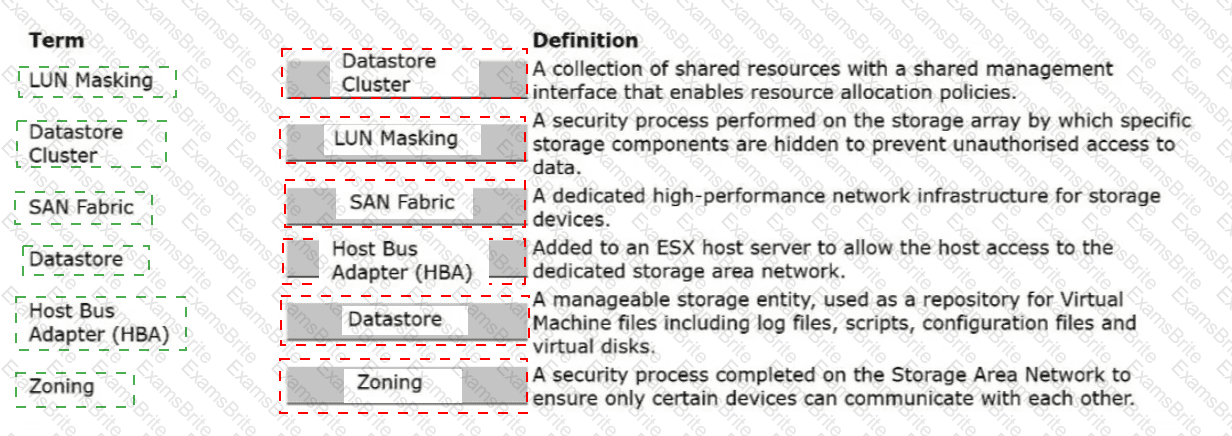
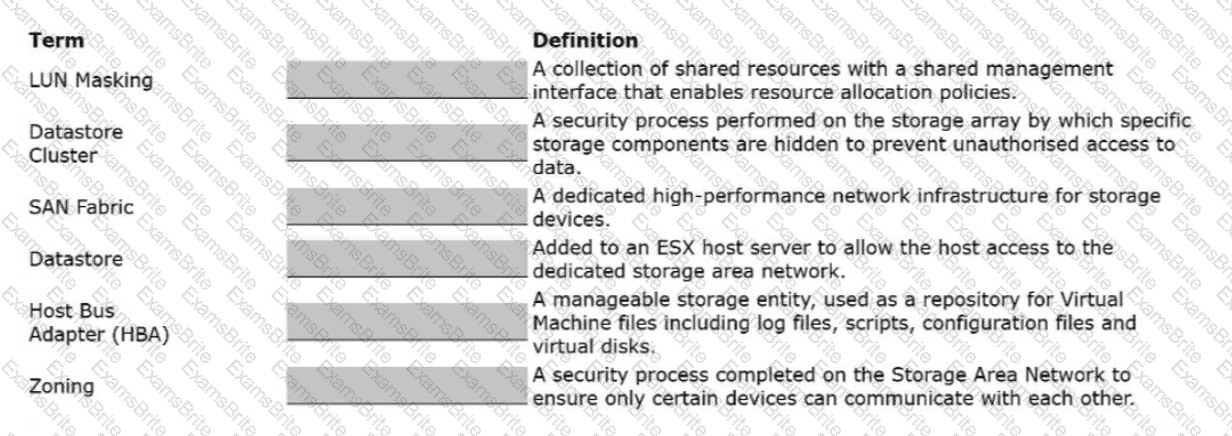
An administrator is responsible for a VMware Cloud Foundation (VCF) Private Cloud and has been tasked with identifying and explaining the different Fibre Channel (FC) Storage Area Network (SAN) components within a VCF Workload Domain cluster.
Drag and drop the correct Term onto its matching Definition.
A VMware Cloud Foundation (VCF) environment runs mixed workloads (Online Transaction Processing (OLTP) + analytics), with the following vSAN configuration:
• 8 hosts (all-flash), ESA enabled.
• Each host: 2 x 3.2 TB NVMe devices.
• Compression is Enabled.
• Checksum is Enabled.
• Storage Policy: FTT=1 (RAID-5/6), Failures to Tolerate = 1 and Object Space Reservation = 0%.
During peak OLTP load, vSAN resync I/O and backend congestion increase latency despite having sufficient network bandwidth.
What is the direct action the administrator can perform to improve write performance while maintaining data protection compliance?
To respect the application criticality, an administrator is configuring the Recovery Priority of protected Virtual Machines (VMs).
What does VMware Live Site Recovery leverage to mark a recovery priority as completed?
An architect is designing a vSAN Original Storage Architecture (OSA) cluster for a VMware Cloud Foundation (VCF) Management Domain. The following details were made available:
• 12 hosts, each host with: 3 x 800 GB NVMe (cache) and 12 x 3.84 TB SAS SSD (capacity).
• Planned configuration: 3 disk groups per host (1 NVMe + 4 SSD each).
• Storage policy: FTT = 2 (RAID-1), Checksum. Deduplication and Compression are Enabled.
• Network: 25 GbE dedicated vSAN network fabric, properly configured for jumbo frames.
After deployment and loading test data to 70% capacity, the operations team reported extended resync times when two hosts are placed into maintenance mode with “Ensure Accessibility” selected and no hardware or network bottlenecks were detected.
How can the administrator explain the observed behavior?
An administrator is managing a local vSAN 3-node cluster running the Express Storage Architecture (ESA) as part of a VMware
Cloud Foundation (VCF) Workload Domain.
The following parameters apply at the cluster level:
• HA is enabled
• Reserved Failover Capacity = 25% for both CPU and Memory
The administrator is tasked with configuring the VSAN storage policy so it will tolerate the maximum number of failures.
What two protection levels can the administrator configure? (Choose two.)
A vSAN ESA solution is configured using the following requirements:
• Seven ESX Hosts, each host contains:
32 CPU
256 GB memory
25 GbE network
12 storage devices 4 TB each
One storage pool using the 12 storage devices • RAID-6 with FTT=2 If a storage device on a single host fails, what percentage of that host’s capacity is impacted?
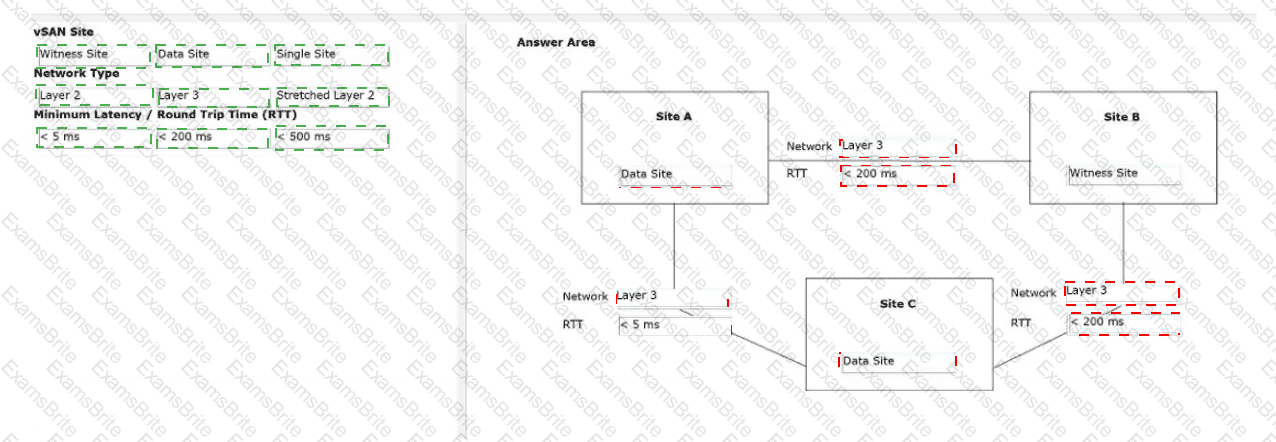
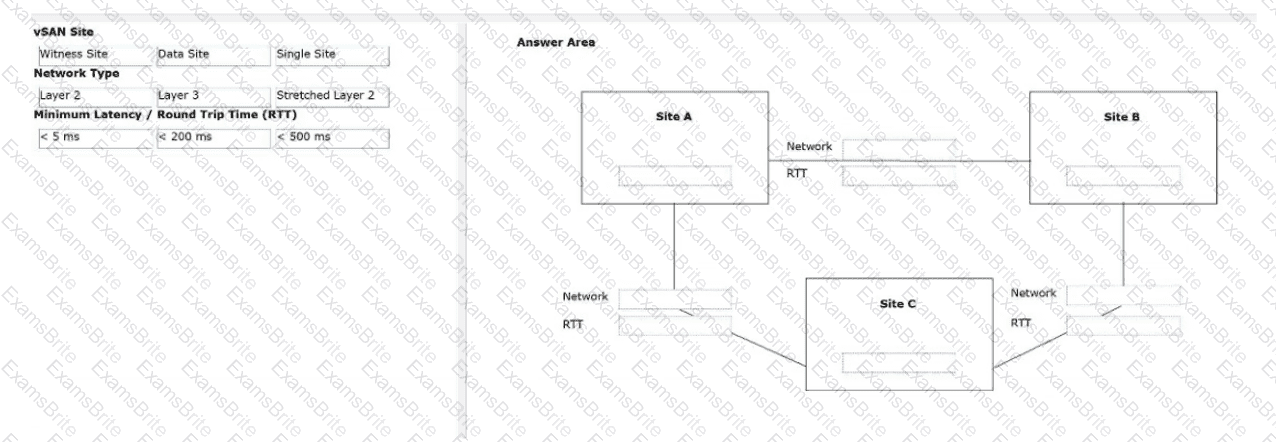
An administrator is responsible for managing a VMware Cloud Foundation (VCF) Private Cloud.
The following information has been provided about the environment:
• There are 3 customer datacenters, Site A, Site B and Site C.
• The datacenter at Site A runs all Production Services.
• The datacenter at Site B has reached capacity and there is no space for additional physical hardware.
• The datacenter at Site C has been commissioned to replace Site B, because there is more rack space and power capacity to cater for future demand.
The administrator has been tasked with identifying the networking requirements for a new VMware vSAN Stretched Cluster with the following requirements:
• The solution will deploy a total of 10 new ESX host servers to create a VMware vSAN Stretched Cluster.
• The solution must deploy appropriate networking to ensure minimal disruption from issues with Spanning Tree Protocol (STP).
Drag and drop the correct vSAN Site Type, Networking Type and Round Trip Latency (RTT) within the boxes provided to complete the high-level diagram.
A clustered legacy application is scheduled for decommissioning at the end of the month. While in use, it stored application and quorum data on a pair of vSAN iSCSI Target LUNs.
After the vSAN iSCSI Target Service is disabled, what will happen to the existing targets and LUNs?
An administrator has deployed a three-host vSphere cluster with a small amount of VMFS storage and wants to add additional capacity from a vSAN ESA cluster located in the same vCenter Server.
When the administrator selects the vSphere cluster and navigates to the Configure tab, the Datastore Management option is missing under the vSAN section.
What prerequisite must be met before the administrator can mount the remote datastore?
An administrator is tasked with enabling vSAN Data Protection.
Which action is required to enable vSAN Data Protection?
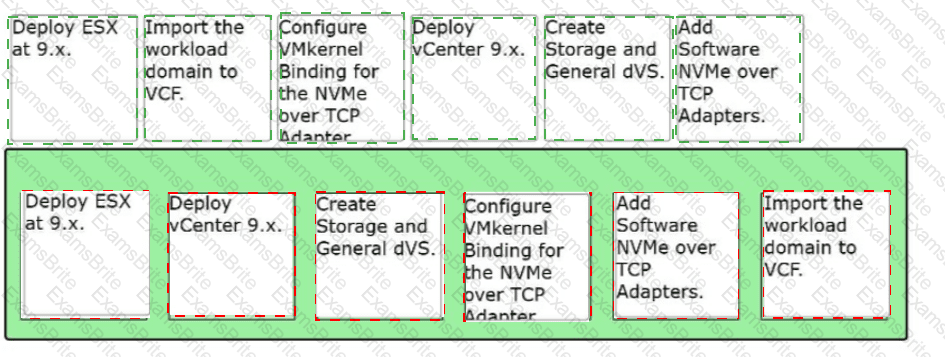
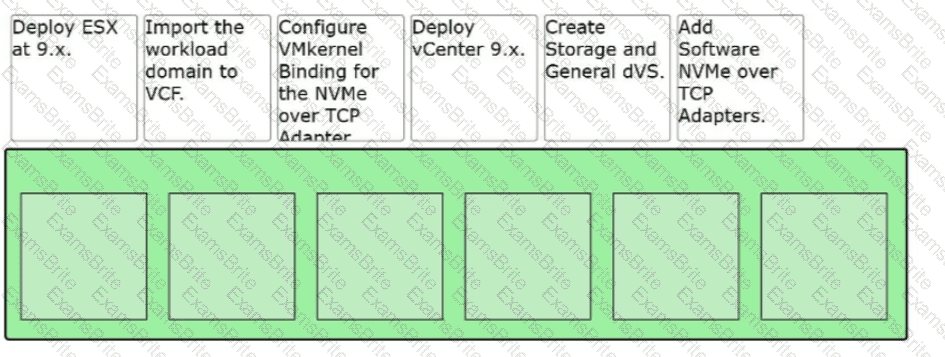
A VMware Cloud Foundation (VCF) Workload Domain is requested to be deployed with the following information:
. 6 blade style hosts with no local storage beyond the operating system.
. 4 25 Gb networking cards installed in each host.
. A 30 TB external array configured to support NVMe/TCP only.
. 2 dVS switches, one configured for storage isolation and one for all other traffic.
. NVMe/TCP multi-path configuration required.
. Existing Management Domain is deployed with VCF.
Place the steps for importing VCF on to this configuration.
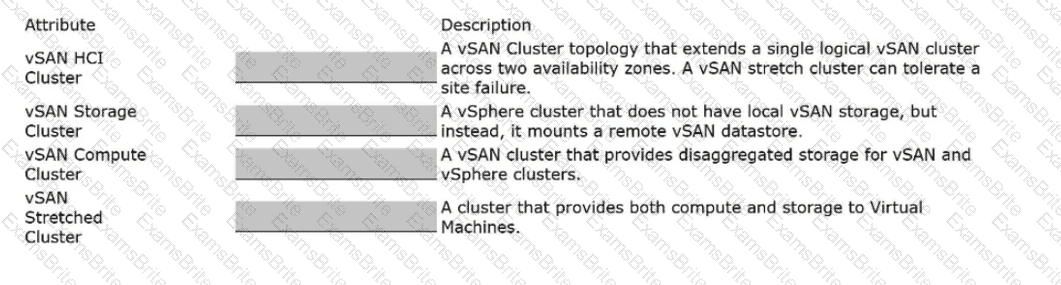
An administrator has been tasked with providing additional storage to an existing VMware Cloud Foundation (VCF) instance. The administrator decides to configure cross-cluster capacity sharing so that multiple independent vSAN HCI Clusters can consume storage of adjacent vSAN storage resources within the same workload domain.
What is a requirement of cross-cluster capacity sharing?
An administrator is troubleshooting a vSAN performance issue. In the vSAN cluster performance charts there is a high latency on the vSAN cluster.
What is a possible cause of the performance issue?
An architect has been tasked with designing a vSAN OSA storage solution for a VMware Cloud Foundation (VCF) Private Cloud. The following requirements and constraints have been gathered from the client:
• 2 x 4 TB NVMe disks per host
• 6 hosts
• FTT=1/RAID-5 for all deployed Virtual Machines
• Expected Dedupe/Compression Ratio = 2 (100%)
• Reserve enough capacity to rebuild a host completely in case of a failure (Host Rebuild Reservation)
• Operational Reserve of 10%
• Expected Overhead for Filesystem, Object, etc. of 25%
What is the approximate expected usable capacity of the resulting array?
An administrator is managing a stretched vSAN ESA cluster where each site has three hosts.
The following parameters apply to the storage policy being configured at the datastore level:
• The policy is configured at the datastore level
• Site disaster tolerance = Site mirroring - stretched cluster
• Failures to tolerate = 1 failure - RAID-1 (mirroring)
• Number of disk stripes = 1
When inspecting some of the Virtual Machines (VMs), why do objects have 3 disk stripes?

TESTED 12 Oct 2026