Advanced VMware Cloud Foundation 9.0 Automation
Last Update Oct 12, 2026
Total Questions : 72
We are offering FREE 3V0-21.25 VMware exam questions. All you do is to just go and sign up. Give your details, prepare 3V0-21.25 free exam questions and then go for complete pool of Advanced VMware Cloud Foundation 9.0 Automation test questions that will help you more.



An organization uses VMware Cloud Foundation (VCF) and requires the following across the private cloud environment:
• monitor IP space utilization.
• detect network anomalies.
• enforce consistent network policies.
What three capabilities are required? (Choose three.)
A customer requires a backup of blueprints within VMware Cloud Foundation (VCF) Automation to a third-party solution each time the blueprint is released.
What construct will satisfy the requirement?
An administrator has been tasked with creating a region to provide resources to an Organization in VMware Cloud Foundation (VCF) Automation.
The following information has been provided to the administrator for this task:
• Two workload domains are configured and will integrate with the region.
• All workload domains are configured to share a VMware NSX Manager.
• All workload domains are configured with VMware vSAN storage.
• All workload domain VMware vCenter instances have a Supervisor enabled.
Before creating the region, what two additional configurations should the administrator validate? (Choose two.)
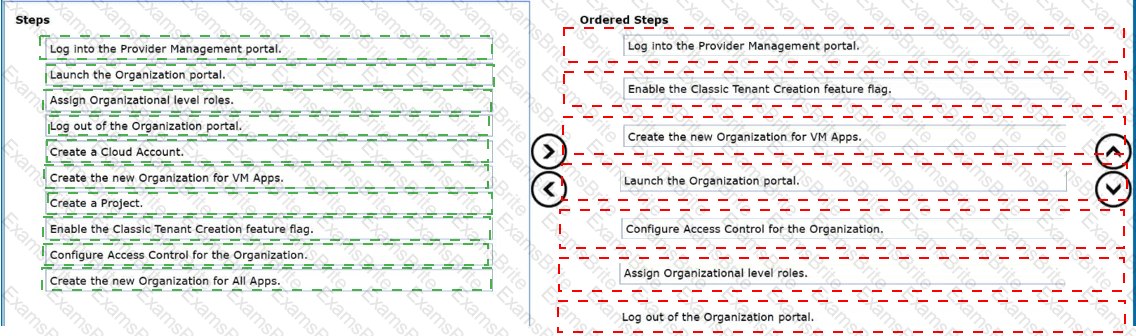
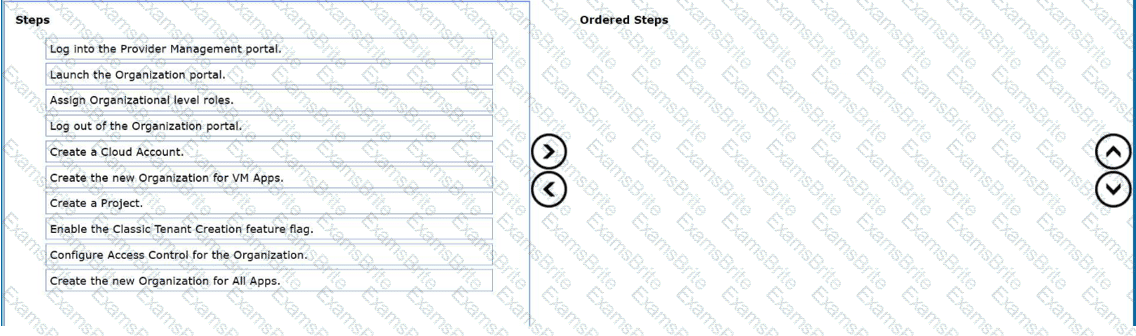
A company has deployed a new VMware Cloud Foundation (VCF) Fleet within their development environment. An administrator has been tasked with creating and configuring a
new organization for VM Apps so that other members of the team can log in using their active directory accounts and complete the tenant configuration to mirror their
production deployment.
Drag and drop the seven steps from the Steps list into the Ordered Steps list and place them in the correct order to meet the objective. (Choose seven.)
An organization uses a centralized external Configuration Management Database (CMDB) to track all infrastructure assets. Currently, when a new virtual machine (VM) is provisioned through VMware Cloud Foundation (VCF) Automation, operations teams are required to manually input associated metadata into the CMDB.
An administrator is tasked with reducing the manual effort and increasing efficiency of this process using VCF Automation.
Which three of the following can VCF Automation perform? (Choose three.)
A Provider administrator received a technical requirement mandating the use of Identity Providers (IdP) in place of local accounts. The following requirements were defined:
• The source directory service must be different between the Provider Management Portal and Organizations.
• The Organization administrators cannot modify the identity provider configuration.
What two requirements should the administrator configure? (Choose two.)
An administrator has been tasked with creating a Day 2 Operation which invokes vMotion migration on a virtual machine (VM). Which two steps are required? (Choose two.)
An administrator has been tasked with configuring tenant branding with the following requirements:
• Organization branding should only appear when a user has logged in to the organization portal.
Select the three steps involved in configuring branding. (Choose three.)
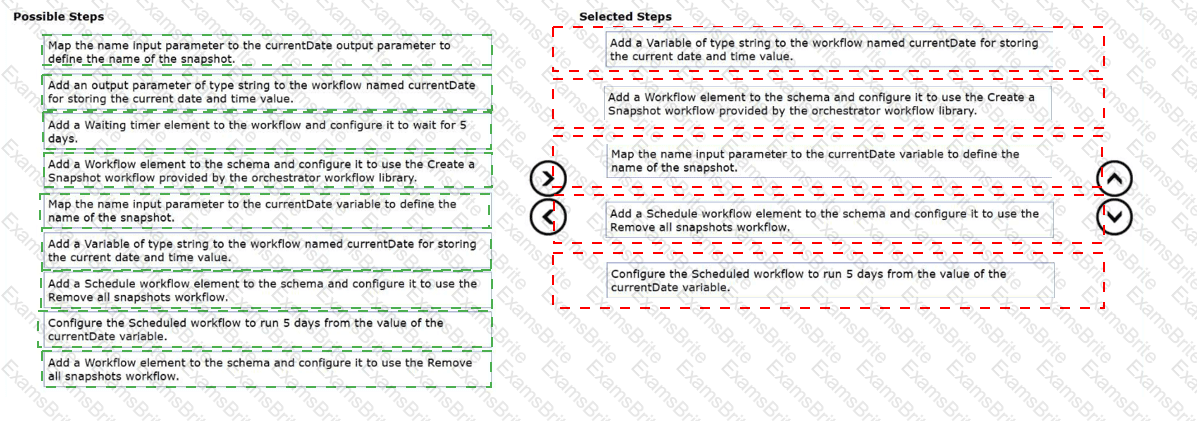
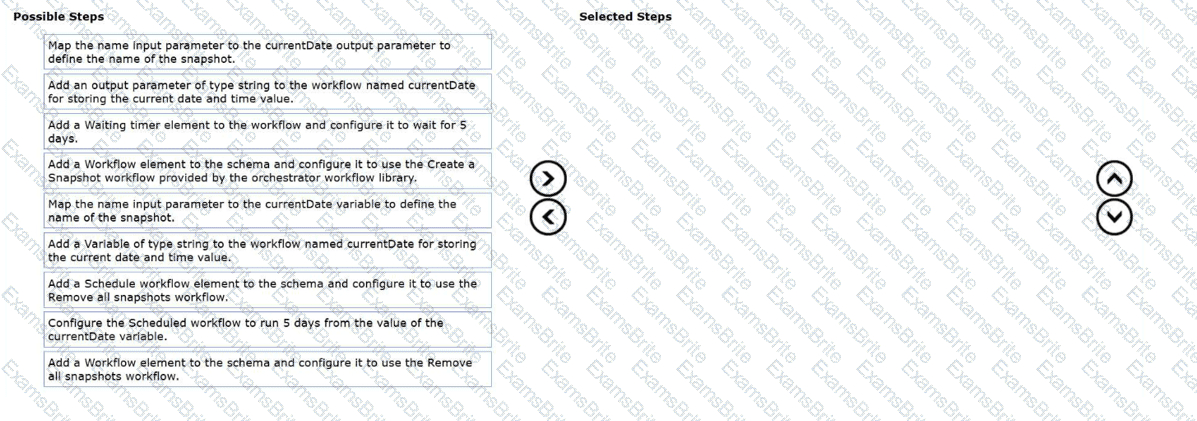
An administrator has been tasked with creating a workflow in VCF Operations orchestrator. The workflow will be used to take a snapshot before planned maintenance work
is carried out within the virtual machine, and then automatically remove the snapshot at the end of the maintenance window. The following information has been provided
for the workflow:
. The workflow must allow a user to specify a virtual machine on which a snapshot should be taken.
. The workflow must take a snapshot of the virtual machine specified by the user.
. The workflow must name the snapshot based on the current date and time.
. The workflow must delete all snapshots on the virtual machine after a cooling off period of 5 days has elapsed.
. The workflow must stop running after the snapshot is created, a second workflow should automatically start when the 5 day cooling off period has elapsed.
The administrator creates a new workflow for this task and adds an input parameter to allow the user to specify the virtual machine.
Drag and drop the additional five steps the administrator should perform to continue configuring the workflow from the Possible Steps list on the left and place them into the
Selected Steps list on the right in any order (Choose five.)
An administrator is designing a blueprint for a multi-tier application. The application requires that a specific shell script be executed on the virtual machine (VM) during the initial boot process to register the instance with an internal security dashboard.
Which construct should the administrator include in the blueprint to achieve this?
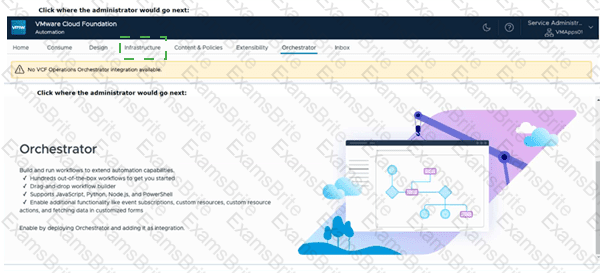
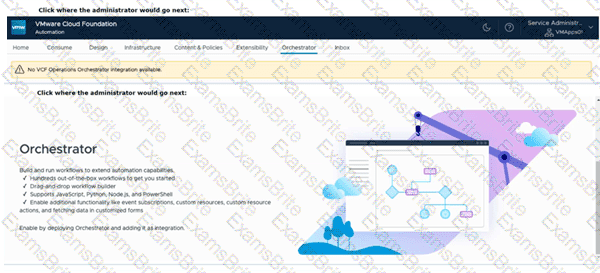
An administrator clicks on Orchestrator to create a workflow in a VM Apps organization as shown.
Where would the administrator go next to enable Orchestrator?
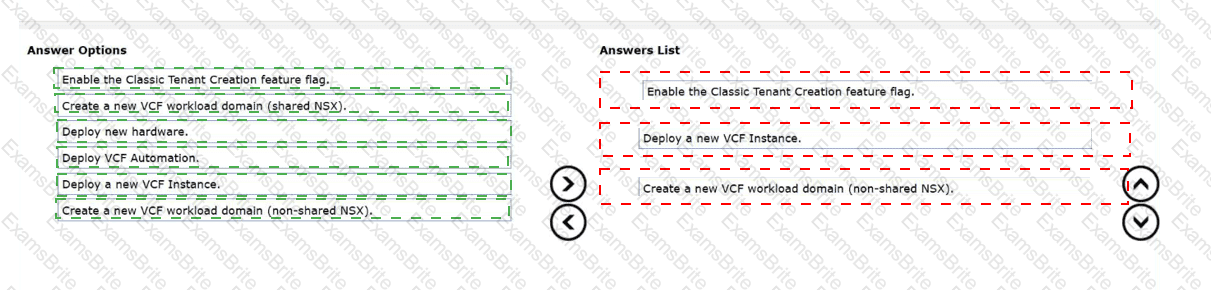
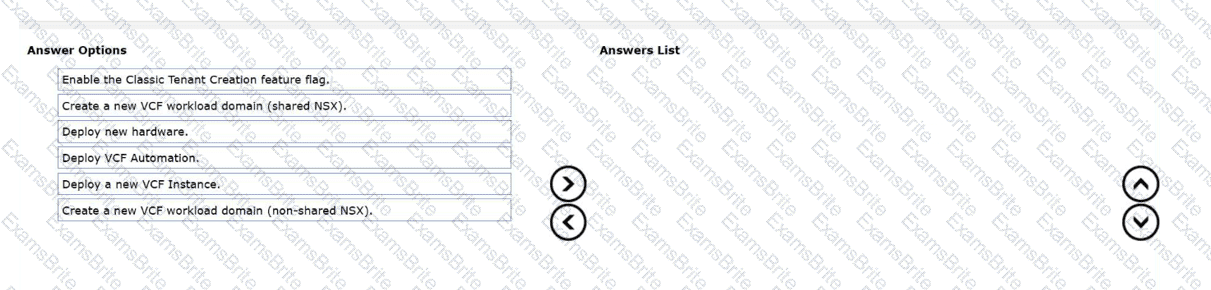
An administrator has been tasked with creating a new organization for VM Apps within an existing VMware Cloud Foundation (VCF) Fleet with minimal operational overhead.
The existing VCF fleet already has an organization for All Apps configured.
Drag and drop the three actions from the Answer Options to the Answers List, in any order, that the administrator needs to perform to complete the objective (Choose three.)
An organization is experiencing rapid growth, and the VMware Cloud Foundation (VCF) administrator needs to ensure that the "Development" organization does not consume all available physical resources in the "West" region, which is shared with the "Production" organization.
What should the administrator configure to limit the total CPU and Memory consumption for the Development organization?
An administrator is tasked with configuring a multi-tenant environment within the organization's VMware Cloud Foundation (VCF) deployment. Requirements are:
• isolated network spaces for development and testing.
• dedicated resources.
• role-based access control.
Which of the actions satisfies the requirement?
Which statement correctly describes the relationship between a Project and an Organization in VCF 9.0?
An administrator is reviewing the network topology of an AllApps Organization. They notice that while each Virtual Private Cloud (VPC) has its own private address space, there is a common component that handles the routing between these VPCs and the corporate backbone.
What is this component?
A design requirement for a new VCF 9.0 deployment specifies that all tenant network traffic must be inspected by a centralized firewall appliance located in a "Security" VPC before reaching the internet.
Which NSX VPC feature should be used to support this "Service Chaining" requirement?
The product development team is rolling out several new application stacks and require a self-service option to deploy their applications quickly and consistently. The requirements are:
• Present only approved application configurations.
• No manual configuration within a blueprint.
Which VMware Cloud Foundation (VCF) Automation approach meets these requirements?

TESTED 12 Oct 2026